Lawrence developer has trio of projects underway, ranging from $600K row houses in downtown to new neighborhoods on city’s edge
You could say that Lawrence developer Adam Williams is a little bit city and a little bit country. Or, based on recent development filings and construction activity, you could say he is a lot of both.
Williams — a longtime Lawrence businessman who is a founder of Lawrence Beer Company and the behind-the-scenes leader of numerous commercial and residential ventures — is full steam ahead on the city scene. He has approximately a half-block’s worth of $600,000-plus row homes under construction in downtown Lawrence.
But he’s also active in an area that has been more likely to produce rows of corn than rows of houses. Williams is the developer behind a recent annexation request of about 60 acres of property just north of the city limits along Queens Road, and he is restarting plans to convert undeveloped rural property near the Kansas Turnpike into a new Lawrence housing development.
Those two projects are expected to add about 300 new single family homes to the northern edge of Lawrence, if they ultimately win all their planning approvals. Williams recently told me there’s a relatively straight-forward reason why he is focusing so much on residential development opportunities.
“This community, like a lot of communities around the country, is in a severe housing crisis,” Williams said. “I think, though, we are a little bit worse off than others in the midwest.”
Indeed, Lawrence has set record lows for new single family building permits three out of the last four years. The city finished 2025 with builders pulling just 36 single family building permits, a new low.
That number got his attention, but it isn’t what gave him enough confidence to move forward on the multimillion dollar housing projects. Instead, a political feeling more than any number has him thinking now is the right time to build.
“I believe we have the correct planning and city commission that want to be part of the solution and not part of the problem,” Williams said of the local political environment, which was shaped by a November city commission election where housing issues appeared to be the top issue for many voters. “For the first time I’m hopeful in 40 years.”
Downtown row houses
Williams is well past the hoping stage on the row house project. He has 15 row houses under construction in what used to be the parking lot of the former Borders bookstore building near Seventh and New Hampshire streets. He expects those units to have people living in them by August.
“We have a few of them under contract already,” Williams said.
If you aren’t familiar with the row house concept, it is an old one that has been a key housing type in big cities for centuries. In one regard, they are like an apartment in that the homes exist in one continuous, multi-story building, meaning you share walls with your neighbors. But they are quite different than many apartments in that they are individual homes with their own front doors that open onto a public sidewalk. They are very non-apartment-like in other ways, too. Each row house in Williams’ development is about 1,800 square feet, spread over three floors, meaning there is no one living above you. All the homes in Williams’ development — which is dubbed Urban Row — include three-bedrooms and three-and-half baths. They also include a one-vehicle garage on the backside of the home.
Starting prices for the row houses are in the low $600,000-range, Williams said, with additional amenities available to be added that would increase the price. One of those amenities is an in-home elevator, which is meant to appeal to empty nesters who may want to live in downtown but don’t necessarily like the thought of climbing stairs in a three-floor home.
But the thought that many people do seem to like is the idea of downtown living.
“The easy answer is because it is downtown,” Williams said when asked why he thought the project would be successful. “A lot of people want to be within walking distance of all the amenities that downtown provides.”
The row houses will give people a chance to own property just two blocks off of Massachusetts Street. While the Borders building is at 7th and New Hampshire street — which is just one block off of Massachusetts — the row houses are located a bit farther east on the former Borders property. The row houses face Rhode Island Street, which is two blocks off of Mass Street.
As we reported in January 2025, Williams didn’t just buy the parking lot of the former Borders building but bought the former bookstore building as well. That is an approximately 20,000 square foot building that has been mostly empty since Borders closed its Lawrence store in 2011.
Williams said he is working on several ideas to redevelop that building, but doesn’t yet have any plans to share.
Hunter’s Hills
Williams also recently filed plans at Lawrence City Hall to revive a stalled housing project that we first reported on in December 2022. The project, Hunters Hills, would build about 130 traditional homes on about 60 acres of vacant property that is south of the Kansas Turnpike and northwest of Grand Vista Drive. If you are having a hard time picturing the area, it is a little more than a half-mile north of the intersection of Peterson Road and Monterey Way.
Williams began picturing the area as a site for new homes back in 2022, and even filed a plan that set aside some land for Perry-Lecompton to build a school on the property. The housing development would be in the Perry-Lecompton school district. As the Lawrence city limits grow to the northwest, several parts of Lawrence are now in the Perry-Lecompton school district.
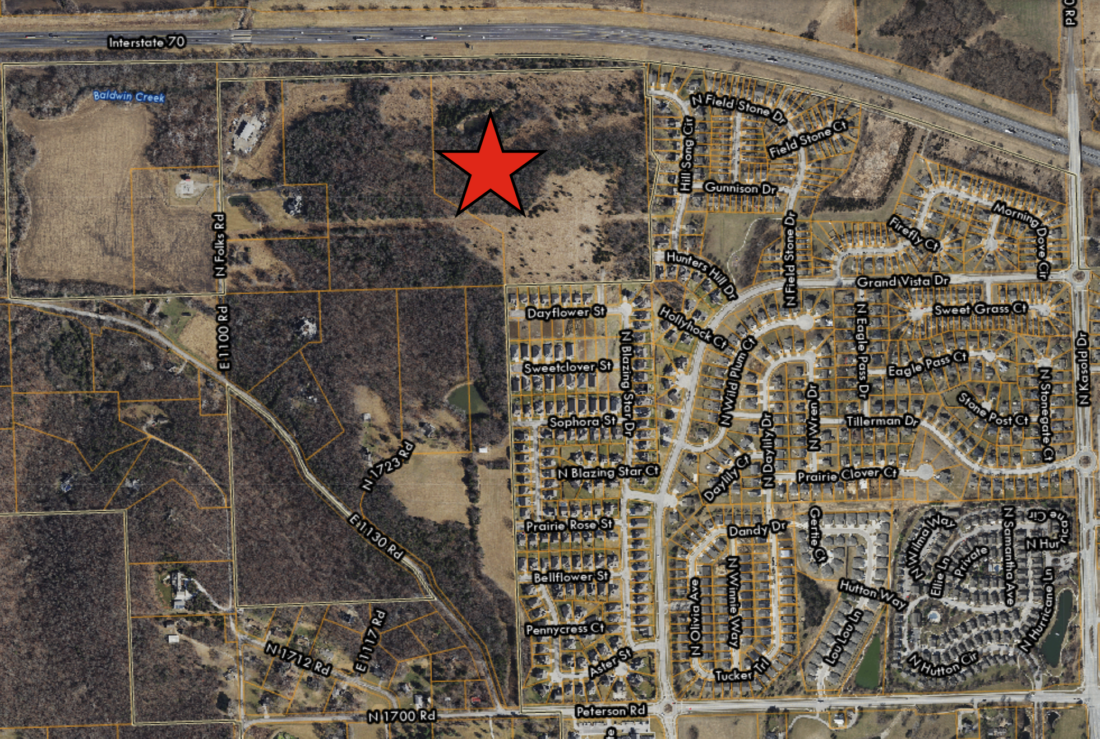
photo by: Douglas County GIS
The star shows the approximate location of a planned housing development — Hunter’s Hill — that would add about 150 homes along the Kansas Turnpike.
All of the property north of Rock Chalk Park is in the Perry-Lecompton school district, and indeed there are students who live in the apartment complex just east of Rock Chalk Park that are bused to the Perry-Lecompton district.
That school district issue — which requires about a 20-minute bus ride to the schools in the small town of Perry in Jefferson County — was not the reason the project stalled after its 2022 City Hall failing. Instead, Williams said he couldn’t reach an agreement with the city on how the neighborhood should feasibly be designed. But now, there is a new zoning and development code in place, and Williams has refiled the development plans.
“I feel like the city and I are now aligned more on what needs to happen at the site,” Williams said.
As for the school issue, he said he’s still setting aside land for a future Perry-Lecompton school, although that doesn’t mean one will be built there. Such issues are up to district officials, and likely would require a vote of residents in the Perry-Lecompton district.
But the idea that USD 497 may not be the only public school district to have a school in Lawrence isn’t a crazy idea. You only have to look to Shawnee in Johnson County to see how a city can outgrow school district boundaries. Some Shawnee residents attend schools of the Shawnee-Mission school district, but others attend schools in the De Soto school district. If you have heard of Mill Valley High School, that is a De Soto school, but it is located in the city of Shawnee.
While the idea of the Perry-Lecompton district building a school in the Lawrence city limits seems remote currently, the picture may change considerably if Lawrence annexes hundreds of acres of new land to the northwest of the current city limits.
Queens Road
Lawrence leaders currently are showing some interest in annexing land that is located in the Perry-Lecompton school district. We reported in December that plans had been filed to annex about 60 acres of property along Queens Road in northwest Lawrence.
When we reported on the annexation request in December, it was unclear what developer was behind the request, but Williams confirmed to me that the proposed Queens Road development is another one of his projects.
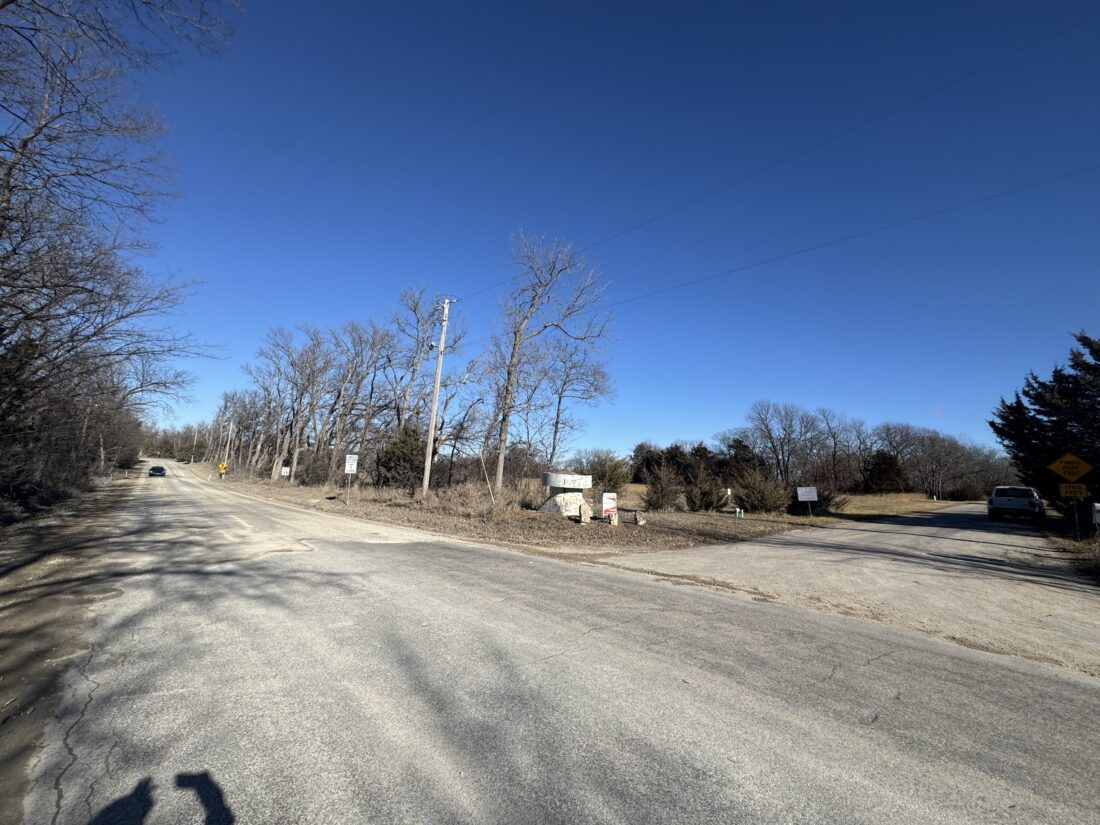
photo by: Chad Lawhorn/Journal-World
The intersection of N 1700 Road and E 1000 Road, known as Queens Road inside the Lawrence city limits, is pictured on Dec. 29, 2025.
That property — located at the northeast corner of East 1000 Road and North 1700 Road — is in the Perry-Lecompton district. The Lawrence-Douglas County Planning Commission at its February meeting voted 6-3 to recommend approval of the annexation. It now will go to the Lawrence City Commission for approval.
Williams is estimating that about 170 homes could be built on the property once it becomes part of the city limits.
Williams said he hopes to be able to break ground on the Hunter’s Hills and Queens Road developments in the next four to six months, assuming that city approvals are secured.
Town Talk column
Lawrence developer has trio of projects underway, ranging from $600K row houses in downtown to new neighborhoods on city’s edge
You could say that Lawrence developer Adam Williams is a little bit city and a little bit country. Or, based on ...
Despite surprise ‘no’ votes this week, city commissioners want public, state officials to know they still support affordable housing
Deal getting close for hotel to build at 11th and Mass; speculation has Graduate by Hilton brand coming to the site
As Costco comes to town, Walmart files plans for convenience store, gas station at its south Iowa store

KU research dollars set a new record in 2025; university conducted more than $600M in research activities