


From a $50M soccer complex to 700 acres of new housing, developer seeking to expand city past SLT
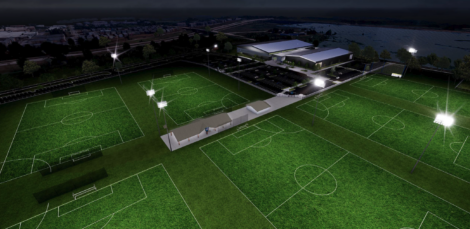
photo by: Sporting Kaw Valley
A soccer and sports complex proposed for the U.S. Highway 59 and South Lawrence Trafficway is shown in this rendering.
A Wichita-based developer is pursuing more than $1 billion worth of new projects both south and west of Lawrence — with a $50 million soccer/sports complex and 700 acres of residential development topping the list.
Phil Bundy, a Wichita entrepreneur who has led a host of retail and residential projects over the years, has long been the developer of record for the land at the southeast intersection of U.S. Highway 59 and the South Lawrence Trafficway.
That’s still the case, but Bundy told me he also has recently secured a contract to purchase approximately 800 acres of land just west of the Bob Billings Parkway interchange on the South Lawrence Trafficway. He’s begun to file plans with the city that ultimately would annex all the property into the city limits, and develop about 700 acres of it with a mix of single family and multi-family housing. He’s hoping to win approval for the remaining 100 acres to serve as a new commercial area along the SLT, which is also Kansas Highway 10.
As for the $50 million sports complex, Bundy has confirmed that would be the anchor tenant for his south Lawrence property, which he is changing dramatically from a proposed mix of residences and retail to one that is more heavily focused on being an entertainment district.
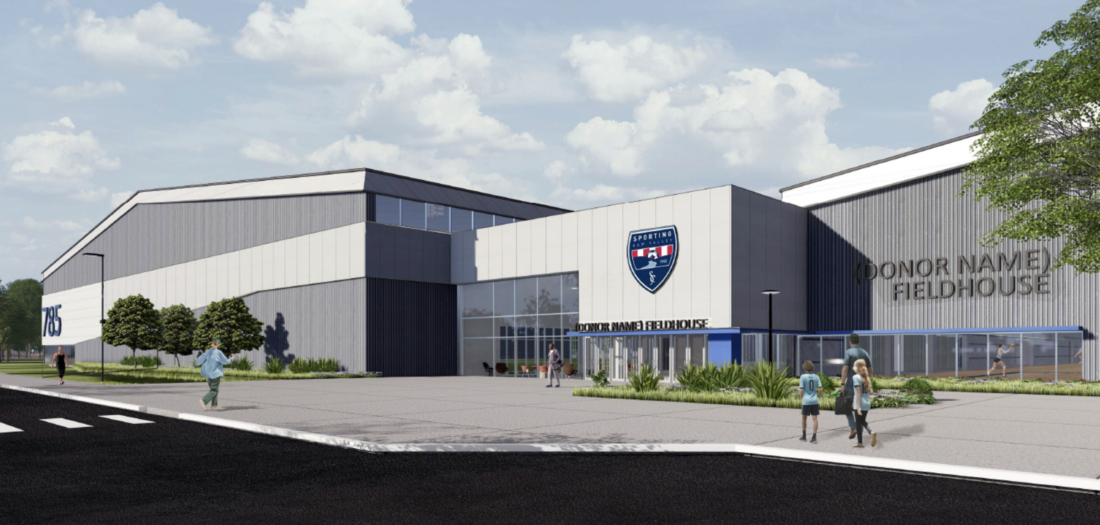
photo by: Sporting Kaw Valley
A rendering shows a proposed Sporting Kaw Valley Fieldhouse that would be part of a south Lawrence development.
Between the south and the west project, Bundy said he and his partners are about to embark on approximately $1 billion to $1.3 billion worth of development that he hopes will come online in the next five to seven years.
If that comes to fruition, it would be one of the largest surges in private development in Lawrence in recent memory. Bundy said he’s long admired Lawrence’s attributes that include the presence of KU, proximity to Kansas City and beautiful, rolling landscapes that make the area picturesque to many, he said.
“It’s got everything going for it,” Bundy said of Lawrence in a recent interview with the Journal-World. “What it has had against it is the fact that they wouldn’t expand, they haven’t been able to grow.”
Whether that changes largely will be up to Lawrence city commissioners. Both the south and the west project, however, will require significant amounts of City Commission approvals, and both are in the early stages of those processes. But Bundy has a team of Lawrence professionals working on the projects, including longtime commercial real estate agent Doug Brown and Phil Struble, who has been the designer of decades worth of development in west Lawrence as the president and CEO of Landplan Engineering.
Struble said he thinks Bundy’s projects can be some of the most significant to come to Lawrence, in part, because they’ll serve the needed purpose of removing some geographic walls in the city.
“K-10 has kind of been the Iron Curtain,” Struble said of Kansas Highway 10 and the South Lawrence Trafficway. “You can’t jump it, you can’t get on the other side of it. You can’t do anything on the other side. You can’t get anything on the other side approved.
“We have two projects right here that are just going to explode that.”
Here’s a look at the preliminary plans for the south and west projects, based upon interviews with Bundy and others involved in the projects.
The south project
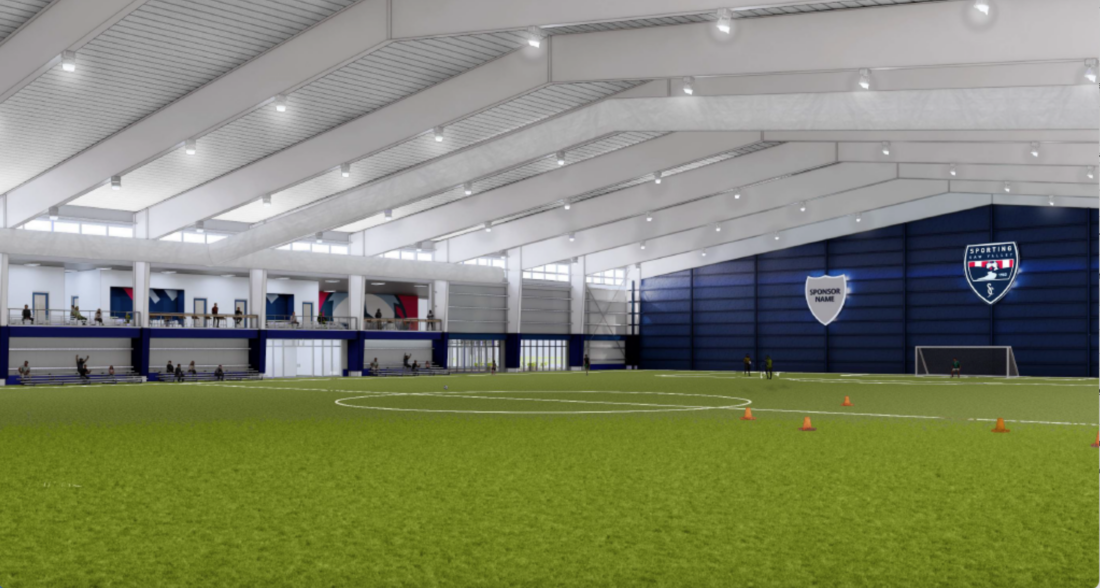
photo by: Sporting Kaw Valley
A rendering shows an indoor soccer pitch that would be part of a new complex for Sporting Kaw Valley.
The development for the intersection of the SLT and Highway 59 is the furthest along of the two, and also is the one with a new player on scene.
The Lawrence-based nonprofit Sporting Kaw Valley — which serves about 2,200 area soccer players and their families — has jumped into the project in a big way. Sporting Kaw Valley would be the owner and operator of large indoor/outdoor soccer complex that also would have a fieldhouse for basketball, volleyball and other sports.
Kirsten Judd, executive director for Sporting Kaw Valley, told the Journal-World that a capital campaign will soon begin to raise $20 million to fund the complex that would sit on nearly 40 acres of property at the SLT and Highway 59 interchange. The project is expected to be a $50 million venture in total, and Judd said Sporting Kaw Valley has made strong progress on securing the other $30 million through other means.
Judd said she is selling the economic development aspects that the complex will bring to the community, which largely boils down to thousands of families that would be in town for everything from practices to tournaments and would spend their money while they are here.
“Four nights a week, I’m sending our members out of town to go practice,” Judd said of the current situation that is driven by a lack of artificial turf soccer fields in Lawrence.
The proposed complex would build six, outdoor artificial turf soccer fields that would be designed in a way that they also could be set up to accommodate baseball, softball, football and lacrosse with minor modifications.
In addition there would be a FIFA regulation-sized indoor soccer field, plus six basketball courts housed in an approximately 175,000 square foot building that also would house concessions, meeting rooms and other amenities.
The complex also would allow Sporting Kaw Valley to host large regional tournaments. Judd is touting that if the complex only hosted 15 tournaments a year, it would easily create $8 million in new spending in the community. Judd is confident the complex can attract far more tournaments than 15, she said.
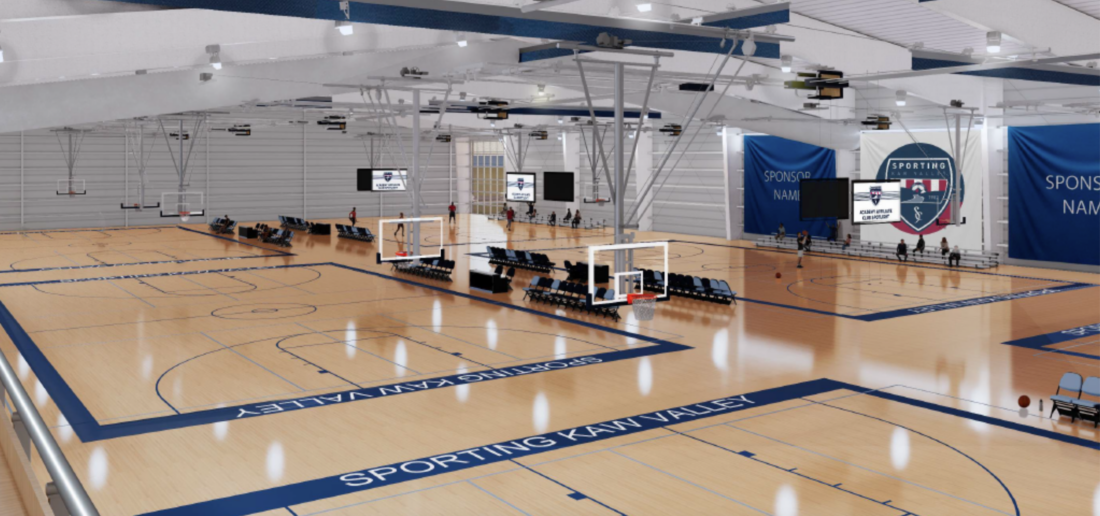
photo by: Sporting Kaw Valley
Combination basketball and volleyball courts are shown in this rendering of a proposed fieldhouse for Sporting Kaw Valley.
The complex, however, may face an interesting question in front of city commissioners: Will it compete with city-owned facilities? The city operates a soccer, baseball, and youth football complex, known as YSI, on Clinton Lake property in west Lawrence. Plus, the city invested tens of millions into building Sports Pavilion Lawrence, the basketball and volleyball fieldhouse at Rock Chalk Park.
Judd said the YSI fields aren’t likely to host the type of tournaments a new complex would because most of the fields are grass. The soccer world is becoming more insistent on playing on artificial turf fields for reasons ranging from weather to quality of play. The city has started to add artificial turf to some of its YSI fields, but most haven’t been converted.
As for the fieldhouse component, Judd said her understanding is that the city currently turns away some basketball and volleyball tournaments because demand exceeds the available number of courts. Sporting Kaw Valley’s fieldhouse likely could be used in addition to the Rock Chalk Park facilities to host even larger tournaments. Plus, the new complex would be the only one in Lawrence to house a full-size, indoor soccer field. Rock Chalk Park has a small indoor turf area, but not an entire soccer pitch.
But zoning, rather than competition, is likely to be the largest question the project faces at City Hall. The site already is in the city limits, and has approved zoning that is a mix of residential and commercial. But to do the sports complex, the 38-acre site needs to be rezoned to one of the city’s most intense commercial zoning categories.
That’s the same type of zoning category that would allow for a big box retailer. Once the zoning is approved, it would remain with the land, even if the sports complex project never got built. Members of Bundy’s team said they know some residents may be skeptical of a “bait-and-switch” that ultimately would result in the property housing fairly traditional, big box, chain retailers.
The developers said they would gladly place restrictions on the type of uses that could be built on the property, but the city’s development code no longer allows that to happen. The city previously had a process called Planned Commercial Development that allowed the city to pick and choose specific uses for a property. But when the city recently rewrote its development code, it eliminated that process in favor of zoning categories that permit a variety of uses. A sports complex and big box retail store now share the same zoning category, Struble said, and there doesn’t appear to be a way around it.
“With the new zoning code, that is what we are stuck with,” Struble said. “We are just following their rules.”
For his part, Bundy said the community should know that he is enthusiastically behind the idea of the property being an entertainment district that is anchored by the sports complex. Since Judd pitched the idea to him, he said he’s become convinced that it is the right type of use for a property that could serve as the southern gateway to Lawrence.
He anticipates the property would land two hotels, four or five restaurants, a major convenience store, and at least one other unique, entertainment, destination type of business.
The west project
What the south project wouldn’t have, however, is hundreds of single family homes. The current zoning and preliminary plat for the south property was created with the idea that it would primarily be residential in nature with some commercial uses nearby.
While the project did win its necessary zoning approvals from Lawrence City Hall, it also drew intense opposition from some community members who said the development was too intense for an area that is so near to the Wakarusa River. The project would develop multiple acres of the floodplain, and currently is in the final stages of getting approval from federal officials on a host of floodplain regulations related to the site.
Bundy, though, said he saw an opportunity to potentially alleviate some of those environmental concerns by shifting the south project from primarily a residential development to an entertainment district. The change allows for a different design that does not develop as much of the floodplain.
But Bundy said he didn’t want to give up on the idea of developing housing in the community. It appears to be the No. 1 community need expressed by leaders, and his business sense tells him there is a lot of pent up demand waiting to be met.
“All of the things that Lawrence has going for it — Mass. Street, KU, great people, really well-educated people — all of that combined with the pent up demand makes Lawrence pretty prime, honestly,” Bundy said of his interest in the community.
So Bundy decided to go searching for land, and ended up going big. The approximately 800-acres that he has under contract stretches along the west side of Kansas Highway 10 essentially from Sixth Street to the Clinton Parkway interchange, he said. It extends west anywhere from a quarter-mile to a mile, depending on the location, he said.
Bundy and his team on Monday filed a request to annex the entire property into the city limits, although I haven’t yet seen that specific filing. Bundy said he envisions about 700 acres of the property being devoted to residential uses, with the remaining acreage — mainly the portion right along the highway — reserved for future commercial growth to serve a larger Lawrence population.
The development could be a major population driver for the city. Struble believes it would be the largest single annexation in the city’s history. He also suspects it will require a paradigm shift in thinking at City Hall.
“Our attitude for everybody is just do small pieces at a time,” Struble said of the city’s past development pattern. “We would annex five acres here, 10 acres there, and you would only annex what you think you are going to develop next year.”
That pattern, however, is susceptible to time periods where the community has few housing lots for new homes. Local real estate leaders have said that’s been the case for several years in Lawrence, and has contributed to housing affordability concerns.
This annexation would essentially ensure that Lawrence has building lots for at least a five to seven year period. Bundy was hesitant to offer a number of homes the property could accommodate, but it would be well over a thousand.
Part of the uncertainty is because Lawrence’s new zoning code allows for a wide variety of housing to be built within its residential zoning categories. The new code, for instance, makes it much easier to build multi-story row houses and other types of dense residential development. But Bundy said it also would be important to build traditional single-family housing, which is likely needed to attract families that will bolster stagnant public school enrollments.
But if you want to get the full sense of what the project could mean for Lawrence’s housing market, you have to think broader, Struble said. That’s because Bundy’s project will require water, sewer and other utilities to be extended west of the South Lawrence Trafficway. Some of that work already is underway by the city, which Bundy took as a sign that Lawrence was getting serious about developing west of the trafficway.
Those new utilities, however, will be designed to serve more than just Bundy’s 800 acres of property, Struble said. Other properties adjacent to Bundy’s ground also would be available for development because it would have access to those same utility lines, city streets and other infrastructure.
If that comes to be, it would be a game-changer for the Lawrence housing market. For more than a decade in the late 1990s and early 2000s, Lawrence routinely added more than 300 new homes per year. More recently, though, the city has set all-time record lows for single-family housing starts in 2022, 2024 and is almost certain to set a record low this year. The city is likely to issue fewer than 50 single-family building permits this year.
Those numbers were fodder on the City Commission campaign trail where two new commissioners — Mike Courtney and Kristine Polian — were elected after frequently campaigning on the need for more building to both boost the city’s tax base and to help housing affordability.
Struble said if city commissioners approve the 800-acre annexation west of the SLT, it will open the door for Lawrence to have another generation of growth.
“This really opens up about 2,000 acres of ground for Lawrence,” Struble said. “I mean, we won’t be the only game in town. There will be adjacent properties that are annexed and rezoned. That is great. We need them, too.”
Town Talk column
Former pool hall space to become a ‘pubcade’ with video games, pinball, Skee-Ball, plus full service bar
Lawrence developer has trio of projects underway, ranging from $600K row houses in downtown to new neighborhoods on city’s edge
Despite surprise ‘no’ votes this week, city commissioners want public, state officials to know they still support affordable housing
Deal getting close for hotel to build at 11th and Mass; speculation has Graduate by Hilton brand coming to the site
As Costco comes to town, Walmart files plans for convenience store, gas station at its south Iowa store
