What the last four seasons — as distinct as they were — say about the state of KU basketball
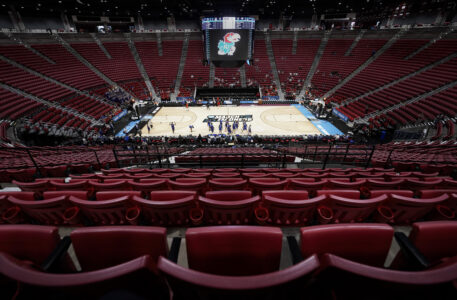
Kansas players take the court for practice on Thursday, March 19, 2026 at Viejas Arena in San Diego. Photo by Nick Krug
What Kansas and its fans consider a rough patch is evidently different than at other basketball programs, many of which would be delighted to receive a No. 7 seed in the NCAA Tournament, as KU did in 2025 in the worst season of Bill Self’s tenure as head coach.
That’s not to say that other schools don’t have high standards, but Duke, Indiana, Kentucky, North Carolina and UCLA have all missed the tournament in recent years. KU hasn’t even gotten close to being on the bubble.
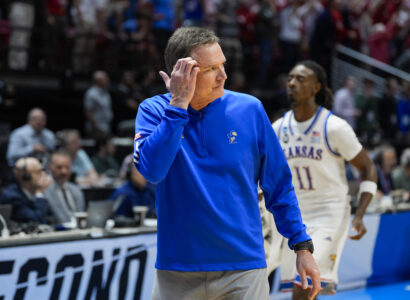
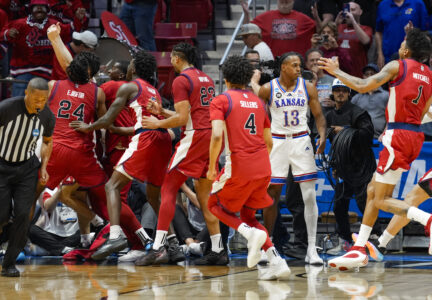
The fact remains, however, that with their last-second loss to St. John’s in San Diego, the Jayhawks have now been unable to advance past the second round for four straight years. It’s the first time that has happened since the last two years of Ted Owens (1982 and 1983) were followed by the first two years of Larry Brown (1984 and 1985).
Of course, by the time Brown had begun his first season in charge he had already earned a commitment from Danny Manning to attend KU the following year, and by the time Manning’s career ended he had reached two Final Fours and won a championship.
Brown left recruiting violations in his wake and KU was ineligible for the 1989 tournament, but after that point Roy Williams and Self combined to reach at least the Sweet 16 in 20 of the following 32 tournaments (the 2018 Final Four was later vacated). No wonder the stretch of four straight first-weekend exits sticks out.
So what happened these past four years, and what can KU learn from it? To recap:
• It feels almost unfair to lump in the 2022-23 season with the three that followed. As Self is often quick to point out when the topic of “the last few years” or some such phrasing comes up, that team was a No. 1 seed in the NCAA Tournament. It won the Big 12 title and had 17 Quadrant 1 wins, the most in the nation. It had Jalen Wilson playing at a consensus first-team All-American level, Gradey Dick rising up draft boards with his impressive shooting and Dajuan Harris Jr. providing the best basketball of his career (he was the Big 12 defensive player of the year). It didn’t have much of a bench or a lot of size, but those three combined with KJ Adams and Kevin McCullar Jr. made for a formidable starting five.
That Self had his health scare immediately prior to the Big 12 tournament shouldn’t necessarily have derailed these Jayhawks altogether. Norm Roberts had coached KU for four games to open the year as Self was undergoing a self-imposed suspension (amid the ongoing Independent Accountability Resolution Process), and the Jayhawks won all four, including the Champions Classic against Duke. But it’s hard to believe Self’s presence wouldn’t have made a difference in at least the one-point second-round loss to Arkansas in Des Moines, Iowa, in a game KU led by as many as 10 points midway through the second half. Had the Jayhawks survived, Self might even have been able to return in Las Vegas the following week.
• The single biggest blow to the 2023-24 team was McCullar’s bone bruise. Before the Jayhawks’ game against Cincinnati on Jan. 22, the first one after which Self made reference to McCullar having a knee bruise, he was shooting 49.6% from the field and 36.8% from beyond the arc. Beginning with that Cincinnati game, those numbers dropped to 36.6% and 26.8%. Already a stellar defender, he had made a similar offensive leap to Wilson in his own final season and was playing like an All-American himself, along with fellow eventual All-American Hunter Dickinson, and then came the bruise. He was in and out of the lineup and ended up missing the postseason altogether. (McCullar had a knee procedure after the season and didn’t play a game for the Westchester Knicks of the NBA G League until the following January.)
Of course, this team had flaws even before it lost McCullar, as evidenced by its numerous road losses to lesser foes. The 2023-24 roster was as thin as any in Self’s tenure.
KU got rid of Texas transfer Arterio Morris prior to the season after he was charged with rape. (The case was dismissed due to insufficient evidence.) The removal of Morris left KU thin at guard, and transfer Nick Timberlake struggled all season, while freshman Elmarko Jackson wasn’t quite ready to play significant minutes. No one could effectively space the floor to create room for Dickinson on a consistent basis. Even so, he was one of just four productive players for most of the year along with McCullar, Adams and Harris until the emergence of last-minute addition Johnny Furphy, but then Furphy himself hit a wall late in the season. With McCullar out and even Dickinson battling a dislocated shoulder, it was no surprise when Gonzaga raced past KU to blow the Jayhawks out in the second round in Salt Lake City.
• Rylan Griffen went from 11.2 points per game on 39.2% 3-point shooting at Alabama in 2023-24 to 6.3 points per game on 33.6% 3-point shooting at KU and then back to 11.2 points per game on 40.4% 3-point shooting at Texas A&M. AJ Storr averaged 16.8 points per game at Wisconsin, 6.1 at KU and then 15.5 at Ole Miss. David Coit actually shot the 3 better at KU than at any other stage of his career, but he contributed 5.1 points per game to the Jayhawks compared to 20.8 at Northern Illinois (albeit at the mid-major level) and 13.5 at Maryland.
It made sense to bring in shooters like Griffen, Coit and the more successful Zeke Mayo to help remedy the spacing issues of the prior season, to add a marquee wing scorer in Storr after the previous team had struggled with shot creation and to alleviate Harris’ burden at point guard by adding Shakeel Moore. And Flory Bidunga gave the Jayhawks a higher-upside post option off the bench than Parker Braun was the previous year.
It all made sense on paper, but rarely worked in practice, as the stats suggest. Teams still inhibited Dickinson by packing bodies in the lane, and Mayo was inconsistent for much of the year, especially away from home. Back-to-back road losses to Creighton and Missouri revealed some early weaknesses, and injuries to Moore and Adams didn’t help, but KU was still 14-4, 5-2 in league play and ranked just outside the top 10 nationally before suffering two of the most baffling losses in program history — 92-86 to Houston in double overtime at Allen Fieldhouse and 81-70 at Baylor after leading by 21 points — in the span of three games. Griffen later said he felt like KU never recovered from the Houston game.
That was borne out on the court in the following weeks, especially in a disastrous trip to Utah that had Self saying the members of the team needed to get away from each other. Dickinson recently said in a podcast interview that he started feeling less motivated and that some of his teammates were ready for the season to be over so they could get back in the portal.
In any case, even as a No. 7 seed, KU still might have advanced past the first-round game against Arkansas if Adams didn’t tear his Achilles with the Jayhawks up three points and three minutes remaining.
• And finally, how to explain the 2025-26 season with far less distance? It’s difficult to comprehend that a year in which KU had a prospective No. 1 pick on the roster, and the vast majority of players elsewhere on the roster outstripped preseason expectations, ended in the second round.
Where KU had been picked preseason No. 1 each of the prior two years, it was No. 19 last fall, with voters perhaps dubious of the supporting cast around star freshman Darryn Peterson (at least besides the high-upside Bidunga). And yet guard Melvin Council Jr. shaped the Jayhawks in his own image and anchored the team at both ends of the floor and forward Tre White had the most productive year of his career, making them perhaps KU’s two shrewdest acquisitions of the portal era (Remy Martin and his tournament heroics notwithstanding). Freshman forward Bryson Tiller also displayed great promise coming off injury and a lengthy absence, and Jackson and Jamari McDowell filled somewhat larger roles than anticipated. Only Jayden Dawson and Kohl Rosario truly underperformed preseason expectations, and in Rosario’s case it would have been hard for any reclassifying freshman to excel immediately in a starting role.
It’s easy to argue that the problem was Peterson’s inconsistent availability. As has been well documented, he battled several injuries and most notably a recurring cramping issue that caused him to miss 11 games and exit during the second halves of many others. It’s obvious why players and coaches alike, dreaming of a fully healthy Peterson, kept saying KU hadn’t yet reached its ceiling. But KU was actually at its finest when he was playing parts of games. The Jayhawks won eight in a row as part of a stretch where Peterson appeared in six games, left four early, was exceptional almost every time he played and in one of the remaining two hit game-tying and game-winning 3-pointers in the final minutes.
Then Peterson finally became consistently available, and the focal point of the team, and all of those players who had been exceeding expectations came back down to earth. They deferred to him perhaps too often in some cases, and then when they were as aggressive as they needed to be simply didn’t make shots, and the Jayhawks lost more than half their games down the stretch. The offense was at its worst at the most important time of the year, and the defense — which had been every bit as switchable and athletic and versatile as Self had envisioned — wasn’t enough on its own.
CONCLUSION
If KU can maintain some semblance of continuity — including with Self himself — it should have a lot of reason for optimism entering next season. Bidunga was the league’s defensive player of the year and could dominate as a junior, if he chooses not to go to the NBA. Tiller is clearly a future pro, Rosario and Paul Mbiya have significant upside and so on.
Player retention and development, however, is more elusive than ever for KU. The Jayhawks were fortunate last offseason to acquire one-year transfers who panned out as well as Council and White. As for all programs, it is becoming increasingly difficult for KU, in an era of increased player movement, to retain players whose demands for either money or playing time are not being met. And the money just keeps increasing year over year, even with the implementation of a direct revenue-sharing cap last July; also in the years since KU’s 2022 national title, restrictions on multi-time transfers have been eliminated. Other teams are dealing with these constraints too, which makes for what Self has in the past called a “let’s just win today” approach enacted on an annual basis across college basketball.
All told, as Self put it earlier this year, KU has a lower “margin for error” than it once did. Without being able to first sign several bona-fide future pros in any given recruiting class and then retain them at the back end of a roster for years until they are ready to play extensive roles, instilling in them the Jayhawks’ culture along the way, KU isn’t going to be automatically head and shoulders above its competition in the Big 12. In the past, as Self said in January after a loss at West Virginia, “our Jimmies were better than your Joes.”
That’s not to say that KU is no longer one of the premier programs in the sport or that it can’t attract top-end talent. It just had one No. 1 player in a recruiting class and is in contention for the next, developments that attest to its continued allure and its impressive resources. It might be a bit dramatic to wonder, as ESPN’s Dan Wetzel did on Wednesday in citing early eliminations for KU, Kentucky and North Carolina, “is ‘blue blood’ even still a thing?”, or to suggest even more firmly as St. John’s head coach Rick Pitino did on Thursday in the wake of knocking out the Jayhawks, “The blue bloods no longer control basketball any longer. There’s no difference between Kentucky, North Carolina than Illinois or St. John’s … There’s no such thing as a blue blood anymore.”
But perhaps KU’s entire rotation isn’t going to be composed of top-end talent, let alone multi-year high-level players. And consequently, it isn’t going to be nearly as well suited to weather the sorts of capricious injury problems for its best players (2023-24, 2025-26) and misevaluations and chemistry issues (2024-25) it has endured in recent years.
So perhaps that’s why Self, in his final postgame press conference of the 2025-26 season, emphasized the significance of evaluating and recruiting in the next four to six weeks. It has become more important than ever that KU get this period of time right so as to lay the groundwork for the best possible results during the season that follows.
KU Men's Basketball
What the last four seasons — as distinct as they were — say about the state of KU basketball
How will Darryn Peterson’s year be remembered?
A look into the future of the KU men’s basketball roster
Jackson, Jayhawks endure agony of losing at the buzzer
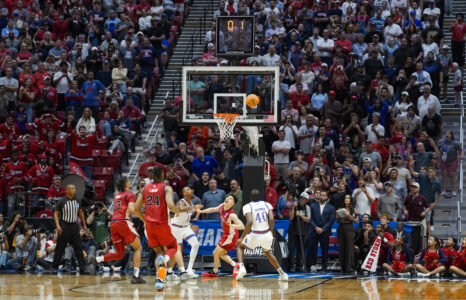
Photo Gallery: St. John’s buzzer-beater ends Kansas’ season