Lingering questions for the KU football offense during summer
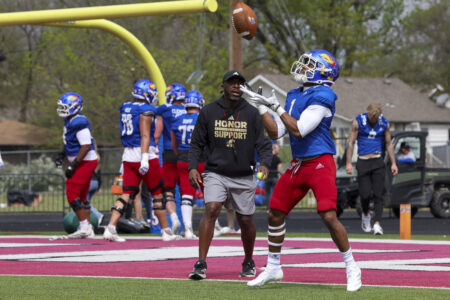
photo by: Kahner Sampson/Special to the Journal-World
Kansas running back Dylan Edwards works on returns during KU Football's spring practice at Lawrence High School on Saturday, April 11, 2026 in Lawrence.
It’s been quite a long offseason for the Kansas football team, but a quieter one than usual in recent months given that there is no longer a spring window for the transfer portal.
After a flurry of activity in the month of January, KU had a pretty clear idea of what its roster was going to look like come September.
“That’s a huge thing,” general manager Rob Ianello said recently, “and I think it’s good for everybody to just kind of focus on the guys you got on your campus, and not have a guy coming in and potentially threaten to leave or go somewhere else, or somebody poaching one of your guys, right?”
But while the Jayhawks know what they have, they may not know exactly how to arrange their talent. Spring practices, which concluded in mid-April, provided KU a chance to get its transfers and early-enrolling freshmen acclimated, but the Jayhawks still have ongoing position battles at practically every spot — some of which did not have all their potential participants healthy in the spring due to offseason injuries.
With talking season on the horizon, then, plenty remains to be discussed before a yet-unannounced contingent of KU players takes to the podium with head coach Lance Leipold on July 8 in Frisco, Texas, for Big 12 media days.
To start, here are five lingering questions surrounding the Jayhawks’ offense.
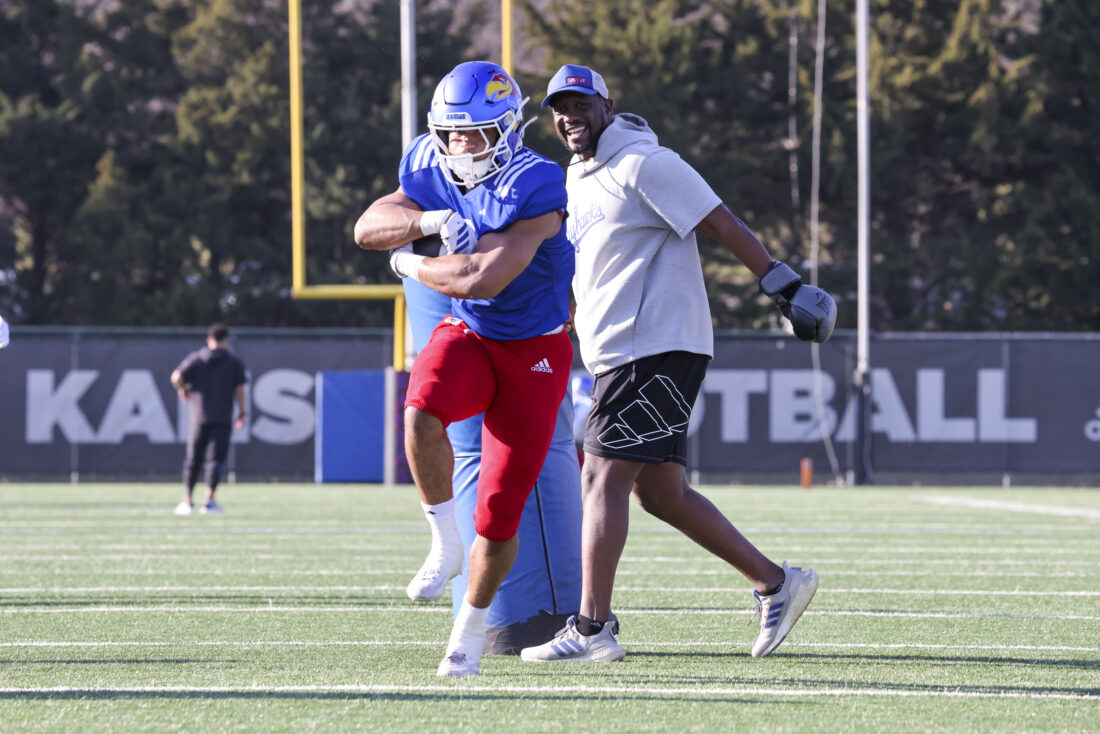
photo by: Kahner Sampson/Special to the Journal-World
Kansas running back Kory Amachree participates in Kansas football’s spring practice on Thursday, March 26, 2026, in Lawrence.
• Are there enough carries to go around?
A late addition to the Jayhawks’ 2026 transfer class, Dylan Edwards might have been the biggest one of all. He was at least the noisiest given that he came to Lawrence straight from Manhattan, but it’s also eminently clear what he is capable of to anyone who watched him in his first career college game, when he scored four touchdowns for Colorado to help the Buffaloes beat national runner-up TCU, or in the 2024 Rate Bowl, when he had 223 total yards and three scores in a win for Kansas State.
One salient point, however, is that Edwards has never spent a full season as a feature back, or even really any protracted stretch of time in that role. He missed most of 2025 due to injury.
Meanwhile, KU also brought in two additional transfers in Yasin Willis and Jalen Dupree who each led their respective teams, Syracuse and Colorado State, in rushing last season despite playing just nine games each. Willis is a big, bruising back, while Dupree can run between the tackles but has some elusiveness to his game.
The significant development in the spring was the emergence of early enrollee Kory Amachree, who Leipold said “shows all the abilities to help us as a true freshman.” That happened while Dupree was out for the entirety of spring due to an offseason surgery. Dupree, a redshirt sophomore from Benton, Arkansas, may now face an uphill battle for playing time, even if offensive coordinator Andy Kotelnicki has a reputation for deploying a wide array of weapons.
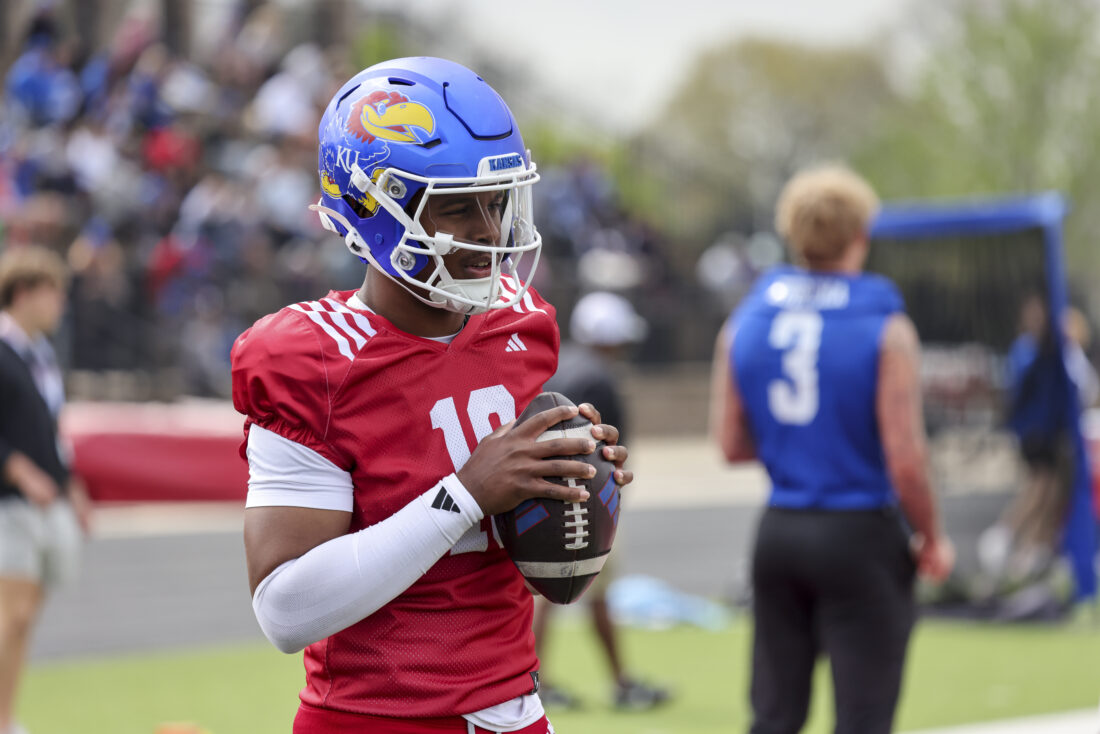
photo by: Kahner Sampson/Special to the Journal-World
Kansas quarterback Chase Jenkins participates in KU Football’s spring practice at Lawrence High School on Saturday, April 11, 2026 in Lawrence.
• Whoever starts at quarterback, will others get incorporated?
On that note, while the quarterback competition is evidently a lingering question in and of itself — practically the only thing national media members can think to write about when it comes to this year’s KU football team — also significant will be what happens to its losers. And yes, there will be losers, after Leipold sounded opposed to the idea of a multi-quarterback system when asked about it during a spring press conference.
During his first stint running KU’s offense, Kotelnicki loved to put Jason Bean and Jalon Daniels on the field at the same time. Once they even both started the same game. Both of KU’s primary competitors for the starting job this time around, Cole Ballard and Isaiah Marshall, are used to entering to take snaps in ancillary roles. Ballard threw a passing touchdown at Iowa State last year, and Marshall carried the ball 15 times for 160 yards, largely out of a specialized shotgun package.
So it’s easy to envision either player still being involved if he doesn’t win the starting job — same with Chase Jenkins, who was sort of an option quarterback in his last stop at Rice and used to play wide receiver so is clearly versatile — but will it not also be important for the young starter to build a rhythm?
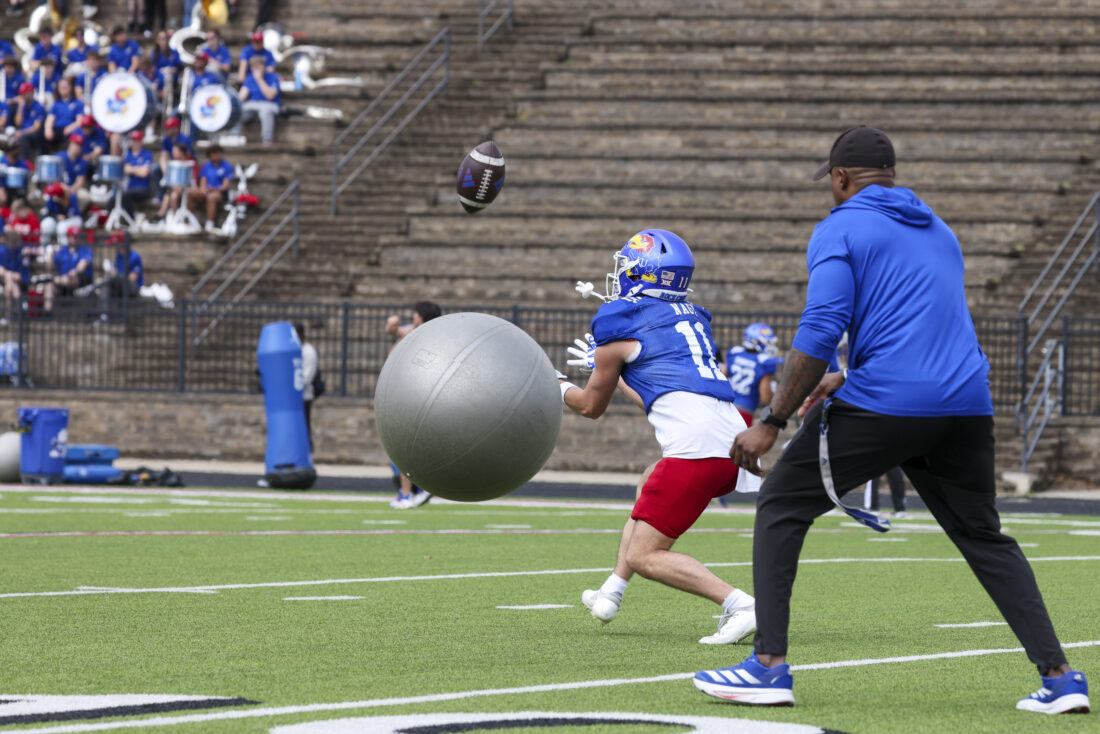
photo by: Kahner Sampson/Special to the Journal-World
Kansas receiver Tate Nagy works on returns during KU Football’s spring practice at Lawrence High School on Saturday, April 11, 2026 in Lawrence.
• Is a young receiver able to step up?
The wide receiver position possesses relatively little intrigue compared to many others on the Jayhawks’ roster, because it is quite clear that returners Keaton Kubecka and Cam Pickett and transfer additions Nahzae Cox and Nik McMillan will lead the way this fall. The question is whether anyone else can make a case to join them in the rotation.
KU has not gotten a lot of production from wide receivers it has recruited out of high school during Leipold’s tenure, outside of Kubecka, a member of the 2023 class, who caught 17 passes for 157 yards and a touchdown last year. But Tate Nagy, a converted quarterback, impressed as a freshman by serving adeptly as the Jayhawks’ full-time punt returner. That might give him the inside track on snaps as a slot receiver on offense.
Jaden Nickens, once a highly touted receiver recruit, made an unexpected post-spring exit to pursue basketball. But Jackson Cook and Bryson Hayes are also still around from the 2025 class and could have a chance to play themselves into the conversation in what is not necessarily KU’s deepest position group.
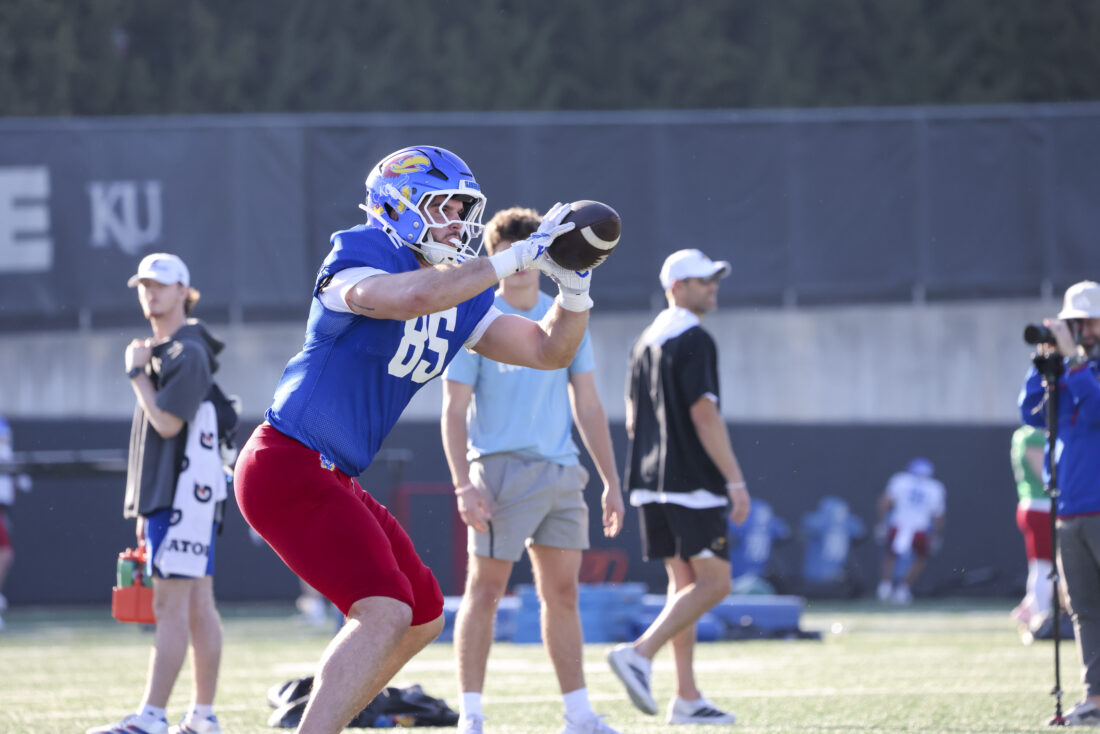
photo by: Kahner Sampson/Special to the Journal-World
Kansas tight end Carter Moses participates in Kansas football’s spring practice on Thursday, March 26, 2026, in Lawrence.
• Does KU have a breakout player at tight end?
Kotelnicki, who coached tight ends during his first stint with the Jayhawks, went on to Penn State and oversaw a season in which Tyler Warren caught 104 passes for 1,233 yards and eight touchdowns, won the Mackey Award and then became a first-round pick in the NFL Draft. Perhaps just as striking — at least to the prospective recruits Kotelnicki has dealt with in the years since — were the creative ways in which he deployed Warren, who also ran the ball 26 times for 218 yards and four scores and threw a passing touchdown. (Not to mention the level of production he was able to get out of Mason Fairchild at KU in 2022 and 2023 — and the number of times he was able to scheme him wide open.)
That level of success was clearly a persuasive factor for transfer tight ends Jailen Butler (Old Dominion) and Carter Moses (Albany). Co-offensive coordinator and tight ends coach Matt Lubick said at one point during the spring, “Part of it was he’s a really good football player, but part of it was the play design and the uniqueness and creativity of moving him around, and so we’re trying to do that. Now I’m not saying we have Tyler Warren on our football team right now. Who knows, we might — we’re trying to get guys like that.”
The Jayhawks indeed may not have a Mackey Award winner, but they would certainly like to have one of their top four tight ends — Butler and Moses along with promising returner Carson Bruhn and veteran Leyton Cure — emerge as a clear-cut red-zone target and security blanket for a young starting quarterback.
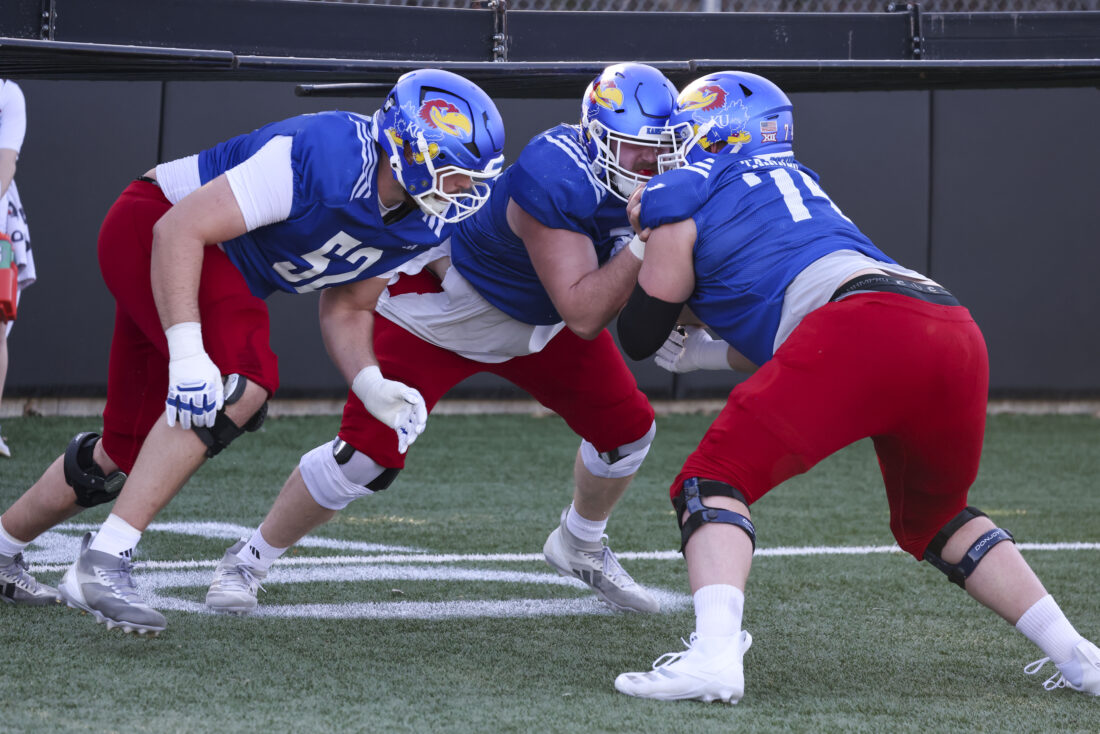
photo by: Kahner Sampson/Special to the Journal-World
Kansas offensive linemen Nick Morrow, James Livingston, and Jack Tanner (left to right) participate in Kansas football’s spring practice on Thursday, March 26, 2026, in Lawrence.
• Who resolves the offensive line battles?
There is reason to believe the left side of KU’s offensive line could be a strength this season with a more experienced Calvin Clements and Amir Herring still in the fold. It might have made sense for Herring to get a chance at center after KU added guard Connor Stroh and lost center Tyler Mercer in the portal, but Herring said in the spring he has focused on guard.
The remaining positions all seem to be more competitive. Kasen Carpenter, an Oklahoma State transfer at center, has received some pressure from redshirt freshman Anderson Kopp. At right guard, Connor Stroh has all the measurables and the experience of playing at Texas, but Tavake Tuikolovatu has apparently improved greatly with a fuller offseason than in his first year in the program, when he battled injury, position coach Daryl Agpalsa said.
Cal transfer Nick Morrow seems a likely pick for right tackle with his impressive frame and two years’ worth of starts for the Bears, but then again all his experience has been on the left side. However, as Agpalsa noted with a smile, “You guys thought I was crazy when I moved Bryce (Cabeldue) to left. Bryce got drafted. You guys thought I was kind of wacky when I moved Enrique (Cruz Jr.) to right when all he had was left snaps.” Cruz, too, got picked in the fifth round of April’s NFL Draft.
Agpalsa has indeed earned the benefit of the doubt at the helm of what has been arguably KU’s most consistent position group, but to maximize the effectiveness of the Jayhawks’ offense, they could use some stability upfront in the early days of fall camp.
KU Football
KU coaches appreciate shoutout from Indiana’s Cignetti
Leipold updates status of pair of receivers after loss to Utah
What did we learn from KU’s loss to Utah?
Jayhawks’ ‘biggest problem’ put them in early hole in loss to Utah
Quick recap: Jayhawks fall 41-24 in road battle with No. 12 Utah