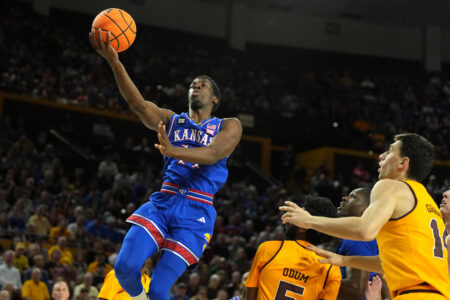
How might an unexpected return for Council impact KU basketball?
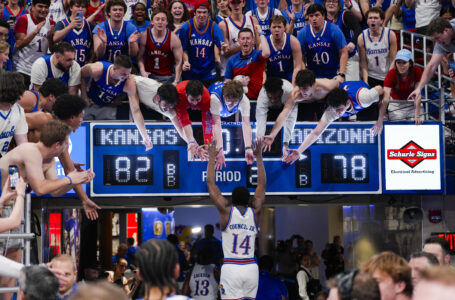
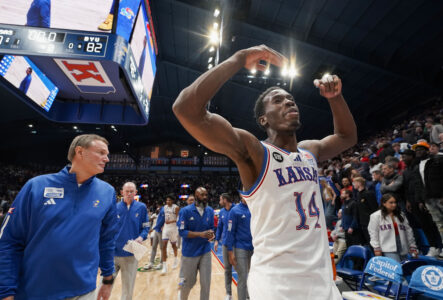
Kansas guard Melvin Council Jr. (14) jumps up to slap hands with the Kansas student section following the Jayhawks’ 82-78 win over Arizona, Monday, Feb. 9, 2026, at Allen Fieldhouse. Photo by Nick Krug
When guard Taylen Kinney announced his commitment to Kansas back in September on a CBS Sports livestream, he relayed a rather telling anecdote about his expectations for the 2026-27 season.
“Coach (Bill) Self told me I was going to get to play right when I stepped in,” he said. “I was going to be the man. He threw me the keys and said this is my team next year. He wants me to be there for 10 months, take the next step.”
The commitment eight months later of his fellow Kentuckian and former middle-school teammate Tyran Stokes, the No. 1 prospect in the class, didn’t necessarily infringe on Kinney’s ability to be “the man” inasmuch as Kinney remained a lock to start at point guard for the Jayhawks and run KU’s offense as a freshman. If indeed Self and Kinney’s plan was for the young guard to shape the team in his image and go pro after one year — i.e., “be there for 10 months” — adding Stokes ensured he would have a highly touted teammate to help him do so.
The prospective return of Melvin Council Jr. could be another matter entirely.
Council, KU’s starting point guard last season, filed suit against the NCAA in Douglas County court last week, as the Journal-World first reported. He is seeking immediate eligibility for the 2026-27 basketball season, which would be his sixth in college, based on the premise that his second junior-college year should not count toward his NCAA eligibility (he already took advantage of a blanket waiver for one additional year). The fall semester draws ever nearer, which is why Council is seeking a temporary injunction to play at KU.
“With each passing week, Mr. Council’s dilemma grows more acute,” the injunction application reads. “As NCAA teams begin preparing and recruiting for the upcoming seasons, he must commit to the University of Kansas before the opportunity closes. Each lost month represents a progressive loss of an opportunity that cannot be restored, and absent timely relief Mr. Council will suffer irreparable harm before this controversy can be resolved on its merits.”
To be clear, bringing Council back was not part of KU’s plan or something the Jayhawks were counting on. As Self put it on Wednesday in his post-summer press conference, “There was actually no thinking of this, serious thought of this, I don’t even think, on his behalf or his agents’ behalf until the ruling in Ohio came down. And then the ruling in Ohio — ‘Well, hold on now. You know, if them, why not me?'”
That’s a reference to the recent injunction awarded by a Hamilton County judge to 24 college players in Ohio, although it should be noted that that group, led by Xavier’s Filip Borovicanin, consists of members of the high school class of 2022 who played four straight collegiate seasons and feel slighted by the fact that the NCAA’s new five-year eligibility rule does not apply retroactively to them. Council is older, has already played five seasons and is taking aim at a different element of NCAA policy.
In any case, Self said he thinks Council’s first choice would be to make a professional roster — he recently spent the NBA Summer League with the New Orleans Pelicans.
“The reality of it is I think that he’s pursuing all his options, which I think is more than fair to do, just like everybody else is doing,” Self said. “And I hope it works out for him. Whatever’s best for him is best. If he was guaranteed a place now, I’d say, ‘Don’t even consider it. You’ve got to go.’ But, you know, depending on how it plays out, we’ll see what happens. But I think it goes without saying that he would probably be welcomed back from our fan base’s standpoint.”
Adding Council would be “a bonus, but it’s not something that anybody is expecting, nor has it been part of our plans whatsoever.”
How, then, will those plans change if he does join the roster?
He has his flaws, but Council is the sort of player who inevitably defines a team. To some extent, that effect is attitudinal. His so-called “dog” mentality certainly seemed to trickle down to the rest of the 2025-26 roster: the way they approached rivalry games, how they embraced defensive assignments against big-time players and teams and so on. In return for the way he rose to the occasion in big moments, he was immediately embraced by KU fans, as Self referenced, despite being — so it seemed — just a one-year player in Lawrence.
But Council’s central role was also borne out on the court — it’s not like he was just a locker-room leader. He led the Jayhawks in minutes per game at 34.9 (by a margin of more than three minutes), and much of his effectiveness as a late-game closer originated from the fact that he simply didn’t get tired at the same rate as everyone else. He always seemed to have an extra gear, and he deployed it to great effect in the late stages of wins against teams like N.C. State, TCU, Colorado, BYU and at home against Arizona in particular.
KU was not the exception in leaving Council out on the floor as much as possible. In fact, the Jayhawks somehow managed to play him the fewest minutes per game of any of his three Division I schools. St. Bonaventure, beginning on Dec. 31 of his lone season with the Bonnies, deployed Council for 40 minutes (or in the case of one overtime game, more) in 15 of 21 games.
One might suppose that a younger Council, in his JUCO days, might have gotten less run. That’s true, but even in a career-low 29.8 minutes per game as a sophomore at Monroe College, he still started all 34 games in which he played. In fact, Council has started 164 of his 170 games at the collegiate level. In just three of those games, and not since March 9, 2024, has he played fewer than 20 minutes.
It therefore becomes difficult to conceive of what a team containing Council, but not featuring him, might look like.
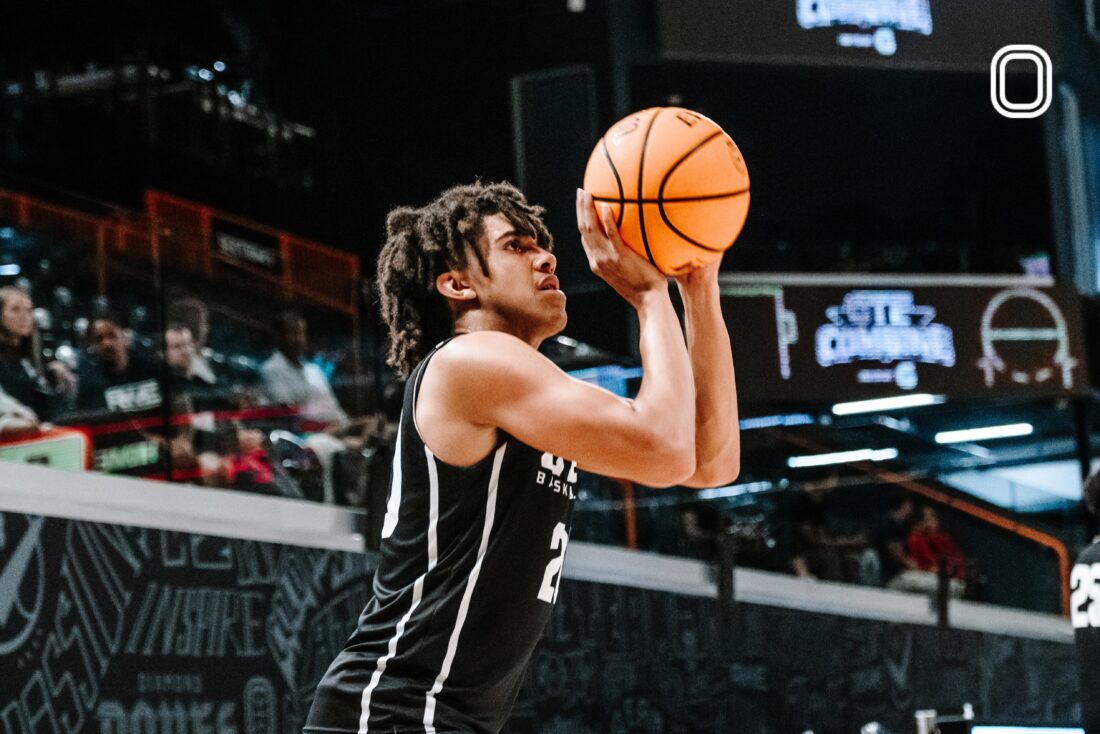
photo by: Overtime Elite
Taylen Kinney lines up a shot at the Overtime Elite combine on Tuesday, Sept. 24, 2024, in Atlanta.
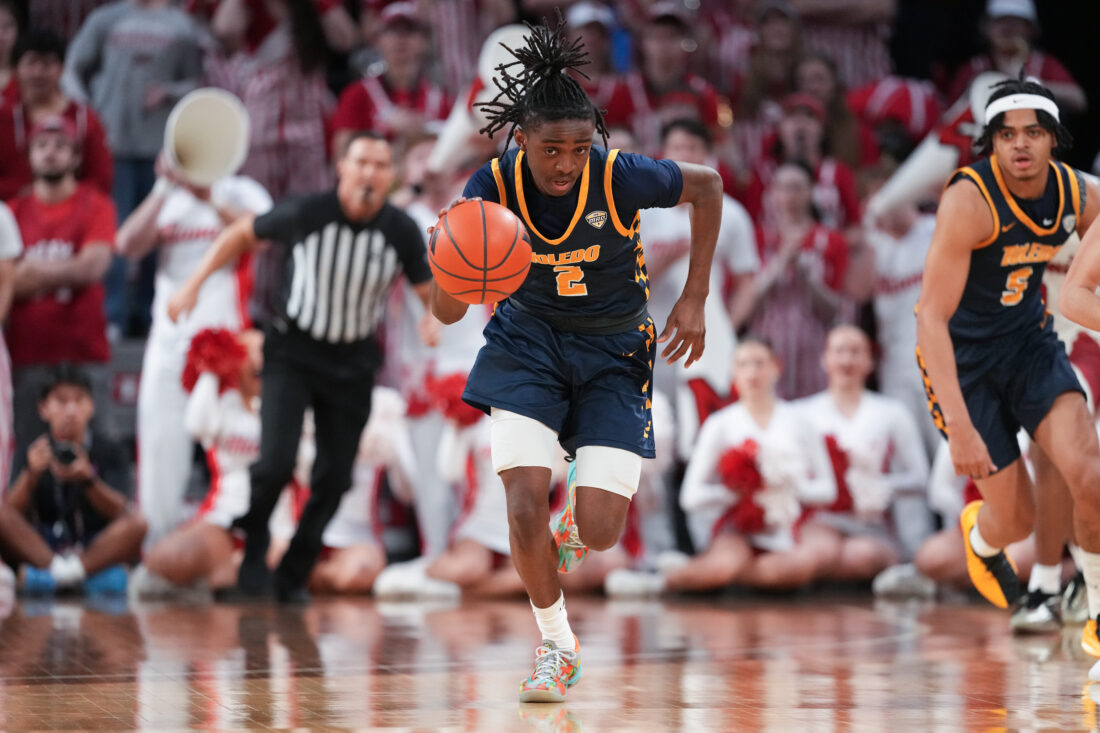
photo by: AP Photo/Kareem Elgazzar
Toledo guard Leroy Blyden Jr. dribbles on a fast break during the first half of an NCAA college basketball game against Miami (OH), Tuesday, March 3, 2026, in Oxford, Ohio.
If he enters the starting lineup, he is either squeezing out Kinney, the one with the keys, or more likely Toledo transfer guard Leroy Blyden Jr., whom KU very much needs to replicate something like his 40.7% 3-point shooting from last year with Toledo. If Blyden comes off the bench — which, admittedly, would help KU a bit with its lack of size in the backcourt — then the Jayhawks are deploying a starting lineup in which the best 3-point shooter is … who, exactly?
Kinney shot about 30% from deep between his two years at Overtime Elite. Council was at 30.8% last year even after he made nine 3s in one game. Stokes might have to take the cake at a reported 36% in high school — and Self recently heaped plenty of praise on his capabilities in this realm — although associate head coach Jeremy Case has said he thinks Utah transfer forward Keanu Dawes, a career 31.1% shooter beyond the arc, can get up towards 38% next season. None of the Jayhawks’ center prospects is a shooter.
Obviously Blyden would still be on the team, as would the likes of fast-rising Luke Barnett, Dennis Parker Jr. and Kohl Rosario, but slotting in Council would present a considerable challenge in terms of perimeter offense — even if would have the physicality and the speed to be one of the team’s best drivers.
Significantly diminishing Kinney’s role feels like a nonstarter. Even setting aside the prior discussion of whatever his preseason expectations might have been, the Newport, Kentucky, native is at his best as a playmaker with the ball in his hands, and the Jayhawks’ ceiling this season will have a lot to do with how quickly he can become comfortable serving in that role at a new level of play — something it will be difficult for him to do if he is marginalized or off the court altogether.
Even earlier in the offseason, it made sense for the Jayhawks to add another veteran point guard, sort of like they did last summer with Nginyu Ngala. Kinney and Blyden as the two combo guards and the sole potential ball handlers felt like a risky proposition. But it became easier to rationalize when it became apparent that Stokes’ “biggest attribute,” as Case has put it, is his passing — he could make for a potent point forward.
KU has two slots left and the Jayhawks certainly seem intent on filling them with some combination of Council, 24-year-old Serbian center Mihailo Mušikić and reported reclassification candidate Javon Bardwell, a wing in the 2027 class. But there are only so many minutes to go around, and any addition will inevitably impact the players who are already on the roster — and have already spent the summer getting acclimated to their prospective roles.
KU Men's Basketball
What’s it like welcoming back Council and White? Jayhawks explain
Evaluating Council’s return and its potential impact on the KU roster
Council rejoining Jayhawks for 2026-27 season
Self not keen on in-season international games
KU faces complex situation with final roster spot