Some thoughts on KU’s unenviable 2026 schedule
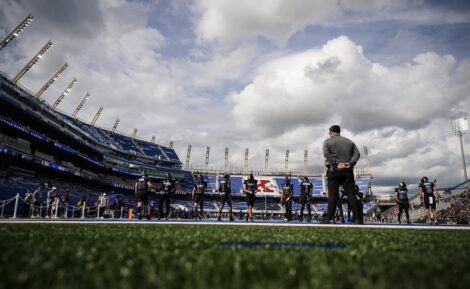
Kansas players take the field for warmups prior to kickoff on Saturday, Sept. 20, 2025 at David Booth Kansas Memorial Stadium.
The Kansas football team’s schedule has been out for a handful of days, providing plenty of time to process the unusual slate of games the Jayhawks have drawn for the 2026 season.
From three bye weeks down to one, from starting on Aug. 23 to Sept. 4, from a home conference opener on Sept. 20 to one on Oct. 24, it’s all laid out quite differently from 2025.
Throw in the presence of a game in London and reduced capacity at David Booth Kansas Memorial Stadium, and the season as a whole will bear little resemblance to years past. (Not to mention the Jayhawks’ dramatically overhauled roster.)
Here are some of the elements of the 2026 schedule that stand out the most.
DOUBLE-BOOKING WILL HINDER KU
This was the first thing I noticed about the schedule when it came out last week.
When the Jayhawks agreed to play in the Union Jack Classic on Sept. 19, they knew they were creating a conflict with a previously arranged buy game against Middle Tennessee State. KU’s stated goal was to relocate that game to week zero — a week before most teams start the season, and a time at which the Jayhawks already have experience beginning their year, having done so in 2025 — by getting a waiver approved. (The game was not itself scheduled to be played in Europe, and neither team had Hawaii on the schedule, so they couldn’t just pick week zero automatically.) The backup plan was to opt for a common open date later in the season.
Well, the backup plan clearly went into effect. Athletic director Travis Goff had said in the fall that KU got approval for the rescheduled game but that Middle Tennessee still needed it and “it’s not necessarily straightforward.” Whatever complications may have arisen, the result is now that the Jayhawks face the Blue Raiders on Oct. 3, after a bye week following the Union Jack Classic — dipping back into nonconference play after an initial taste of the Big 12.
Not only does KU now get its only extra week of preparation for a team it can likely beat without needing it, the game kicks off a stretch of nine consecutive games without a bye to close the season, .
Needless to say, if KU and MTSU had been allowed to play on Aug. 29, it would have allowed for a much more reasonable pace for the Jayhawks’ Big 12 slate. On the other hand, having three byes didn’t necessarily do KU a lot of favors in 2025, so maybe the unceasing grind will be a welcome change of pace.
One other note about the Union Jack Classic, and one about which I’ve already written on multiple occasions: A key measure of success for a unique game like this will be how many eyeballs KU can get on the program that it would not be able to otherwise. Certainly the Big 12, the institutions and the TV networks will be eager to promote the historic game. But can it possibly garner anywhere as much attention as the Ireland games that take place in week zero when nothing else is going on? Sept. 19 is right in the thick of the season at a time that features numerous other distractions.
FIRST-TIMERS
The Big 12 will have quite a few new faces on the sidelines this season, and KU gets to see several of them firsthand. Out of the four new head-coaching hires — Jimmy Rogers at Iowa State, Collin Klein at Kansas State, Eric Morris at Oklahoma State and Morgan Scalley at Utah — KU takes on all but Rogers. (It will be the first year in which KU and ISU do not play since 1931. I understand the Big 12 can only protect so many rivalries, but that’s a rather grim and ahistorical development.)
Given that the Jayhawks begin the meat of their Big 12 schedule with ostensibly unpleasant back-to-back games on the road at Utah and Kansas State — two of the most hostile environments in the league — it’s at least a small consolation that they’re getting teams with new coaches in the early stages of the season. And even though Scalley was an internal hire, his predecessor Kyle Whittingham took much of the Utes’ staff to Michigan, so there’s not exactly a huge amount of continuity there; similarly, Klein may have previously coached under Chris Klieman, but his staff is almost entirely new. Of course it’s not like KU is facing these teams in Week 1, but it’s also unlikely they will have fully jelled by early- to mid-October.
The season finale at Oklahoma State is perhaps not quite as fortuitous. It’s easy to envision Morris hitting the ground running given how much of his player personnel and staff he transported directly from his prior highly successful stint at North Texas, and a date at Boone Pickens Stadium on senior day in the regular-season finale is not the most favorable assignment for the Jayhawks.
EARLIER AND EARLIER
Last year I carped at great length about how playing the Sunflower Showdown on a random weekend in October diminishes the matchup by dissociating it from some of the other great rivalries in the sport, and I suggested that a late-November date would be much more suitable.
The Big 12 did not exactly heed my words. In fact, the rivalry game arrives even earlier than usual, on Oct. 17 — its earliest timing since 2012 — and that’s despite a relatively late start to the season on Sept. 4. KU will have already faced both Kansas State and Missouri by Week 7.
KU coach Lance Leipold and Klieman had discussed a set of circumstances in which their stadiums would take turns hosting KSHSAA state championships, in order to create the best possible experience for student-athletes, with the responsibility falling to the school that isn’t home to the Sunflower Showdown in a given year.
KSHSAA hosted its title games on Thanksgiving weekend last season. Would it make sense for the Sunflower Showdown to take place then as well? One might argue that those two events shouldn’t conflict because some of the same fans would want to attend both. That’s a valid point. In that case I would happily settle for KU and K-State facing off in the season’s penultimate week (as they did in 2023, by the way). Anything in the second half of the season would be preferable at this point. (And for the record, any movement with the high school games is likely years away with KU’s stadium project still in progress and Klieman having retired.)
SETTING RECORDS STRAIGHT
The Jayhawks have as a result of their generally increased quality of play in recent seasons ended long losing streaks against quite a few programs — OSU and West Virginia, both on this year’s schedule, have each lost to KU twice since Leipold took over — but some of the teams with which KU continues to struggle are on the schedule this year.
The most obvious is K-State, of course, which has beaten the Jayhawks 17 years in a row, including in an anticlimactic 42-17 blowout in Lawrence last season despite fielding the Wildcats’ weakest squads in recent memory. But KU also hasn’t beaten Baylor since 2007 (that’s 14 straight losses, including one with bowl eligibility on the line in 2024) and is 1-11 against TCU since the Horned Frogs joined the Big 12.
Also, the Jayhawks’ last win against Utah came in 1951 after KU collapsed late against the Utes (again with bowl eligibility on the line in the final week) last season, but that’s in a much smaller sample size of three losses across 33 seasons, since Utah only recently entered the league.
In any case, KU faces those four programs in a row in the month of October. To stay afloat, the Jayhawks will have to reverse some historical trends.
KU Football
KU football’s quarterback competition well underway during spring practice
Veteran long snapper Monteforte hoping to make more memories at KU

How KU’s new Australian punter Gill became an American football player
Another offseason brings development for last year’s breakout player Harris
Edwards enjoying early days at KU after offseason move from K-State