5 Jayhawks who will need to improve this offseason to earn big roles
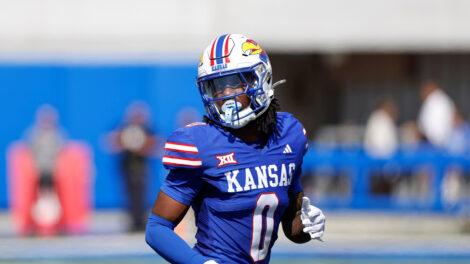
photo by: AP Photo/Colin E. Braley
Kansas defensive back Austin Alexander (0) during an NCAA collage football game on Saturday, Sept. 27, 2025, in Lawrence.
Plenty of the offseason discussion of the Kansas football team, especially before the Jayhawks have taken the field for spring practices, will inevitably center on the Jayhawks’ numerous and in many cases quite promising transfer-portal additions.
That’s natural considering how much KU had to overhaul its roster, particularly at positions like running back, linebacker and safety, after an offseason that combined key graduations with many transfer defections from the back end of the roster.
What the moves have also done, however, is challenge some of the returning Jayhawks to step up their levels of play entering the 2026 season.
Here are just a few of the many players who will need to improve to fend off their new teammates in the many positional competitions that are sure to come.
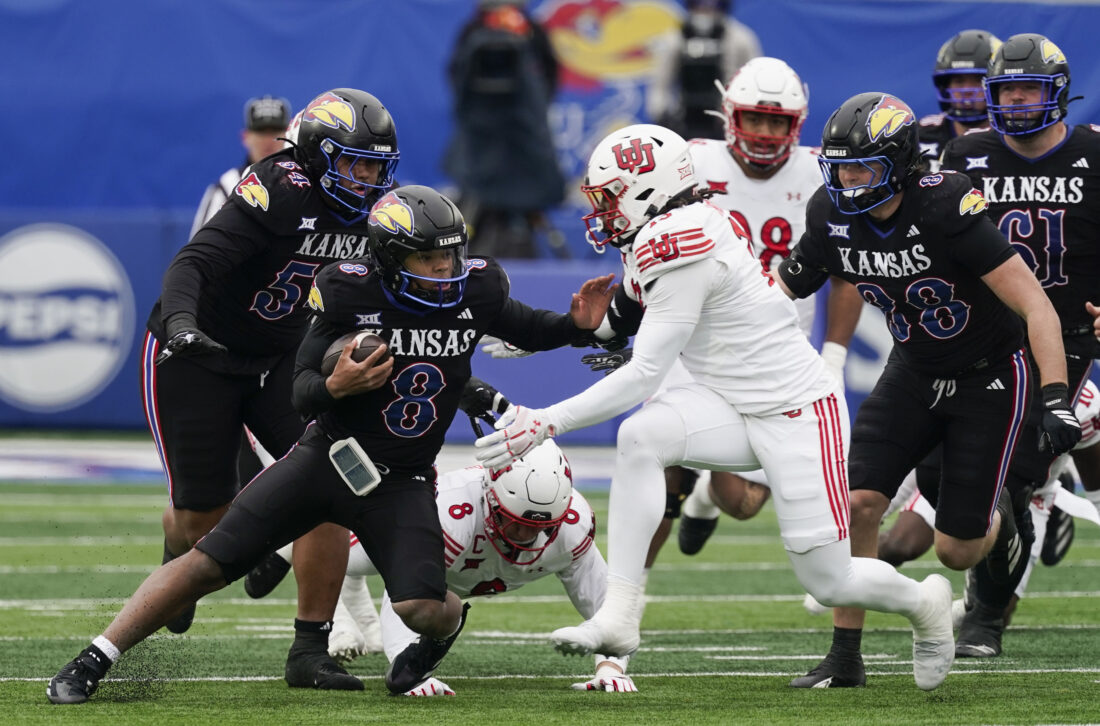
Kansas quarterback Isaiah Marshall (8) makes a cut against Utah defensive end Lance Holtzclaw (15) during the second quarter on Friday, Nov. 28, 2025 at David Booth Kansas Memorial Stadium. Photo by Nick Krug
Isaiah Marshall
Much of the Kansas fan base has treated it as a foregone conclusion that Marshall will serve as the successor to Jalon Daniels — maybe an understandable one given the excitement surrounding his recruitment several years ago and the moments in which he shined as an explosive runner throughout the 2025 season. Yet the fact is that he never ascended to the role of No. 2 quarterback during his redshirt freshman season and has thrown three career passes.
It’s not that Cole Ballard is necessarily the incumbent, or the favorite to take over — it should be an open battle between Ballard, Marshall and Chase Jenkins — but after seeing Ballard and Marshall at work together for two offseasons, the KU coaching staff still consistently put Ballard in front. Whether that changes with Andy Kotelnicki back in the fold, after Kotelnicki helped recruit but never coached Marshall during his previous stint, remains to be seen.
In any case, Marshall will need to turn the tide in some sense in his third offseason entering his redshirt sophomore year and surge ahead of a more experienced, albeit less highly touted, competitor in Ballard. The wild-card addition of Jenkins, who as a 12-game starter at Rice last year has more experience leading a team than either, only adds another hurdle for Marshall to clear if he is to take command.

photo by: Kahner Sampson/Special to the Journal-World
Kansas tight end Carson Bruhn takes part in spring practice on Thursday, March 6, 2025, in Lawrence.
Carson Bruhn
Last season was a generally strong one for KU’s deep group of tight ends, to the point that the Jayhawks lost their veteran leader DeShawn Hanika to injury early in the season — after losing Keyan Burnett to an unexpected transfer defection — but still got a career year out of Rice transfer Boden Groen, whom the staff had envisioned as more of a depth piece as he came off shoulder surgery.
Also valuable, at least in his first seven games before suffering a season-ending foot injury, was Bruhn, who as a redshirt freshman surged up the depth chart to play about 32 snaps per game, according to Pro Football Focus. At 6-foot-6, 255 pounds, Bruhn has the frame to serve as both a physical blocker and a prominent red-zone target.
It’ll help his cause entering 2026 that he was recruited by Kotelnicki — who in his introductory press conference earlier this month recalled going to see Bruhn in a production of “Grease” directed by his mother — and he likely has a leg up already on his fellow returnee Leyton Cure. But it’s a bit hard to tell at this point how this year’s transfer additions Jailen Butler and Carter Moses fit into the mix. Butler is a former JUCO basketball player with 18 career catches at Old Dominion who clearly has high upside as an athlete. Moses has had a more consistently productive career, including 27 catches for 338 yards and three touchdowns in 2025, but it came at the FCS level. Bruhn should come in with an edge over both, at least if he can come back from his injury promptly. But he’ll also need to grow as a receiver after catching just five passes on 10 targets in his first season of action.
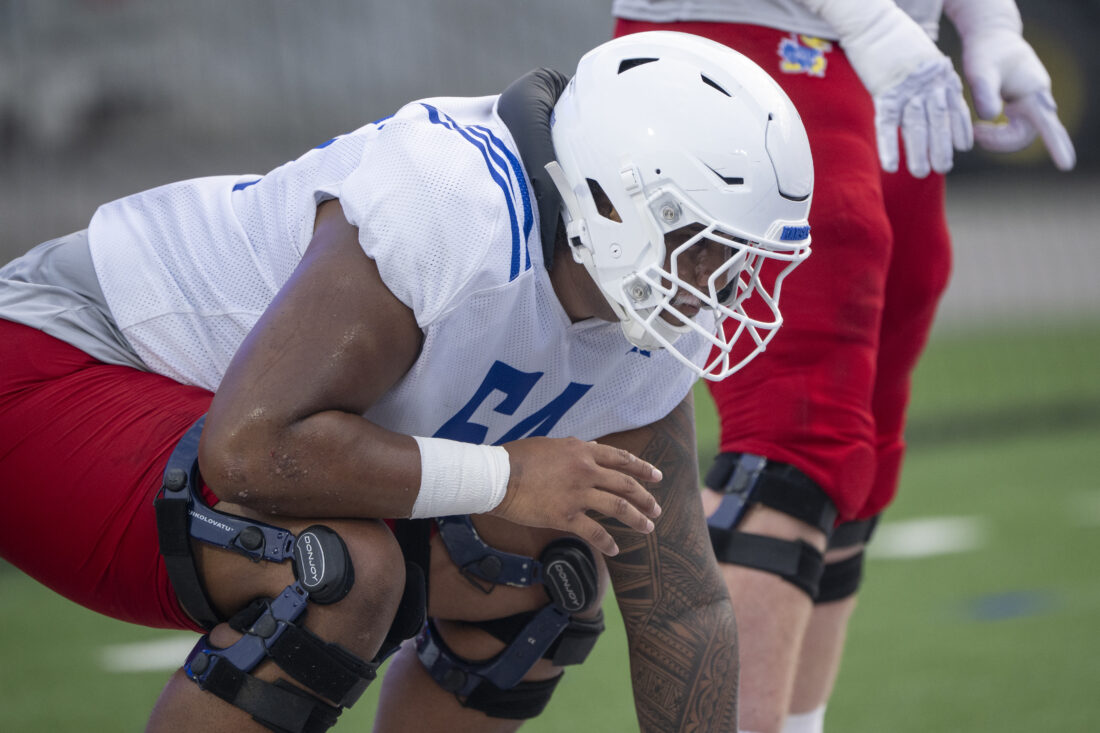
photo by: Mike Gunnoe/Special to the Journal-World
Kansas sophomore Tavake Tuikolovatu lines up for a drill during practice Friday, Aug. 1, 2025 at David Booth Kansas Memorial Stadium in Lawrence.
Tavake Tuikolovatu
The UCLA transfer guard missed some time in his first spring at Kansas due to injury, and he lost the competition to start at left guard to unexpected victor Amir Herring, who ended up having a quietly productive season for the Jayhawks. But KU’s coaching staff clearly saw enough value in Tuikolovatu, at 6-foot-6 and 325 pounds, to deploy him in a rotational capacity throughout the year. He played in all 12 games with 174 offensive snaps, mostly as the left guard but occasionally, especially toward the end of the year as KU’s tight end room got depleted, as an additional blocking tight end, the role in which Nolan Gorczyca was KU’s first choice.
That baseline role as a sixth offensive lineman is surely still there for the taking for Tuikolovatu as he enters his redshirt junior season. But an opportunity to start, which initially seemed like it would be available to him after the graduation of Kobe Baynes, will require winning a competition after he didn’t do so last year. Even after KU brought in former Texas guard Connor Stroh, it initially seemed like Tuikolovatu was in the driver’s seat to start at guard opposite Stroh because Tyler Mercer left in the portal — which would have forced Herring to slide further inside to center. But with Oklahoma State transfer Kasen Carpenter joining KU a week into the portal window, there is a very real version of the Jayhawks’ interior line that contains Herring, Carpenter and Stroh from left to right.
Stroh, also a redshirt junior who brings plenty of size at 6-foot-7 and 340 pounds, opened last season as a starter for the Longhorns. He’ll be difficult to fend off. Granted, to some extent, Tuikolovatu’s fate also depends on the quality of Carpenter. KU’s staff has always aimed to put its best five linemen on the field, and it could decide that Herring, Stroh and Tuikolovatu are better than Carpenter, Herring and Stroh, so Herring could become the center anyway. (Recall what Michael Ford Jr. did in the spring of 2024 even after KU brought in Shane Bumgardner, but before it added Bryce Foster.) That would help Tuikolovatu’s chances of significant playing time.
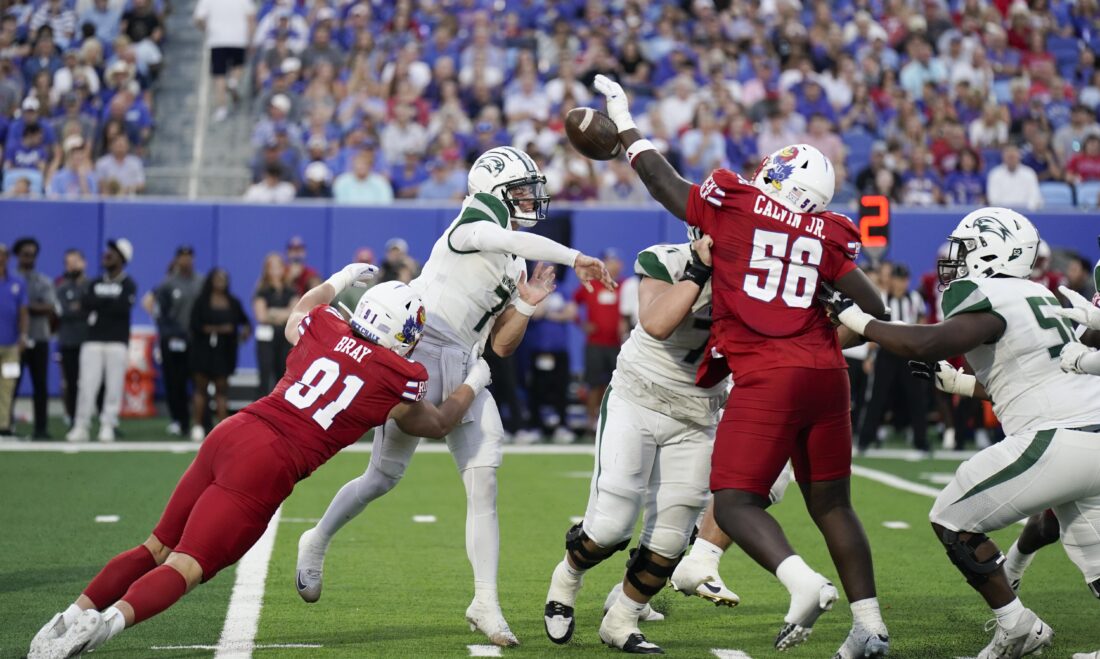
Kansas defensive tackle Marcus Calvin (56) swats a pass from Wagner Seahawks quarterback Jack Stevens (7) during the second quarter on Friday, Aug. 29, 2025 at David Booth Kansas Memorial Stadium. Photo by Nick Krug
Marcus Calvin
Calvin, a project coming out of high school, has developed greatly over the course of his first three seasons with the KU program. He didn’t demonstrate his high upside as early as classmate Blake Herold, who was playing as a redshirt freshman, but Calvin worked his way into the Jayhawks’ rotation as a redshirt sophomore and recorded 15 tackles with one sack while playing 186 defensive snaps in 12 games.
With the graduations of Kenean Caldwell, Tommy Dunn Jr. and D.J. Withers, Calvin is definitely second in the hierarchy of KU’s returning defensive tackles behind Herold, with freshman Josiah Hammond the only other player coming back. That would undoubtedly have put the St. Petersburg, Florida, native in a great position if not for the sheer quality and quantity of experienced transfer tackles that KU brought in via the portal.
Jibriel Conde (Grand Valley State), Tre’Von McAlpine (Tulane), Eamon Smalls (UAB) and late addition Kevin Oatis (Arkansas) each bring distinct body types to help facilitate the multiple fronts that D.K. McDonald implemented in his first year as defensive coordinator. They also bring, in the case of all but Oatis (who was sought after by most of the SEC out of Hattiesburg High School), considerable experience, more than Calvin. McAlpine in particular seems a shoo-in for significant snaps given that he has played in the Big 12 before during his previous tenure at Texas Tech.
Calvin won’t get squeezed out altogether, of course. KU has shown a willingness to play as many functional defensive tackles as it can, and the staff is quite high on him. But he is likely in a similar situation to Tuikolovatu where to elevate his role beyond what it was in 2025 will require significant growth.
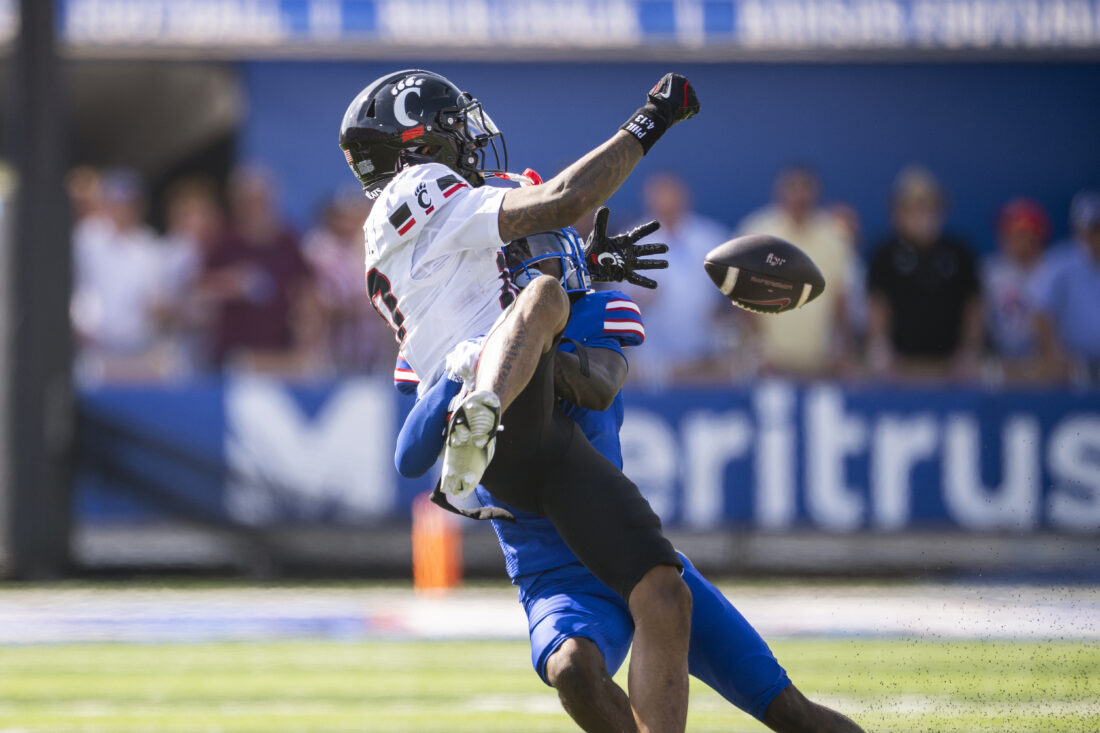
photo by: Mike Gunnoe/Special to the Journal-World
Kansas cornerback Austin Alexander breaks up a pass to Cincinnati wide receiver Caleb Goodie at David Booth Kansas Memorial Stadium on Saturday, Sept. 27, 2025, in Lawrence.
Austin Alexander
In one of the more passionate segments of his recent offseason press conference, KU coach Lance Leipold pointed out that inevitable “growing pains” on defense were sure to come with the implementation of “a whole new back seven” last season, while also acknowledging that the unit has room for improvement, particularly in terms of communication.
As new as the unit was, its newest member of all might have been Alexander. His fellow outside corner Jalen Todd had seen playing time down the stretch as a true freshman, as had safety Taylor Davis as a redshirt freshman. Mason Ellis, who started the season as KU’s fifth defensive back, had demonstrated plenty of promise early in 2024 before battling injury (as he did in 2025). And transfer additions like safety Lyrik Rawls (who has since departed for Arizona State) and cornerbacks Syeed Gibbs and D.J. Graham II had played plenty at their previous schools at the power-conference level.
Alexander, meanwhile, did not play at all during his freshman season in 2024 coming out of Hazel Crest, Illinois, and also missed a chunk of time due to a broken wrist. Then he became a day-one starter for KU as a redshirt freshman opposite Todd, ultimately starting 11 of the 12 games in which he played with a reasonable 61.0 PFF grade. He went from zero defensive snaps to 542 and showed some flashes along the way, such as a key late-game pass breakup against UCF and a fumble returned for a touchdown against Missouri, and finished the year with 46 tackles.
On the other hand, he also got targeted more than any other Jayhawk (45 times) and allowed a higher percentage of those targets to turn into catches (75.6%) than any other defensive back on the team besides Ellis (who was only targeted nine times). His 14 missed tackles were the second most on the team.
Because last year’s group was so young, KU did not lose much at cornerback. The Jayhawks did, however, have some reserves decide to transfer, and so they bolstered the group with Elijah Cannon and Roman Pearson. Cannon didn’t play much at Mississippi State, but Pearson looks like a threat to start. He’s a fifth-year senior with 26 career starts between stints at Bucknell and Ball State. It certainly seems like any significant role for him could come at Alexander’s expense, especially because he played almost exclusively on the outside at Ball State.
KU Football

KU’s first 2027 commitment is lineman Gonzalez
Trio of Jayhawks invited to NFL Combine
5 Jayhawks who will need to improve this offseason to earn big roles
Pair of former Jayhawks earn Super Bowl rings

Onatolu to focus on special teams; Dineen will coach defensive ends