Projecting the KU football depth chart — with caveats
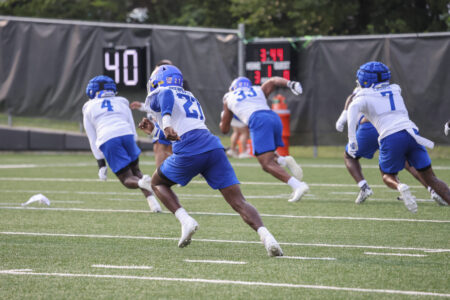
photo by: Kahner Sampson/Special to the Journal-World
Kansas safety Taylor Davis sprints during the first day of KU Football's fall camp on Tuesday, Aug. 4, 2026, in Lawrence.
It’s almost time for the Kansas football team to reveal its first depth chart of the season, though it may not be all that revelatory.
That depends largely on how much the KU coaching and communications staffs decide to incorporate the word “or” at various spots in the two-deep to include additional players or to leave intentional ambiguity at certain positions.
When the depth chart comes out next Monday, there will almost certainly be ors at quarterback, running back and tight end, and probably some more on the defensive line and in the secondary.
The Journal-World is not bound by such conventions. What follows is my best guess at a strict two-deep, with commentary on some of the tough decisions involved and the omitted players who could still make significant contributions.
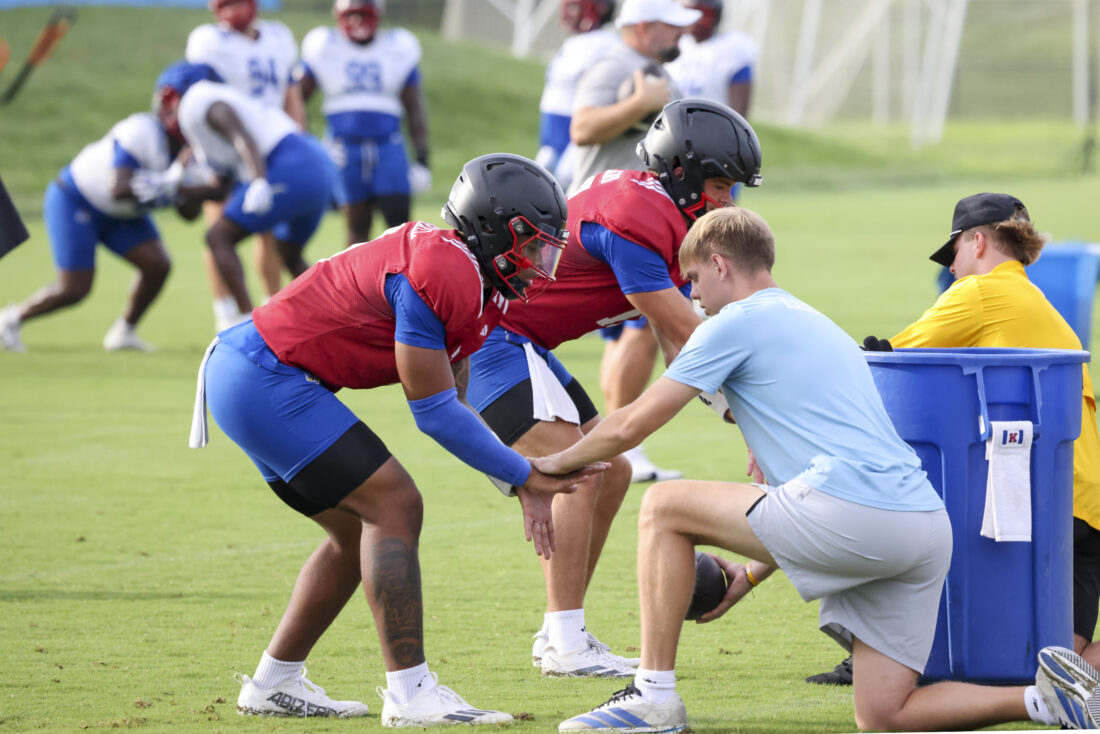
photo by: Kahner Sampson/Special to the Journal-World
Kansas quarterbacks Isaiah Marshall (front) and Cole Ballard take a snap during KU Football’s practice on Monday, Aug. 17, 2026, in Lawrence.
Quarterback: Cole Ballard; Isaiah Marshall
Obviously someone has to start the Long Island game at quarterback, by the letter of the law — unless KU runs the wildcat formation on the first play, who knows — but recent comments by head coach Lance Leipold have me wondering if KU will at any point soon officially name a starter in the way a school traditionally does to resolve a quarterback competition.
At the Jayhawks’ local media day, Leipold first said he does not fall on either side between naming a starter prior to the season opener on Sept. 4 or using that opener to evaluate the competition. He then reiterated that both quarterbacks could play throughout the season.
At the same time, KU’s head coach has said in the past that he does not want to use a full-time two-quarterback system because “you have to give people an opportunity to get into the flow of the game at that position, instead of kind of going back and forth.” Whatever the case, it certainly seems like the Jayhawks are trying to maintain the element of surprise for as long as they can, potentially even up until they face Missouri on Sept. 11.
As for my own pick here, I think it’s fair to say that Marshall, whom Matt Gildersleeve has described as one of the best athletes on the team, would make the Jayhawks more dynamic and exciting as the starter. But when I hear passing game coordinator Jim Zebrowski say that Ballard needs to focus on being less rigid in his mechanics and Marshall needs to focus on “functional intelligence, processing all that information,” that seems like a pretty dramatic asymmetry in terms of deficiencies in a potential starting quarterback.
It’s possible that Marshall could have made sufficient improvement since Zebrowski made those remarks on Aug. 8 as to assuage any possible concerns. Again, I do think the Jayhawks’ ceiling is higher and the range of plays Andy Kotelnicki can call is wider when Marshall is in. But maybe KU is going to opt for the best of both worlds — “flow of the game” notwithstanding — by using them both in various capacities all season.
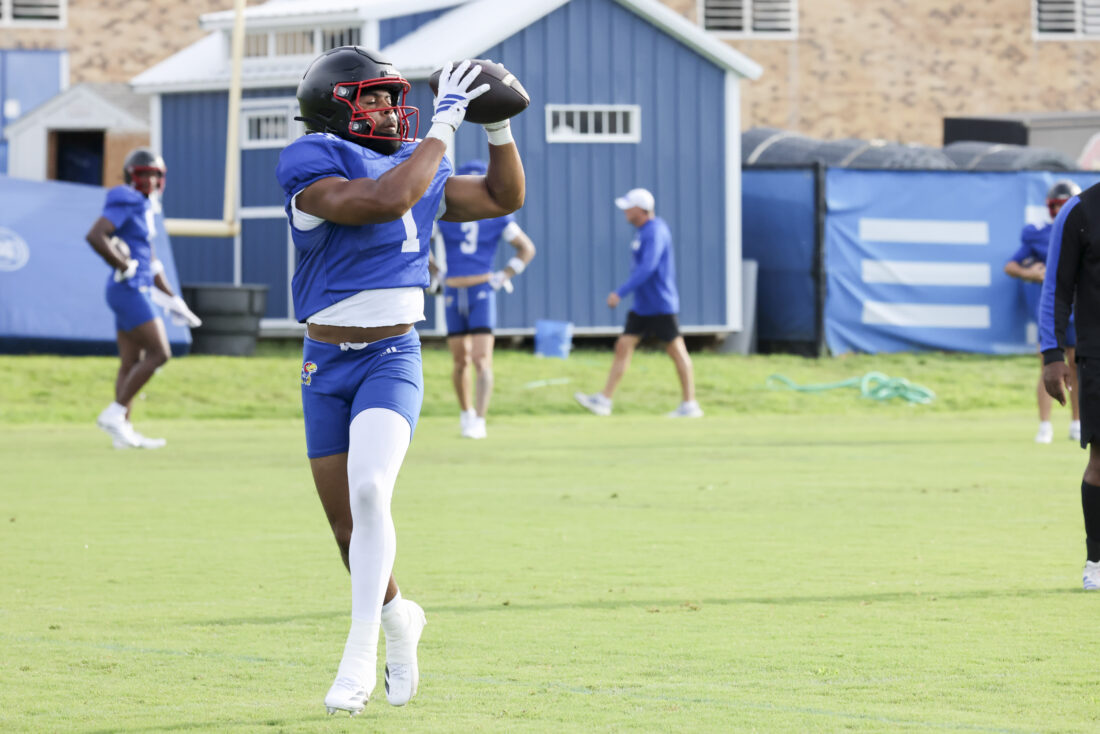
photo by: Kahner Sampson/Special to the Journal-World
Kansas running back Dylan Edwards catches a pass during KU Football’s practice on Monday, Aug. 17, 2026, in Lawrence.
Running back: Dylan Edwards; Yasin Willis
It really doesn’t matter who is technically the starter between these two because both fulfill such different purposes — Edwards at 5-foot-9, 175 pounds, and Willis at 6-foot-1, 230 pounds — and Willis will likely get more touches regardless because he is the early-down bruiser. Edwards has only received double-digit carries in five games during his career. He has tended to do very well in some of these — 18 carries for 196 yards and two touchdowns in the 2024 Rate Bowl, 20 carries for 166 yards and a score in Kansas State’s game against UCF last season — but Willis is more used to being a bell cow given that he averaged 14 carries per game at Syracuse in 2025.
In all likelihood, both will be on the field at the same time quite often, because particularly given KU’s lack of depth at wide receiver, there is reason to believe Edwards will spend a lot of his time in the slot. Even though I think there is a greater chance Willis will be at running back for the first play of the season, I give Edwards the top spot here on my depth chart as a symbolic nod to his multiple potential uses.
For what it’s worth, I believe Jalen Dupree is now likely to be the No. 3 running back and potentially serve in a similar role to Dylan McDuffie in 2023 (45 carries, 253 yards, four touchdowns). After missing the spring due to an offseason surgery, Dupree had a lot of ground to make up after freshman Kory Amachree’s impressive spring, but Amachree has dealt with his own injuries in the fall and hasn’t received nearly as much buzz.
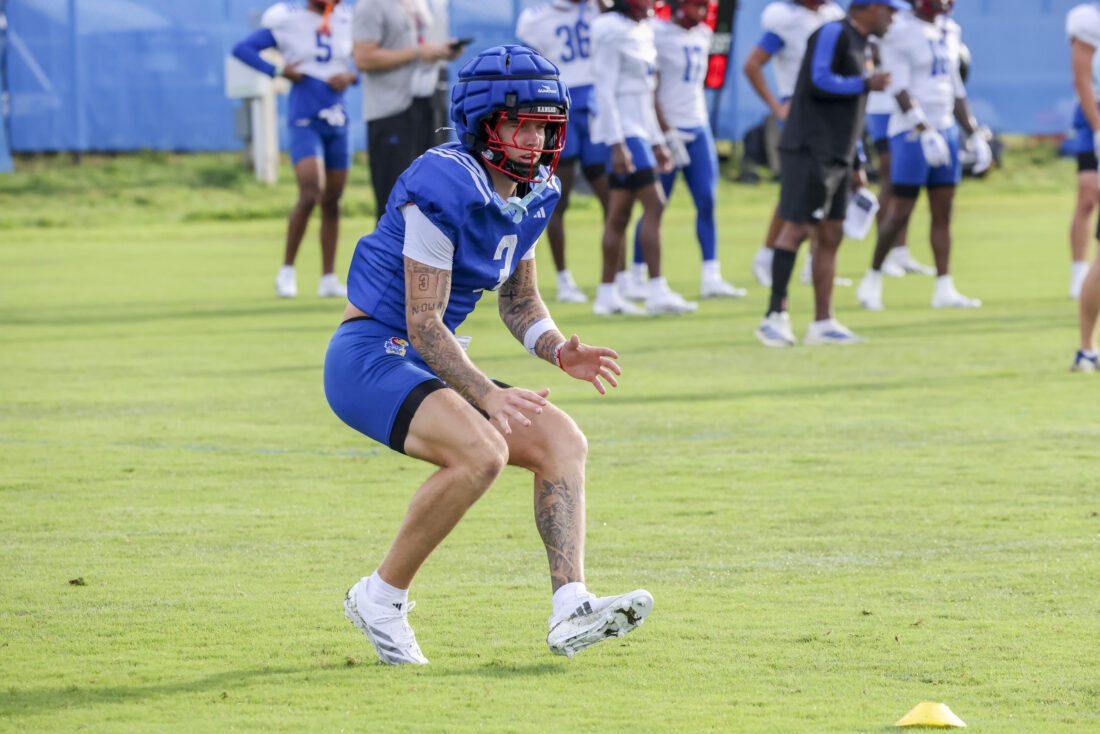
photo by: Kahner Sampson/Special to the Journal-World
Kansas receiver Keaton Kubecka changes direction during KU Football’s practice on Monday, Aug. 17, 2026, in Lawrence.
Wide receiver: Cam Pickett; Tate Nagy
Wide receiver: Nik McMillan; Bryson Hayes
Wide receiver: Keaton Kubecka; Nahzae Cox
Not too much to say here, although it does demonstrate KU’s somewhat shallow bench at this position that Hayes and Nagy are second-string options as redshirt freshmen with two combined catches in their career.
The good news for KU is that provided Pickett can stay healthy — which he didn’t last year, and which may already be a reasonable concern given that he has been banged up recently and missed practices — both he and McMillan should be among the most complete wideouts KU has had in Leipold’s tenure as head coach.
I do not expect Kubecka and Cox to garner significantly different numbers of snaps. They should each bring some level of physicality to that outside receiver spot. Kubecka has the edge based on seniority and how highly position coach Terrence Samuel spoke of him in fall camp while also suggesting that Cox and McMillan still needed more time to grow in their understanding of the offense. Kubecka, of course, is now one of the most experienced players on the Jayhawks’ offense, to the point that he has been around for both of Kotelnicki’s tenures.
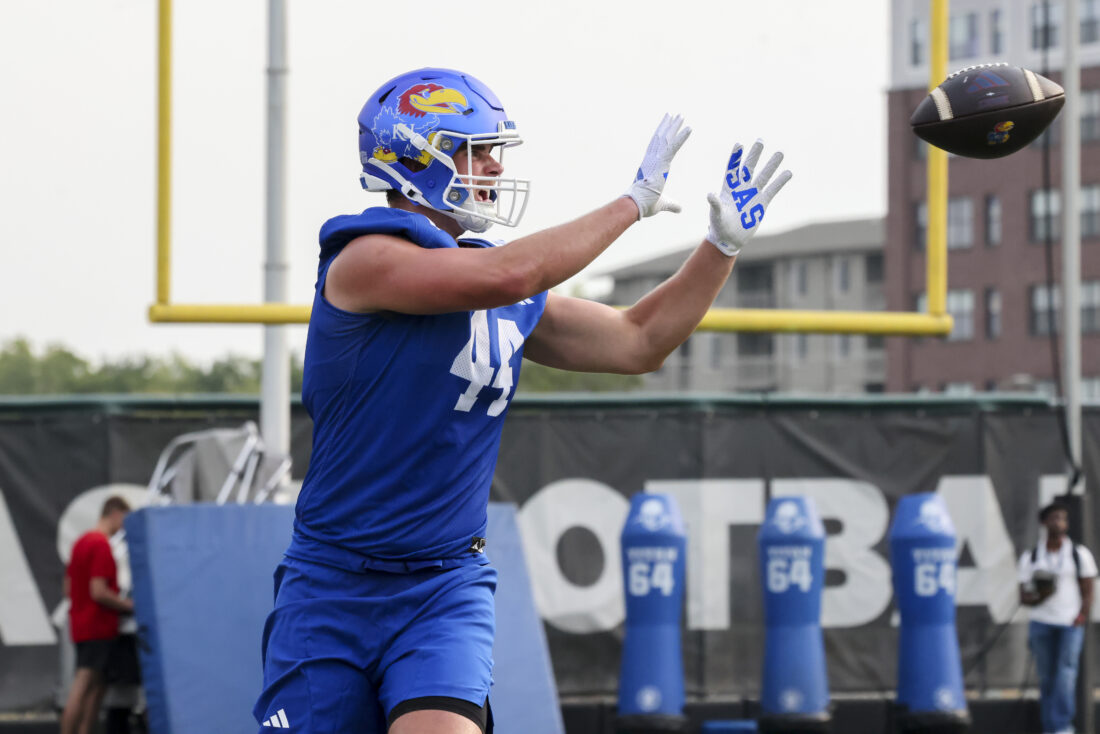
photo by: Kahner Sampson/Special to the Journal-World
Kansas tight end Carson Bruhn keeps his eyes on a pass during the first day of KU Football’s fall camp on Tuesday, Aug. 4, 2026, in Lawrence.
Tight end: Carson Bruhn; Jailen Butler
Bruhn caught just five passes last season before suffering a season-ending foot injury, but he’s a well-regarded blocker at 6-foot-6 and 260 pounds, and Kotelnicki has said that tight ends coaches Matt Lubick and David Parker have challenged him to improve as a receiver this offseason, with a high level of success. If he can develop into a reliable target over the middle, it will make things substantially easier for whoever is playing quarterback.
Anyone who has watched KU under Leipold knows that Leyton Cure and Carter Moses will get snaps of their own, but it does seem like Butler has the edge for the No. 2 spot. Leipold has cited him as a camp standout. Old Dominion used the former junior-college basketball player almost exclusively as a blocker, but Bruhn has said that Butler profiles as a faster type of tight end who can play split out. If KU really can use him that way on a regular basis, this top two could make for an effective complementary pair.
Moses has missed some time during camp, so don’t be surprised if he plays a less active role early in the season.
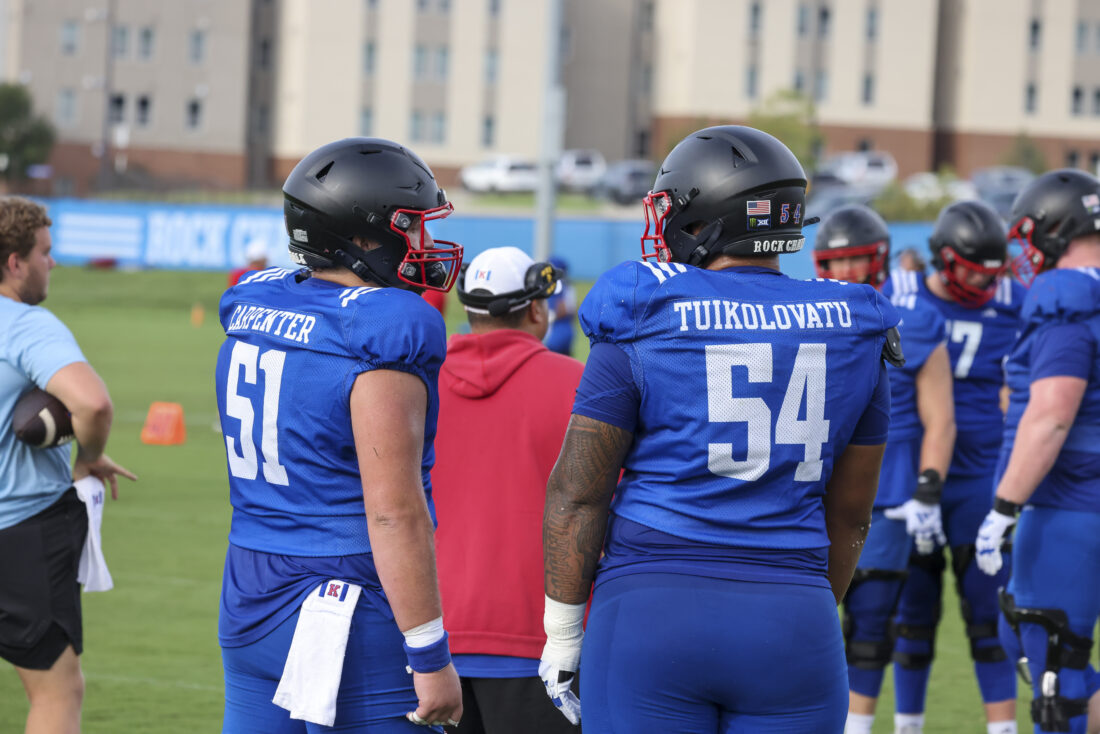
photo by: Kahner Sampson/Special to the Journal-World
Kansas offensive linemen Kasen Carpenter (51) and Tavake Tuikolovatu share a chat during KU Football’s practice on Monday, Aug. 17, 2026, in Lawrence.
Left tackle: Calvin Clements; Jack Tanner
Left guard: Amir Herring; DeAndre Harper
Center: Kasen Carpenter; Anderson Kopp
Right guard: Tavake Tuikolovatu; Connor Stroh
Right tackle: Nick Morrow; Brandon Solis
Could KU ultimately decide that the best version of its offensive line is a more physically imposing one with Herring at center and Tuikolovatu and Stroh each starting at one guard spot? Maybe, but when Leipold said at local media day that with Carpenter’s return to center Herring was “back where he needs to be getting more reps” at guard, it suggested that the Jayhawks were returning to their original vision for the offensive line.
Certainly there is some merit, for the sake of continuity, especially with young quarterbacks, in sticking with the player who seemed poised to serve as the starting center for the entirety of the offseason. Ultimately, the Herring-at-center experiment may be more of a contingency plan to prepare for future injuries.
KU has been known to rotate at closely contested offensive line spots until (or unless) one player separates himself. While Tuikolovatu has the edge due to experience, particularly after his first healthy offseason in the program, I expect right guard to be one such position in 2026, and don’t be surprised if Harper gets his chances there sooner rather than later given how much he impressed in fall camp.
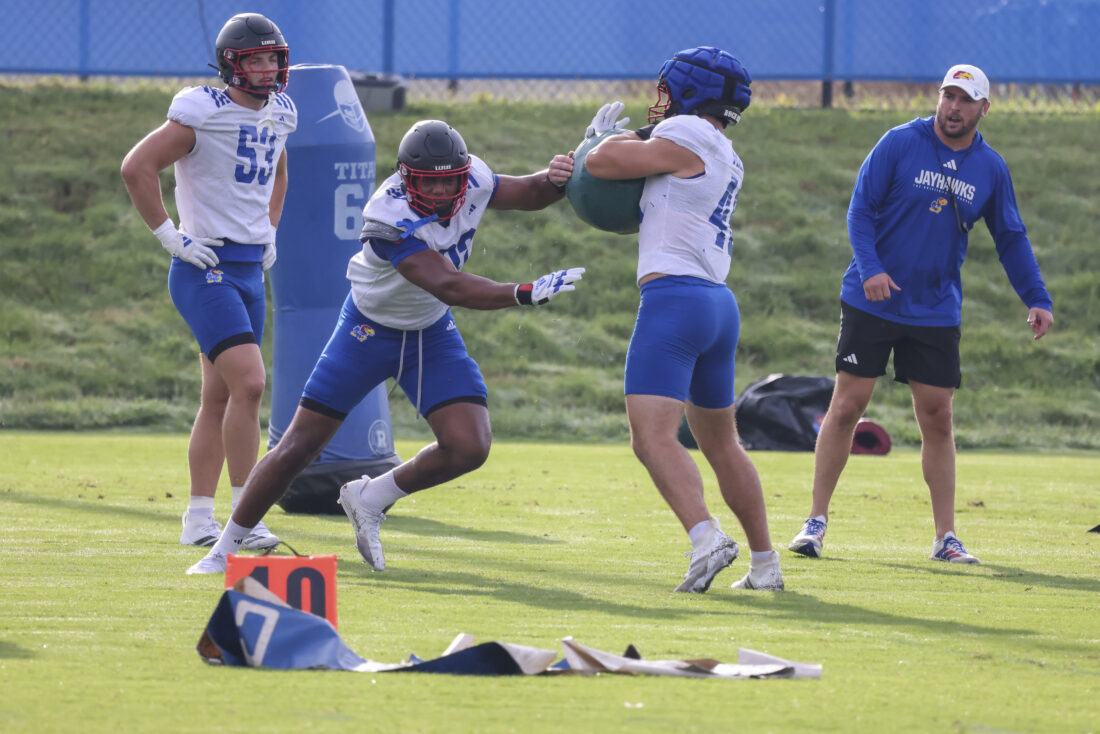
photo by: Kahner Sampson/Special to the Journal-World
Kansas defensive end Leroy Harris III takes part in a drill during KU Football’s practice on Monday, Aug. 17, 2026, in Lawrence.
Defensive end: Leroy Harris III; Dak Brinkley
Defensive tackle: Blake Herold; Kevin Oatis
Defensive tackle: Eamon Smalls; Marcus Calvin
Defensive end: Alex Bray; David Santiago
As effusive as Leipold and defensive coordinator D.K. McDonald have been in recent days about the Michigan State transfer Santiago, who according to McDonald “had one of the best camps of anybody on defense” and grew as a pass rusher in particular, I still think Bray gets the start at the run-stopping “stud” end spot based on his size and the fact that he has already played a season there for KU. It could be a situation like with Dean Miller and Harris in 2025 where one begins as the starter and the camp standout grows to take on a greater number of snaps over time.
As for Harris, he and Brinkley should make for a potent duo on the weak side, particularly given that Leipold has called Brinkley potentially the team’s best overall pass rusher. Keep an eye out for Garrett Martin to get a handful of snaps each game, more likely at the pass-rush spot, which he has played this year, than at the stud spot where he trained as a freshman.
KU runs enough odd fronts on the defensive line that it would also be reasonable to add a third defensive tackle spot with Calvin as the starter and put Jibriel Conde as the backup to Herold (with whom he is probably most comparable among all of KU’s defensive tackles). But for now Oatis gets the edge over Conde for inclusion on this depth chart because he seems like he might be a bit more immediately ready to contribute, even as a redshirt freshman.
As for picking Smalls over Calvin to start, even though Calvin is in his fourth year in the program and Smalls missed much of his first spring after transferring from UAB, that comes down more so to body type. “Big E” is 30 pounds heavier and can play as more of a run-stopping nose tackle, which KU needs in the absence of Tre’von McAlpine (who suffered a season-ending ACL injury). Calvin may earn more snaps than Smalls when all is said and done, especially on passing downs alongside his classmate Herold.
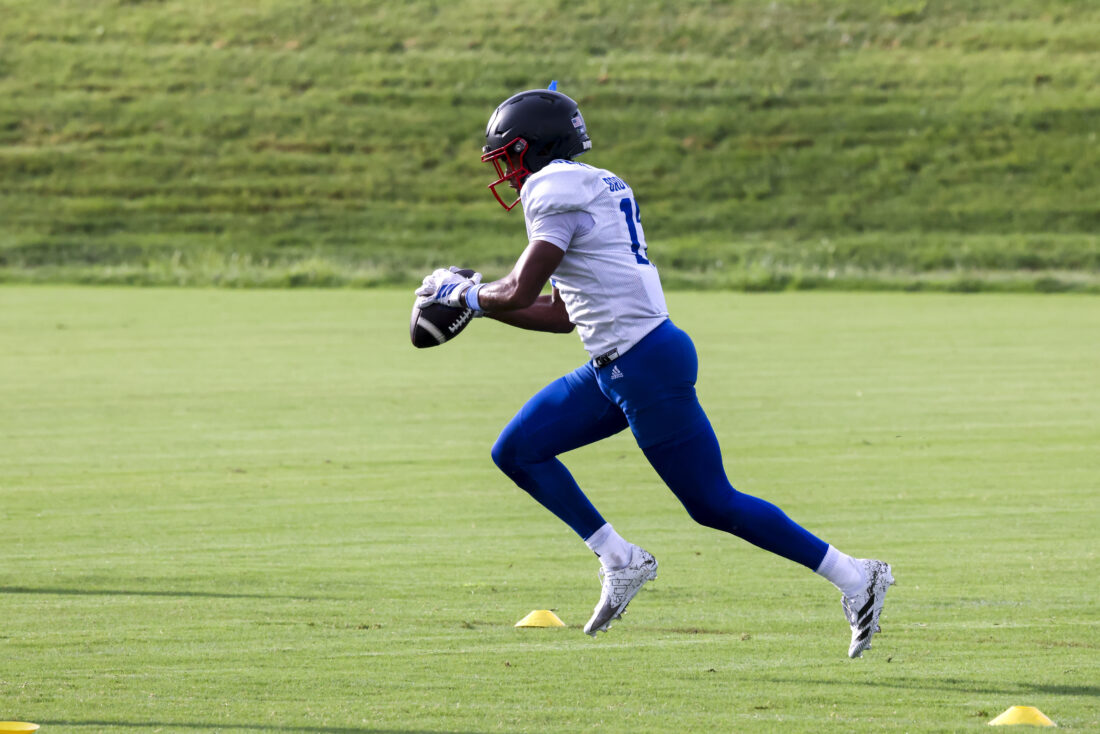
photo by: Kahner Sampson/Special to the Journal-World
Kansas cornerback Trey Brown catches a pass during KU Football’s practice on Monday, Aug. 17, 2026, in Lawrence.
Hawk: Jibreel Al-Amin; Khijohnn Cummings-Coleman; Trey Brown
This is a little bit of an avant-garde approach to this position, but it matches what KU did last season on its initial depth chart, listing a linebacker, safety and cornerback at the same single position and so accounting for potential 4-3 and 4-2-5 alignments. The 4-3 was not nearly as prominent a component of KU’s defensive scheme under McDonald as it had been under Brian Borland, but perhaps it can make a comeback this season now that the Jayhawks have an athletic hybrid-type player in Al-Amin, a fast playmaker who can cover but also stop the run.
More likely, though, is that KU spends the bulk of its time in a 4-2-5 again with Cummings-Coleman, an Iowa State transfer, or Mason Ellis (who started last season at nickel).
The inclusion of Trey Brown is partly for consistency with last year’s inclusion of a cornerback (at that time it was Syeed Gibbs, but he is now playing primarily outside corner for KU) and partly to acknowledge how much he has impressed the coaches this offseason after enrolling early as a true freshman. His biggest impact this year may ultimately be on special teams, but it’s not unreasonable to include him here, even if a fully healthy Ellis or even Mississippi State transfer Elijah Cannon might be the pick over him in a vacuum. Needless to say, as Leipold himself has noted, there is no shortage of choices, it’s just about finding the most consistent options.
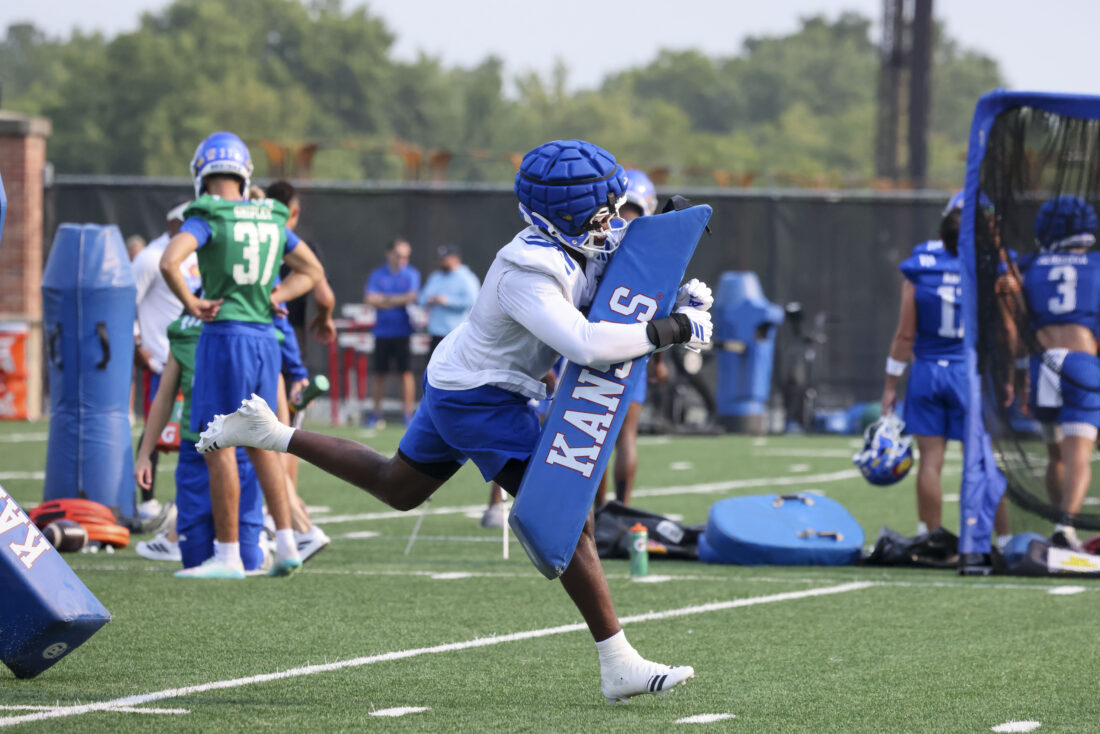
photo by: Kahner Sampson/Special to the Journal-World
Kansas linebacker Trey Lathan hits a pad during the first day of KU Football’s fall camp on Tuesday, Aug. 4, 2026, in Lawrence.
Linebacker: Bam Crouch; Malachi Curvey
Linebacker: Trey Lathan; Quincy Davis
I think KU prioritized training Davis to back up Lathan over cross-training him at weak-side linebacker, but if he got sufficient experience in the latter position over the course of fall camp, he might well be the second choice at either spot.
One additional benefit of putting Al-Amin in the Hawk spot for the purposes of this two-deep is that it provides an opportunity here to include Curvey, an imposing 6-foot-4 and 245 pounds as just a redshirt freshman.
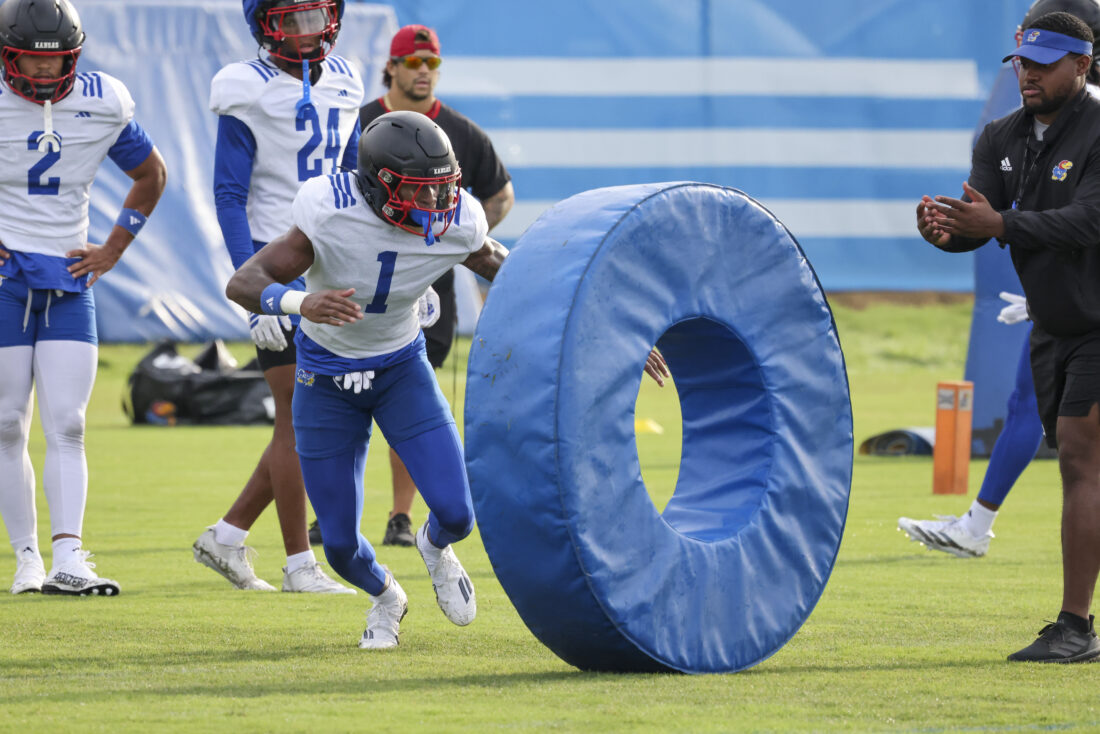
photo by: Kahner Sampson/Special to the Journal-World
Kansas cornerback Jalen Todd runs towards a pad during KU Football’s practice on Monday, Aug. 17, 2026, in Lawrence.
Cornerback: Jalen Todd; Syeed Gibbs
Safety: Corey Gordon; Christian Pritchett
Safety: Taylor Davis; Jaden Harris
Cornerback: Austin Alexander; Roman Pearson
The secondary has featured quite a bit of offseason competition, particularly given that injuries made it difficult to get a clear picture at the position for much of the spring and summer and gave opportunities to players who might not have had them otherwise.
In the end, I think KU has enough invested in Alexander’s development and sufficient reason to believe he will be a more confident and capable outside corner in his third year in the program to give him the starting nod over the Ball State transfer Pearson, but as the 2025 season demonstrated, both will need to play quite a bit. As previously mentioned, Gibbs is primarily playing on the outside after doing so late last season, and he gets the nod over Jahlil Hurley and Cannon for the No. 4 spot at corner.
Davis and Harris have also been in a lengthy battle of their own, but I think for a long time it has looked likely that Davis will start at boundary safety and, like, Alexander, hope for a bounce-back campaign with an added year of experience under his belt. The KU staff is excited about having a pair of rangy, coverage-inclined field safeties in Gordon and Pritchett after previous teams included a lot of safeties who were more comfortable playing in the box.
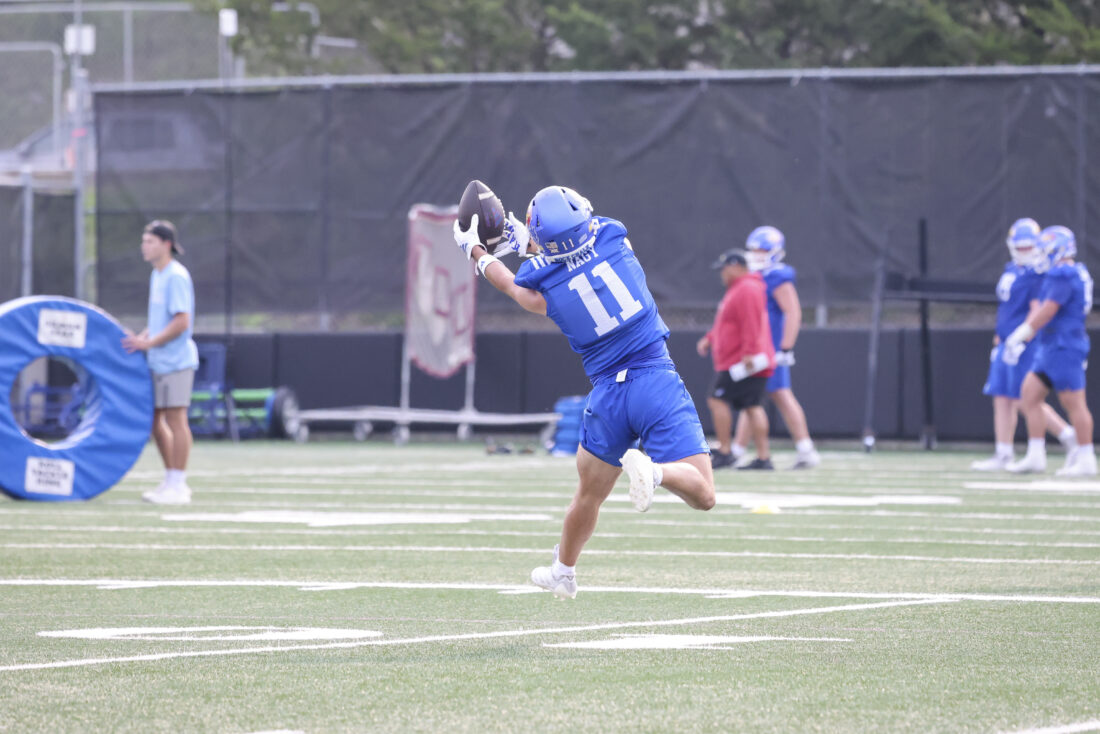
photo by: Kahner Sampson/Special to the Journal-World
Kansas receiver Tate Nagy brings in a pass during the first day of KU Football’s fall camp on Tuesday, Aug. 4, 2026, in Lawrence.
Kickoff specialist: Dane Efird; Martin Connington
Placekicker: Martin Connington; Dane Efird
Punter: Matt Gill; Ben Shipley
Long snapper: Rino Monteforte; Hollis Moeller
Punt returner: Tate Nagy; Keaton Kubecka
Kick returner: Dylan Edwards; Tate Nagy
Holder: Hollis Moeller; Matt Gill
There are a couple of interesting wrinkles in here this season. I’ve given Efird, a second-year walk-on backup kicker, the edge as a kickoff specialist, given that Leipold has suggested he could compete for that role, and he apparently has a pretty strong leg. Maybe it could help Connington to focus more on place kicks.
Leipold has also mentioned that in a rather unusual arrangement, Moeller, the reserve long snapper, volunteered to serve as a holder and has earned the starting role there. It’s hard to know with an Australian import like Gill how much experience he might have holding for place kicks, but one would imagine he’d serve as the other option there.
Nagy was nearly flawless on punt returns as a true freshman and has earned the right to retain that spot; Kubecka has worked there for a while. I wouldn’t be surprised to see Edwards take some punts as well, even though I have him listed as the top kick returner.
KU Football
Leipold reacts to firing of Baylor’s Aranda: ‘One of the true real people in this profession’
What we learned from KU’s win over Baylor
Herold answers Jayhawks’ prayers with blocked field goal to save game against Baylor
Photo Gallery: Strong 4th quarter by KU puts them over Baylor, 25-24
Quick recap: KU blocks last-minute field goal to beat Baylor, 25-24