


Best of Lawrence Profile: HEALING THE WHOLE PERSON: HOW RAVEN RAJANI IS REDEFINING MENTAL HEALTH CARE IN LAWRENCE
Editor’s Note: This article is sponsored content produced by the Journal-World’s advertising department. Businesses who received a top three award in the Best of Lawrence competition are eligible to participate in the Best of Lawrence Spotlight Series program, which includes a question-and-answer profile. Look for future profiles in the print and online editions of the Journal-World.
Lawrence carries a distinctive rhythm, where university energy blends with Midwestern steadiness. Mental health needs are both visible and quietly held. Students wrestle with identity and pressure. Parents juggle careers and caregiving. Professionals navigate burnout in an uncertain world. Beneath the surface, many are simply trying to keep pace with expectations that feel relentless.
Rajani maintains her own private practice and is the founder and owner of Integrative Therapy Services (ITS), a group mental health practice. She also owns The Shakti Place and Loving Paws Animal Therapy Association. Each reflects her belief that healing is multidimensional and that care should be accessible, creative and community-oriented. Together, these endeavors form a network of support that reaches far beyond a traditional therapy model.
Although ITS includes other practitioners, her integrative philosophy guides the group and its clinicians, shaping how care is delivered and how clients are understood.
A calling, not a career move
Rajani’s path into mental health was personal, not strategic. “I’ve always had a heart for helping, both people and animals,” she said. Long before earning her credentials, she was drawn to those who were struggling, offering steadiness and compassion in uncertain moments.
Returning to graduate school as a nontraditional student shaped her approach. She entered the profession with lived experience, resilience and a deep understanding of what it means to begin again. That perspective informs both her individual work and the culture she cultivates within ITS, where clinicians are encouraged to lead with curiosity and humility.
“The work wasn’t born out of ambition,” she said. “It was born out of care.”
What “integrative” means to her
For Rajani, therapy is not confined to a single model. “We are not just our thoughts. We are not just our diagnoses,” she said. “We are nervous systems, stories, relationships, histories, culture, biology, grief and creativity, all woven together.”
Her approach blends evidence-based talk therapy with somatic awareness, attachment frameworks, mindfulness, expressive arts and, when appropriate, animal-assisted therapy. Rather than impose rigid structure, she adapts to the individual, meeting each client where they are emotionally and physiologically.
This philosophy shapes her own sessions and the collaborative spirit of ITS. Mental health, she believes, is intertwined with sleep, movement, stress load, identity and belonging. Healing unfolds across those layers, gradually and relationally, often in ways that are subtle before they are visible.
The transformative power of Shakti
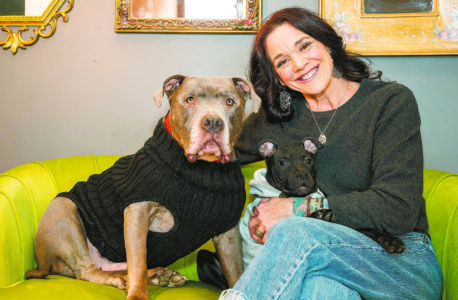
A pivotal influence on Rajani’s work was her rescue dog, Shakti. After adopting her, Rajani witnessed how the presence of a calm, attuned animal could soften guarded nervous systems. Shakti became a certified therapy dog and inspired the founding of Loving Paws Animal Therapy Association.
“Watching clients soften in her presence changed the way I understood healing,” Rajani said. “Regulation and connection can happen without a single word.”
Shakti was voted No. 1 Best of Lawrence (BOL) Working or Service Animal, even after her passing, reflecting her profound impact on the community and the depth of connection people felt in her presence. For Rajani, Shakti’s legacy affirms a core truth: Therapy is embodied and relational, often unfolding before words ever come.
Creating spaces for safety and connection
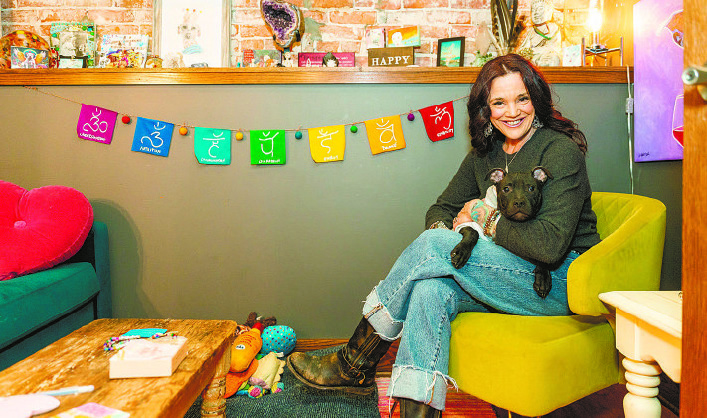
Intentionality shapes the environments where Rajani’s work unfolds. In addition to her private and group practice offices, she owns The Shakti Place, designed for workshops and community gatherings that extend healing beyond the therapy hour.
These spaces are curated to feel warm and grounding, with soft textures, natural elements and meaningful artwork. She believes nervous systems register safety before conversation begins, and that physical surroundings can either support or hinder emotional openness. “Therapy is vulnerable work,” she said. “The atmosphere should meet that vulnerability with warmth.”
Walking with clients through transition
Adolescents, young adults and adults seek Rajani’s support during pivotal transitions such as parenthood, career changes, relationship shifts, grief, identity exploration and medical diagnoses.
Many arrive in survival mode: hypervigilant, emotionally numb or exhausted. Together, they work toward regulation, self-awareness and renewed agency, building internal resources that extend beyond the therapy room.
“There’s something deeply meaningful about being invited into those tender seasons of becoming,” she said.
As home to a major university, Lawrence brings unique pressures. Students balance identity development with academic demands and cultural uncertainty. Beyond campus, economic strain, political tension and nonstop news cycles leave many residents depleted. “Feeling overwhelmed in this environment is not a personal weakness,” she said. “It is a response to real pressure.”
More than talk: Opening healing to the wider community
Rajani’s vision extends beyond traditional sessions. Through ITS and The Shakti Place, she supports offerings such as sound healing, expressive art workshops, trauma-informed yoga, writing groups and grief gatherings. These experiences invite healing through movement, creativity and shared presence, creating opportunities for connection outside of clinical settings.
All are welcome, whether or not they are participating in therapy. Rajani designs these gatherings as accessible spaces for reflection and community. Community members can learn more about upcoming events and offerings on the ITS website, where updated information is regularly shared.
“Healing doesn’t happen through conversation alone,” she said. “It can happen through movement, creativity, stillness and shared space.”
By widening access, she reinforces her belief that mental health care can be proactive and communal, not only crisis-driven, and that prevention and connection matter as much as intervention.
Measuring growth beyond symptom reduction
Clients may seek relief from anxiety or depression, but Rajani watches for subtler shifts: fuller breathing, less bracing in the body, healthier boundaries and moments of pause before reaction.
Growth, she believes, is measured in self-trust and self-compassion, in the quiet confidence that comes from feeling more regulated and less alone.
“When someone moves from survival into agency and choice,” she said, “that’s meaningful.”
Across her roles as therapist, founder, business owner and community collaborator, Rajani’s approach remains consistent: depth over scale, relationship over rigidity, care over ambition.
At a time when many feel fragmented, her work offers a steady reminder that people are not problems to be fixed, but whole beings to be understood, and that healing can unfold in many forms, both inside and beyond the therapy room.
To learn more, call 785-979-7937, visit www. integrativetherapyservices.org, or Instagram: integrative.therapy.with.raven, Facebook: Raven Rajani, LSCSW.