

Kansas Quadball brings fantasy to life
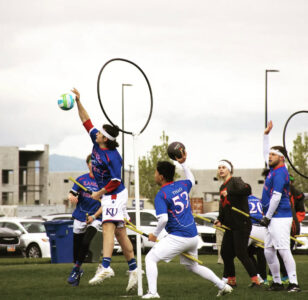
photo by: Courtesy of Blake Moore
Members of the Kansas Quadball club defend their hoops against the Oklahoma State Quadball Club at a tournament in Salt Lake City, Utah, on Saturday, Aug. 20, 2022. Kansas performed well in the tournament, reaching the quarterfinals.
In the “Harry Potter” books and movies, the sport of Quidditch is only for the most daring of wizards. It’s a dangerous, thrilling game whose players soar high above the field on broomsticks, dodge flying iron balls and dart around to capture the elusive golden snitch.
It might come as a surprise, then, that its real-life counterpart — known as quadball — is one of the most welcoming and inclusive sports out there.
“Quadball is a very open sport, and you get a lot of different people from a lot of different walks of life,” said Gavin Klaassen, president of the Kansas Quadball club at the University of Kansas. The KU senior has been a part of the club since his freshman year, and he says he’s met hundreds of people through it.
The sport of quadball began in 2005 at Middlebury College in Vermont, when two fans of the “Harry Potter” novels wanted to find a way to play Quidditch in the real world. What they came up with was a contact sport that combined elements of rugby, handball and tag.
Since then, the sport has grown in popularity on college campuses, and it is now played in over 40 countries and at 100 universities. The sport was actually known as Quidditch for years until it was rebranded as quadball in 2022, both to allow greater control over its own name (as opposed to a name that’s trademarked by Warner Bros.) and to distance itself from “Harry Potter” author J.K. Rowling and her controversial remarks about transgender people.
Unlike many other sports, quadball is a mixed-gender sport that limits the number of players of a particular gender that a team may have on the field at a given time, a rule that ensures each team will develop a diverse roster, according to the American governing body US Quadball. But while the game is open to everyone, understanding the rules can be challenging for new players and spectators.
Here’s a look at how it works and the impact it’s made at KU.
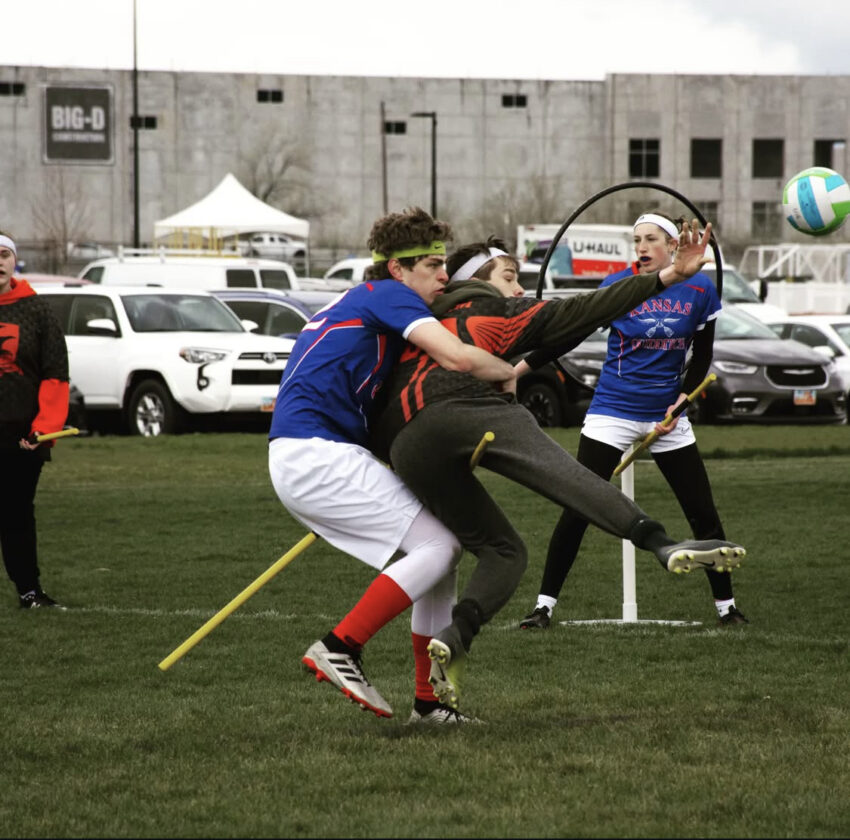
photo by: Courtesy of Blake Moore
Jacob Bradford, left, prevents his opponent, right, from catching a quadball at a tournament in Salt Lake City, Utah, on Saturday, Aug. 20, 2022. Bradford’s job as the keeper is to prevent opposing players from scoring on his team’s hoops.
How is quadball played?
A quadball field spans roughly half the dimensions of a football field, with three hoops on each end. Each hoop sits atop a post, and they vary in height at 6 feet, 4.5 feet and 3 feet.
The game is played by two teams of seven players, all of whom are equipped with broomsticks. While the broomsticks don’t actually fly, they are an essential part of the game. They are 40-inch plastic or fiberglass poles, and the rules say they must stay between a player’s legs at all times while the game is being played.
There are four balls in play at all times: one volleyball and three dodgeballs. The volleyball is called the quadball or the “quaffle,” and it can be thrown through any of the three hoops for 10 points. The dodgeballs are also known as “bludgers,” and they are used to temporarily knock opposing players out of the game.
The rules divide the players’ roles into four distinct positions: one keeper, one seeker, two beaters and three chasers. Each position wears a different color of headband: the keeper wears green, the seeker yellow, the beaters black and the chasers white.
• The chasers and the keeper: The chasers are responsible for getting the quadball through the hoops, and the keeper is basically a goalie who protects the team’s hoops against the opposing team’s chasers.
• The beaters: The beaters’ role is to throw the dodgeballs at opposing players to knock them out of the game. Any player hit anywhere on their body by an opposing beater’s dodgeball must immediately drop whatever ball they were holding and return to their side’s hoops. Only once they’ve reached the hoops are they allowed to rejoin play.
• The seeker: Just like in Quidditch, quadball has a golden snitch — but it looks a little different on the real-world field. In the books and movies, the snitch is a tiny, enchanted ball that moves randomly around the field. But in quadball, the snitch is actually a neutral player called the flag runner. They join the game about 20 minutes in, dressed in golden shorts, and run around the field trying to avoid the seekers. The flag runner has a flag attached to their uniform with a tennis ball tucked into the end of it, and it’s the job of each team’s seeker to chase the runner down and pull off the flag.
In fictional Quidditch, the snitch is worth a whopping 150 points, which virtually guarantees that the team that catches it will win. It’s not that lopsided in quadball, but the snitch still provides a significant advantage. If a seeker manages to pull the flag, their team scores 30 points.
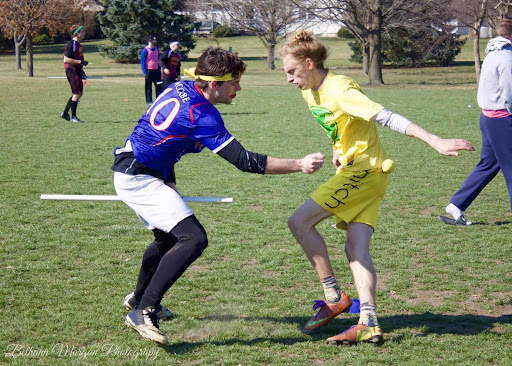
photo by: Courtesy of Blake Moore
James McCobe, left, tries to grab the snitch off the flag runner, right, at a tournament in Tulsa, Okla., on Tuesday, August 22, 2023. McCobe’s job as the seeker is to capture the snitch, winning 30 points for his team.
Another feature that distinguishes quadball from other sports is that it is played to a target score. After 20 minutes of action, the target is set at 60 points higher than the leading team’s current score. For instance, if after 20 minutes, Team A has a score of 40 and Team B has a score of 20, the target score would be set at 100. Once the target score is set, the first team to reach it is declared the winner.
Quadball’s influence at KU
The Kansas Quadball club has been active since 2010, and it’s given thousands of students the chance to play this game that’s unlike anything else in sports.
“There’s no other sport like it, or even close to it,” KU junior Blake Moore said. “The inclusivity makes it fun and a safe space to express yourself.”
The club holds practice sessions two times a week and travels to various tournaments throughout the year, with some competitions as far away as California. Moore, who has been part of the team for two years, enjoys not just the practices and games, but traveling with the team as well. It allows him to slow down and enjoy the camaraderie of the group, he said.
“We had a tournament in Indiana one Saturday, and we all crammed into one car for an overnight drive,” Moore said. “It was a bit crazy, but I enjoyed the time I spent with my friends.”
There’s definitely a lot of work involved, too, to become comfortable with the fundamentals of the game and its unique rules. KU graduate Eva Ruiz-Chavez, the previous club president, said practices were all about helping the recruits learn and adapt to the game’s unique playing style.
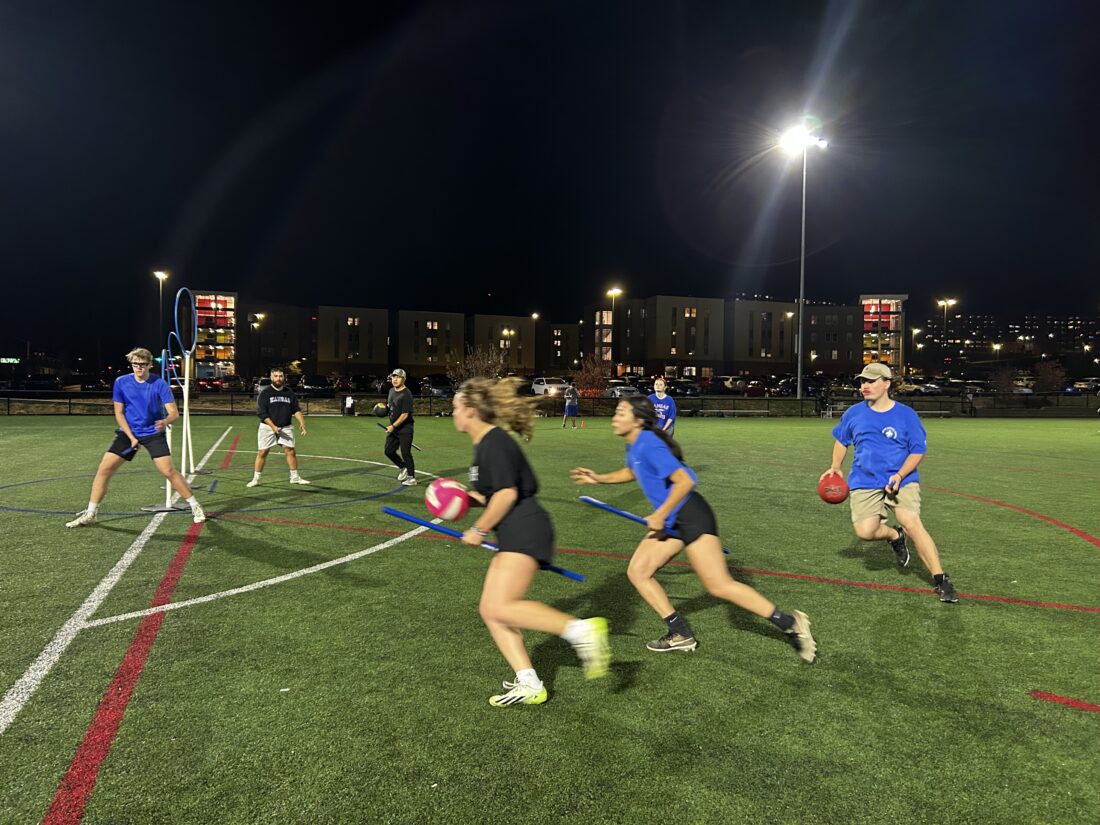
photo by: Courtesy of Blake Moore
Members of the Kansas Quadball club chase after each other during one of their practices at Central Field in Lawrence on Thursday, Sept. 12, 2024. The club practices twice weekly, working on the fundamentals of the game.
“I’d always make sure we focused on the basics, such as passing, endurance and communication, because it’s hard to succeed without the fundamentals,” Ruiz-Chavez said. “It’s difficult to pick up within the first couple of days, but once you get out on the field, it gets easier.”
Now that she’s graduated, Ruiz-Chavez misses taking part in the club, but the friendships she formed through quadball are still there.
“It’s a close-knit sport, and you begin to get familiar and become friends with people in other states and clubs,” Ruiz-Chavez said. “I still have connections with people after graduation, and one of the friends I made even helped me get a job interview.”
Numerous other universities in the region, including Creighton, Colorado, Missouri and Oklahoma State, have their own quadball clubs and frequently compete against Kansas Quadball. As the current president, Klaassen is tasked with planning practices and events, setting up fundraising, and, most importantly, recruiting new players.
Finding new players is especially important, he said, because quadball is a true team sport.
“Without your teammates, you can’t do anything,” Klaassen said. “It’s a great community to be in, because it’s not like other sports where one person can take over a game. You have to work as a team if you want to win.”
While some may doubt the appeal of a sport that was inspired by a fantasy world with talking snakes and sentient trees, Klaassen and his teammates believe that giving it a chance can turn skepticism into enthusiasm.
“It’s all-inclusive, played around the world, and I’ve met some of my best friends from joining the club,” Klaassen said. “I think everyone should give it a try.”
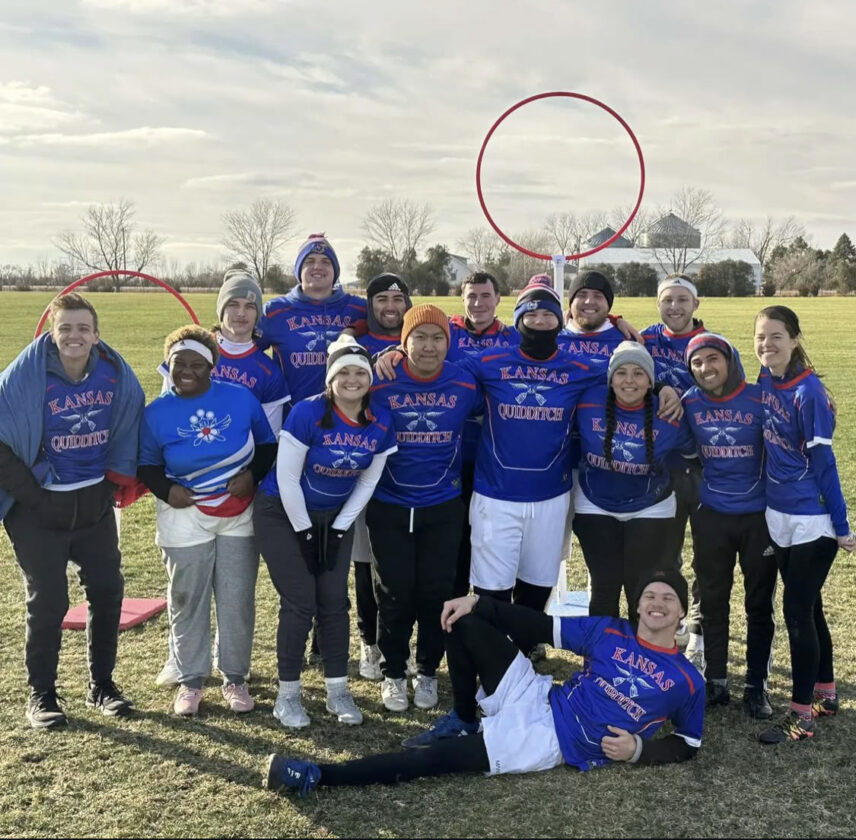
photo by: Courtesy of Blake Moore
The Kansas Quadball club poses for a group photo after a tournament in Marion, Iowa, on Sunday, Nov. 13, 2022. The club played six games in two days in 30-degree weather.
KU

KU researcher excited to bring prestigious NASA fellowship to university as way to mentor students, expand research opportunities

Local vendors can apply now for KU’s new monthly on-campus market, Jayhawk Fridays

KU professor, current interim leader, first finalist for journalism school dean position

U.S. Supreme Court Justice Sonia Sotomayor to visit KU next month; will speak to students, select guests

KU researcher wins the university’s first-ever NASA Hubble Prize Fellowship for study of faraway planets
