This day in Jayhawk history: 10 years ago, 3 overtimes
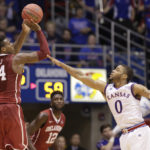
photo by: Nick Krug
Kansas guard Frank Mason III (0) defends against a three from Oklahoma guard Buddy Hield (24) during the second half, Monday, Jan. 4, 2016 at Allen Fieldhouse.
The game lasted 55 action-packed minutes, but one of its lasting images manifested itself well after the final buzzer.
When Oklahoma guard Buddy Hield, fresh off one of the greatest performances ever recorded by a Kansas opponent at Allen Fieldhouse, concluded his postgame interview on the ESPN broadcast and prepared to depart James Naismith Court, a throng of late-departing KU fans gave him a standing ovation.
“He deserved it,” KU’s Perry Ellis said at the time.
Such was the gravity of Hield’s spectacular showing that day — 46 points on 13-for-23 shooting, eight rebounds and seven assists. Outside of Hield and Kevin Durant in 2007, opposing players don’t often get that sort of treatment from the discerning Jayhawk fans.
But even as Hield matched the record for points by a KU foe inside Allen Fieldhouse, and OU set a new mark for points by an opposing team in the vaunted building, the Jayhawks had a set of heroic performances of their own from the likes of Ellis, Devonte’ Graham, Frank Mason III and Wayne Selden Jr., and emerged with a 109-106 victory in triple overtime — 10 years ago today, on Jan. 4, 2016.
(This is the first installment of a new series that will highlight prominent moments from KU’s history on their anniversaries, complete with recollections from at least one Jayhawk involved.)
The legendary game, of course, does not require much historical reevaluation. Its greatness was so eminently apparent that ESPN broadcaster Brent Musburger called it “a classic that will live forever” before the telecast had even concluded. It was one of just five battles featuring No. 1 vs. No. 2 in which KU has participated over the course of its history and one of just five games to go at least three overtimes.
“If we’d have lost the game, I would have walked into the locker room and I (would have) said, ‘You know, you’ll never forget this one, and this would be a proud one to be a part of,'” KU coach Bill Self said afterward. “But we beat a team that can win a national championship tonight.”
What happened before
The Jayhawks were 12-1 with a 28-point win over No. 23 Baylor in their Big 12 opener two days earlier; the Sooners were 12-0, having just slipped past No. 11 Iowa State, 87-83.
That, along with No. 1 Michigan State’s loss to Iowa, set the stage for the biggest possible Big Monday: a game in which KU ranked No. 1 in the AP poll and OU ranked No. 2 (and, by the way, the Sooners were No. 1 ahead of KU in the coaches poll). Such a matchup had not occurred since 1990.
“It’ll be ridiculous, and it should be,” Self said at the time.
The Jayhawks and Sooners had engaged in some prominent battles over the years — most notably in the 1988 national title game — but OU hadn’t won in Lawrence since 1993.
Ten months earlier, in the previous matchup between the two teams, KU was down three key players on the road but tied the game late thanks to clutch free throws by Mason. However, Hield tipped in a miss by Jordan Woodard to win the game with 0.2 seconds remaining.
By the time Hield came to Lawrence on a fateful January night in 2016, he had already put up four 30-point games on the season and was averaging 24.7 points while shooting 49.4% from deep.

photo by: Nick Krug
Kansas forward Landen Lucas (33) wrestles away a ball from Oklahoma guard Jordan Woodard (10) and tosses it to Kansas guard Devonte’ Graham (4) late in the third overtime, Monday, Jan. 4, 2016 at Allen Fieldhouse.
What happened
Hield made the game’s first bucket from beyond the arc, but KU used 3s of its own from Graham, Selden and Brannen Greene to jump ahead early. The Jayhawks led by as many as 11 points at 32-21 after a three-point play by Mason and Greene’s second 3.
KU did not close the half well. With the Jayhawks ahead 40-32 inside of two minutes, OU connected on three straight 3-pointers — one from Hield, two from Woodard — and then Mason got whistled for a foul trying to take the ball away as Hield went for a stepback in the final seconds. Self incurred a technical foul arguing the call, and Hield made three of four free throws.
The Sooners’ newfound lead grew ever larger after the break, as large as 10 thanks to eight quick points by forward Ryan Spangler. KU spent much of the second half trying to erode OU’s margin. Selden played a significant role with a vicious dunk and a 3-pointer that immediately answered one by Hield. After Spangler’s dunk put the Sooners back up 68-60 with eight minutes to go, KU responded with eight straight points, capped off by Selden’s layup off a spinning feed by Mason in transition.
Ellis, who eventually finished as KU’s leading scorer with 27 points, was responsible for some of the game’s most significant buckets. He put back his own miss to tie the score at 75 with 1:23 remaining, then hit a hook shot on the baseline to briefly put the Jayhawks ahead in the final minute, before Hield responded with two free throws.
The game could have ended in anticlimactic fashion when Mason missed a tough shot at the rim and Landen Lucas got called for an over-the-back foul, but Khadeem Lattin hit the back rim with his free throw.
In the first overtime, OU went up five points on a right-wing 3 by Hield, but Graham pulled up for a jumper and then the Sooners left Ellis uncovered for the tying 3. Selden hit the front rim on a potential game-winner at the buzzer.
The second featured an early 3-point barrage that gave way to an erratic remainder of the period. Once again KU had the ball in its hands in a tie game, but Mason came up empty on a pull-up in the lane.
The third overtime went back and forth. Selden hit a 3 through a foul to open the period, although he did not complete a four-point play. Lattin, the grandson of David Lattin (the center who helped Texas Western beat KU and eventually win the title in the 1966 NCAA Tournament), played a key role, tying the game at 98, generating a second-chance opportunity for a 3-pointer by Hield and then putting OU ahead 103-102.
Selden muscled his way in to give the Jayhawks the lead back, but Woodard immediately knocked down another 3.
Mason drew a foul, but made just one of two free throws. He redeemed himself in short order, swiping the ball from Hield as the star guard attempted to spin through the lane, setting up Graham to get fouled in transition and make two shots from the line. Then Mason deflected Hield’s inbounds pass, grabbed the ball and sank two free throws of his own.
After Ellis ripped the ball from Ryan Spangler on the final play, Hield had to take the last shot, a wild effort launched over Mason that hit the backboard and rattled out.
His 13 points across multiple overtimes are still the most ever by a KU opponent, but he would have needed three more to keep the game alive.
What happened after
Even amid some postgame grumbling about officiating — and specifically whether Mason may have been too close to Hield as he defended the late inbounds pass — the game generally inspired awe from viewers and commentators around the country.
“I don’t know that I’ve been in one better,” OU coach Lon Kruger said afterward. “It was terrific. We would’ve much preferred the satisfaction of winning a game like that … Happy about our guys’ effort. Proud of ’em. Just disappointed couldn’t quite feel that satisfaction.”
The Sooners never felt that satisfaction at Allen Fieldhouse. They lost there an additional eight times before departing for the SEC in 2024.
As for those 2015-16 teams, they met one more time six weeks later at the Lloyd Noble Center. At that point KU was No. 6 and OU No. 3, and the result was again in the Jayhawks’ favor, 76-72, behind 27 points by Graham, who helped limit Hield to a less efficient 24 in the rematch.
The Jayhawks hit their stride down the stretch, didn’t lose another game for the rest of the season after beating Kentucky in another overtime thriller and entered the tournament as the No. 1 overall seed, only to lose to Villanova in the Elite Eight as the Wildcats limited the second-team All-American Ellis to four points and five rebounds in his final game. OU, meanwhile, beat its own bracket’s No. 1 seed, Oregon, to reach the Final Four and then lost by 44 to that same Villanova team in the national semifinal. The Sooners have not made it out of the first weekend since.
Hield, for his part, went sixth overall in the 2016 NBA Draft and is currently in the midst of his 10th NBA season. He crossed paths with KU in 2023 when training with the Bahamas national team; he scored 18 points in 16 minutes against the Jayhawks in the first half of one exhibition and then joined the KU radio broadcast for the second half. Then, in a second exhibition, he scored 19 with five 3s in three quarters as the Bahamas avenged a previous defeat and beat the Jayhawks 87-81.

photo by: Nick Krug
Kansas guard Wayne Selden Jr. (1) is fouled by Oklahoma guard Buddy Hield (24) on a three during the third overtime, Monday, Jan. 4, 2016 at Allen Fieldhouse.
Eyewitness account
How often Selden hears about this game when he talks to KU people, he says now, “depends on how the team’s doing that year, because if the team’s doing really well they don’t think too much in the past.”
But when they do contemplate years gone by, this game is one of their most salient memories.
“It’s kind of the pinnacle of the fieldhouse, you know what I mean?” Selden told the Journal-World on Saturday. “We played in there a bunch of times, but I think that was at the 10 of 10 of playmaking, 10 of 10 of the crowd, the defense was there — to think that Frank probably played the best defense ever in a 46-point game, whatever Buddy had.”
As much praise as Selden had for Mason’s defense in retrospect — and he had plenty — he also characterized the epic battle as one in which each Jayhawk got his chance to shine, got to carry out an “individual story.” That included players like Ellis, Graham and Mason, but also Jamari Traylor, who provided a key energy surge after starting the second half with fierce blocks and a couple of key buckets.
“That was finally all of us kind of hitting on all cylinders,” Selden said.
As for Selden himself, whose share of contributions included the big second-half dunk, the tying transition lay-in and the 3-pointer through a foul in the third overtime, he said he felt he was “under really good control” at that time.
“That was kind of me coming into my own in maturity level when it comes to basketball,” he recalled.
Of course, for weeks afterward, despite the outcome, Selden still thought back to the open 3-pointer he missed at the buzzer in the first overtime: “If I would have just hit that…” That’s despite the fact that in the moment, when he missed, he only gave himself about 10 seconds to be mad before moving on to the second overtime period that immediately followed.
By the way, Selden had a front-row seat for Mason’s final deflection on Hield’s attempt at an inbounds pass — he was trying to guard Isaiah Cousins as Hield looked to lob him the ball. (“I don’t really want the ball to go to him but I’d rather the ball go to him than Buddy.”) He said he had no doubt that Mason gave Hield sufficient room to make the pass.
“He had plenty of space,” Selden said. “What are we talking about? We didn’t design the fieldhouse. That’s how it is.”
Asked after the game at what point he realized it was going to be a classic, Self had said that at about the two- or three-minute mark in regulation, he looked down toward the OU bench and saw the Sooners smiling and thought, “God, there’s some kids out there playing their tails off and making play after play.” For those out there making the plays, Selden says now, it didn’t dawn on them how memorable the game would soon become until afterward.
Selden earned second-team all-conference honors that season, declared for the draft and ultimately appeared in 124 NBA games for three teams. Over the course of his college and NBA careers, he only played 43 or more minutes — as he did that fateful day against OU — three times.
“We were young,” he said. “We could have played another five overtimes. We were saying after the game, ‘I could have kept going.’ That didn’t play a factor at all, actually.”
But to think that it was 10 years ago now…
“We’re getting old, that’s all that is,” Selden said. “We’re getting up there. It’s pretty cool, though, to kind of see clips of it and things like that.”
KU Men's Basketball
This day in Jayhawk history: 10 years ago, 3 overtimes
Longtime KU academic advisor ‘Scooter’ Ward dies
‘We’ve got to have that to be good’: KU doesn’t produce in post against UCF
No. 17 KU falls short at UCF, 81-75
Preview: Big 12 play begins away at UCF