What we learned from the first three episodes of Paramount’s KU basketball documentary
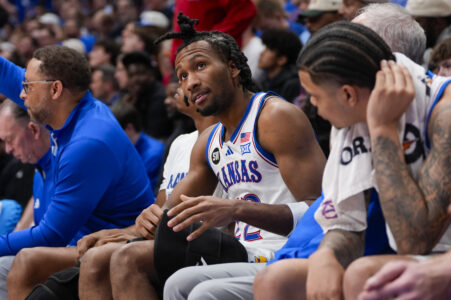
Kansas guard Darryn Peterson (22) watches from the bench during the second half on Saturday, Jan. 31, 2026 at Allen Fieldhouse. Photo by Nick Krug
The third episode of Paramount+ documentary series “Made for March” concludes with Kansas coach Bill Self sitting around a table at Johnny’s Tavern with several of his key players, discussing the importance of getting the Jayhawks aligned heading into the final stretch of the season.
The depiction of that final stretch — which, spoiler alert, ended in anticlimactic fashion for KU with a second-round loss to St. John’s on a buzzer-beater — will have to wait until the fourth and final episode of the show releases on April 18.
In the meantime, the series has depicted KU’s men’s basketball season (as well as Michigan’s) via essentially a series of vignettes centered on notable games throughout the year — the Players Era tournament, BYU, Arizona, Houston and more.
Along the way, it has shed light on some significant elements of the year.
• Self had promised in a CBS Sports interview about the documentary in early March that it would include scenes of him with his family, one way in which he provided the crew virtually unprecedented access. The first and second episodes do indeed place a significant emphasis on Self’s personal relationships, including his desire to spend time with his grandchildren in a way he admits he didn’t always with his family earlier in his career.
In the first episode, the documentary crew asks him how he has navigated balancing basketball and family and he says he has “done a poor job with that line.”
“I feel like my family has benefited from me being a coach because they’ve been exposed to so many great and cool things — the teams, the travel,” Self says. “But it’s a 12-month, seven-day-a-week job for the most part, and too much of my family time involves my job. Even though I spent time with them, I still think I shortchanged them. I can make that excuse that ‘Well, there’s good reason for it.’ But the reality of it is, can’t get that time back. So I’m really looking forward to not making that mistake with my grandchildren.”
Needless to say, that topic took on added resonance in recent days in the wake of the 10-day period of uncertainty following the conclusion of KU’s season in which it wasn’t clear if Self was going to stick around for a 24th year at the helm, as he said he wanted to visit and discuss with his family in light of his recent health issues. (He ultimately announced his return on Wednesday.)
• Those issues also receive plenty of airtime in the second episode of the documentary.
“My family sees Kansas University, the basketball program, as prestigious and as good a job that their father/husband can possibly have,” Self says in the episode. “They think it’s great. They think it’s big time. But at the end of the day it’s still just a job. Their concern is not the job, their concern is just making sure dad’s OK.”
Self describes the circumstances that led to his unexpected absence from KU’s game at Colorado on Jan. 20 in similar terms to how he did publicly at the time: “The day before we played Colorado, we quit practicing, and when I got up the stairs, I’m like going, ‘Something doesn’t feel right.’ I go downstairs and I have them check me and my heart rate was really, really racing. And I’m thinking, ‘What do I do? I’m supposed to get on a plane in 30 minutes with my team.'”
The documentary then interpolates the audio from the 911 call to Allen Fieldhouse for chest pains that resulted in Self’s hospitalization. Self downplays that bout with atrial fibrillation somewhat by noting that “a lot of people have it, so it’s not the biggest thing in the world.”
But his prior hospitalization last July, he says, was a “whole different story,” one in which he was on the golf course and suddenly thought he was having a heart attack.
As Self said at the time, he made some changes to his diet and exercise in the wake of that episode. The documentary features a scene in late January in which Self is with his family and eats his first piece of pizza in six months.
“It’s no way to live,” Self says, to which his daughter Lauren Browning responds, “That actually is the way to live.”
• Evidently, weeks or months before Darryn Peterson spoke to several reporters in the locker room after KU’s Big 12 tournament win over TCU about his severe cramping episode prior to the season, he had recounted it to the “Made for March” documentary crew.
He explains that a couple days after the conclusion of KU basketball’s September conditioning boot camp, he “hit a freshman wall” at practice.
“And then I had, like, a full-body cramp, like I thought I was about to die,” Peterson says. “My legs was stuck straight, I couldn’t bend them. My arms, my back, my stomach, everything was just cramping up. They had to call 911, all types of stuff, like get an IV.”
Self said that it was “a big deal, one that made him very nervous, and in turn made us nervous too.”
“I’ve always thought, ‘Oh God, everybody gets those,'” Self said. “‘You know, I can get a cramp at night.’ This wasn’t one of those (types) of cramps. I had never seen anybody experience what he went through for that period of time, and it was scary because this young man was hurting.”
Peterson, of course, went on to deal with periodic cramping issues, along with a couple of other various injuries, until mid-February, before he played nine full games to close the season.
By the way, elsewhere in the documentary, Self describes Peterson’s first-half performance against BYU as “the best I’ve ever seen a kid play in Allen Fieldhouse.”
• The series’ extensive coverage of that BYU game includes a bit of time spent with KU and NBA great Paul Pierce, who visited Allen Fieldhouse for the first time since 2011. It includes a brief speech he gave to the Jayhawks at practice ahead of the game.
“I done played around the world in so many different arenas, man,” Pierce says. “Ain’t no place like this, man. You wear a jersey every day — treat that like a badge of honor. This is a badge of honor you’re wearing, really. You know what I’m saying? This stays with you the rest of your life.
“So I just want y’all to treat it like that, protect this house. This is what it’s all about because you don’t get these opportunities like this often, because once you leave here, it ain’t going to be no arenas like this.”
KU Men's Basketball
What we learned from the first three episodes of Paramount’s KU basketball documentary

Documentary series featuring KU basketball premieres on Saturday
Report: Bidunga to enter NBA Draft, transfer portal
Self announces he will continue as KU coach

Future Jayhawks represent KU in McDonald’s All-American Game