Fall sports preview: KU football hoping for resurgence with new talent, new quarterback
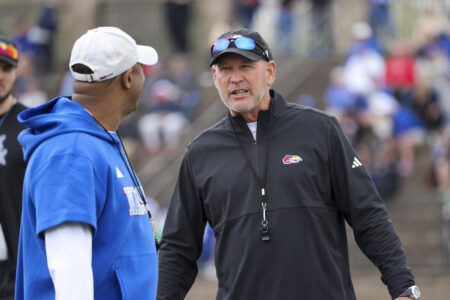
photo by: Kahner Sampson/Special to the Journal-World
Kansas head coach Lance Leipold walks through warm ups during KU Football's spring practice at Lawrence High School on Saturday, April 11, 2026 in Lawrence.
The margin between unprecedented success and undistinguished stagnation has proven very thin for the Kansas football team.
Not so long ago, the Jayhawks were riding high coming out of the 2023 season with consecutive bowl appearances for the first time in 15 years. What followed were consecutive near-misses.
The disappointment of early 2024 gave way to a late-season surge with three straight victories over ranked teams, only for the Jayhawks to fall one game short of a bowl at 5-7. They then found their way to that same record in 2025 by reaching five wins on the first day of November and lost three straight to conclude the season, including some of the most agonizing defeats of head coach Lance Leipold’s tenure against Arizona and Utah.
“We’ve had some opportunities, probably well documented, some close losses, that easily put us that we could be sitting up here talking about four consecutive bowl games and yada yada yada,” Leipold said at Big 12 media days. “But we haven’t done that.”
After an offseason guided by a focus on increased depth at key positions — to ease the burden on top players and ideally provide less erratic late-game performances — Leipold and the Jayhawks will hope that his sixth season yields better results.
“I also know that our guys believe that we’ve put together a staff and a team this year that can be extremely competitive, to be surprising,” he said.
There are reasons to believe that KU, back in a sort of understated underdog role, can exceed expectations. Andy Kotelnicki is back after two years at Penn State, this year’s transfer class includes some of the most dynamic playmakers Leipold has had during his time in Lawrence and the Jayhawks’ multiple defense should take a notable step forward in its second year under coordinator D.K. McDonald.
But questions remain at the most important position on the field, where KU will have a new starting quarterback after six straight seasons in which Jalon Daniels started at least three games. Fair or not, the battle between Cole Ballard and Isaiah Marshall, and the performance of whoever wins the job, will come to define the 2026 season.
The year begins with Friday night home games against FCS Long Island (Sept. 4) and rival Missouri (Sept. 11). While there will be plenty of opportunities for the Jayhawks to bolster their record down the stretch as their schedule eases in the second half of the year, nothing will come easily. KU, which will play with reduced capacity at David Booth Kansas Memorial Stadium due to ongoing renovations on the east side of the venue, gave up a home game to play the Union Jack Classic against Arizona State in London on Sept. 19.
A bye week will follow that game, but then the Jayhawks will play nine straight weeks without a break, including against their remaining eight Big 12 foes (beginning at Utah and at rival Kansas State, which could make for a challenging stretch). Their depth and resilience will be tested throughout.
Below is a deeper look at each position.
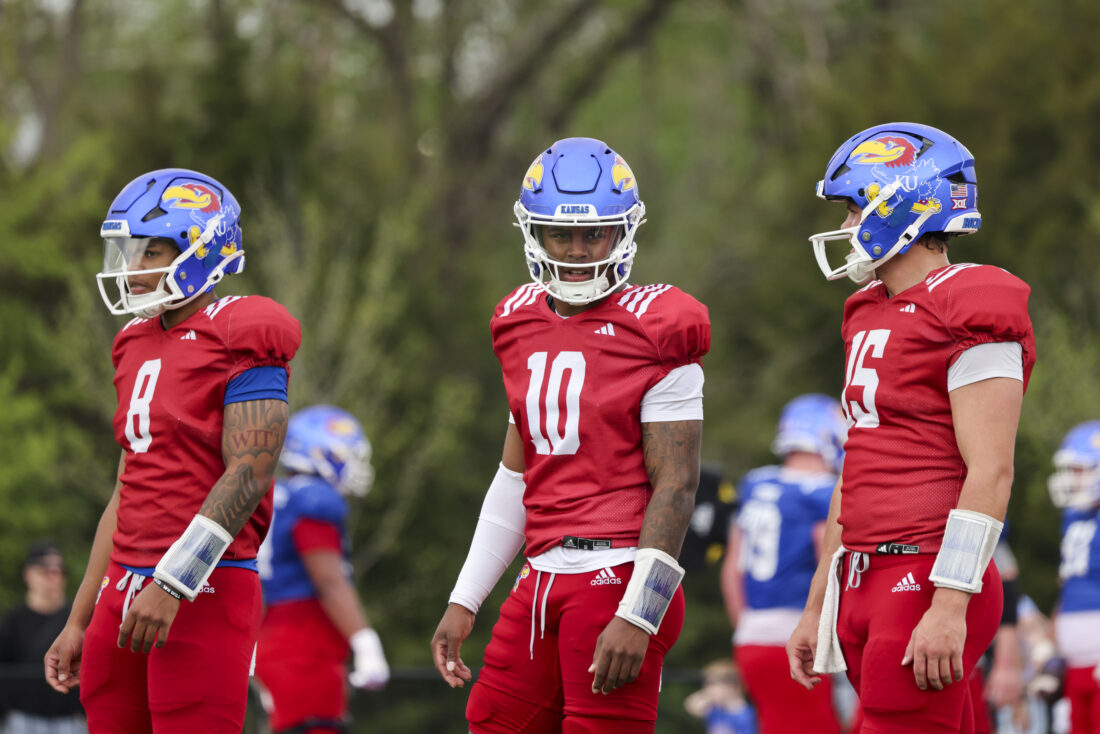
photo by: Kahner Sampson/Special to the Journal-World
Kansas quarterbacks Isaiah Marshall, Chase Jenkins, and Cole Ballard (left to right) wait to throw during KU Football’s spring practice at Lawrence High School on Saturday, April 11, 2026 in Lawrence.
Quarterbacks: Ballard is a redshirt junior from Westfield, Indiana, a former walk-on who got thrown into the fire late in his freshman year and served as Daniels’ primary backup in the years since. Marshall is a redshirt sophomore from Southfield, Michigan, a well-regarded three-star recruit out of high school whose play style drew immediate comparisons to Daniels when he arrived on campus and who accrued more than 10 yards per carry as a situational rusher in 2025.
The competition between these two will surely last well into fall camp. Whoever proves to be the superior decision-maker and the more consistent passer will get the chance to lead the Jayhawks into the season, although Leipold’s comments at Big 12 media days suggest both will have the opportunity to play regardless.
Rice transfer Chase Jenkins, a wild card who ran a spread-option offense in his final season with the Owls after briefly converting to wide receiver, seems to be on the outside looking in.
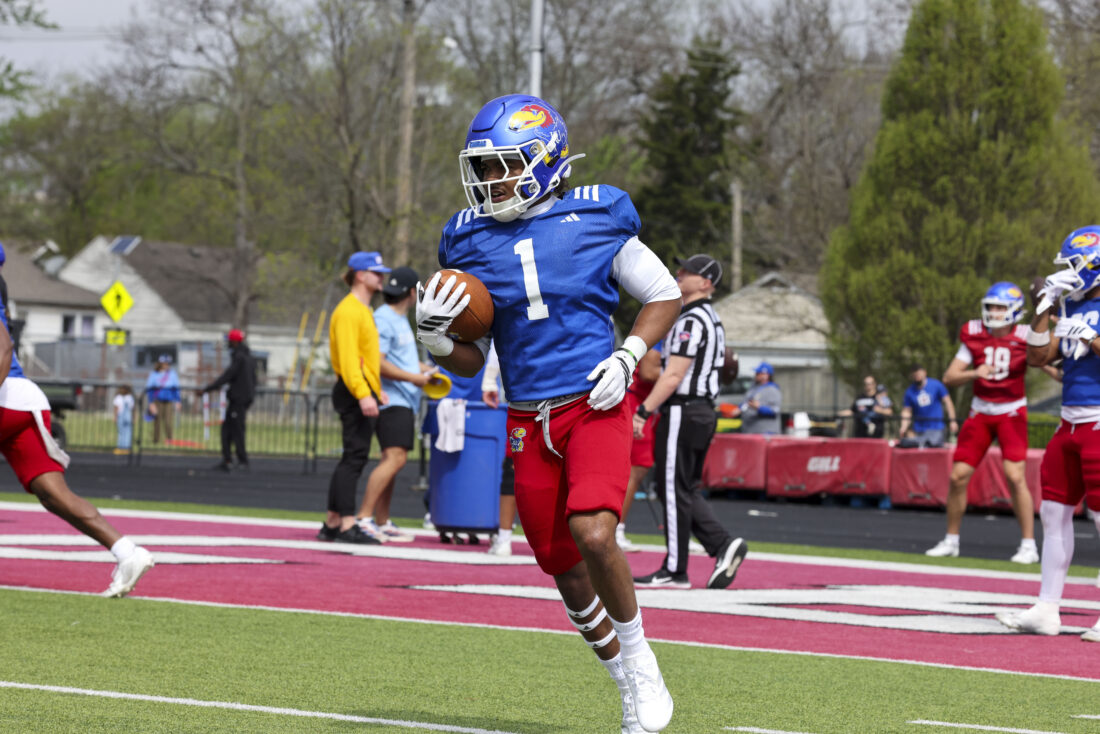
photo by: Kahner Sampson/Special to the Journal-World
Kansas running back Dylan Edwards participates in KU Football’s spring practice at Lawrence High School on Saturday, April 11, 2026 in Lawrence.
Running backs: As much talent as KU has had at this position in recent years, it has never fielded a pair of backs with the contrasting skill sets of 6-foot-1, 225-pound bruiser Yasin Willis and 5-foot-9, 175-pound blur Dylan Edwards. Willis featured at Syracuse last season with 129 carries for 558 yards and four touchdowns, while Edwards missed most of the year at Kansas State due to injury and will look to revive his career for his former rivals. Exactly how they split their touches remains to be seen, but Kotelnicki has to be thrilled at the chance to put Edwards in space and deploy him as a pass-catching threat on key downs.
Muddling matters somewhat is the presence of a third back who was his team’s leading rusher last season, Colorado State transfer Jalen Dupree, who missed the spring due to injury. While he was gone, early enrollee Kory Amachree, a freshman from Haslett, Michigan, who has received as much buzz as any rookie in Leipold’s tenure, staked his own claim for playing time this fall.
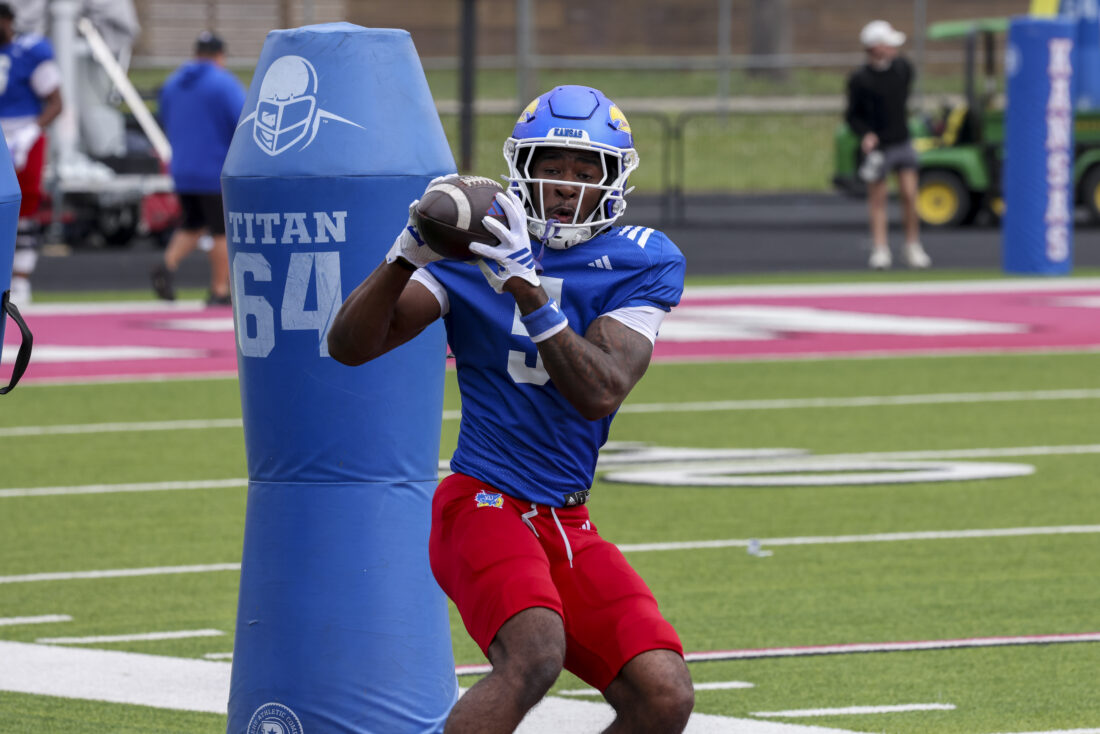
photo by: Kahner Sampson/Special to the Journal-World
Kansas receiver Nik McMillan participates in KU Football’s spring practice at Lawrence High School on Saturday, April 11, 2026 in Lawrence.
Wide receivers: It is not necessarily the deepest group of pass catchers the Jayhawks have fielded in recent years, but it is strong at the top and should make life easier for whoever starts at quarterback. The safe and familiar option in the slot will be Cam Pickett, who caught 45 passes for 476 yards and three touchdowns last year after transferring from Ball State but could perform even better with a fully healthy campaign after early-season injuries hampered him last year.
KU has high hopes for its two transfers on the outside, Nahzae Cox (Middle Tennessee) and Nik McMillan (Buffalo). McMillan is in fact a Buffalo native who had a chance to interact with Leipold’s old staff before they made the move to Lawrence. He ended up blossoming into an elite wideout who was first-team All-MAC last season after catching 62 passes for 981 yards. Cox is a contested-catch target at 6-foot-3 who worked his way up from the junior-college level to become a productive player for the Blue Raiders.
Once a true freshman who earned reps in the final year of Kotelnicki’s first stint, now a redshirt junior looking to carve out a larger role, Keaton Kubecka remains with the Jayhawks. He caught a touchdown on opening day in 2025 and showed flashes a month later against Cincinnati but never worked his way up the depth chart. Beyond him, it’s not clear who else might find a way to get seriously involved, although the slippery Tate Nagy seems poised to earn at least occasional touches on offense after acquitting himself well as a true-freshman return specialist.
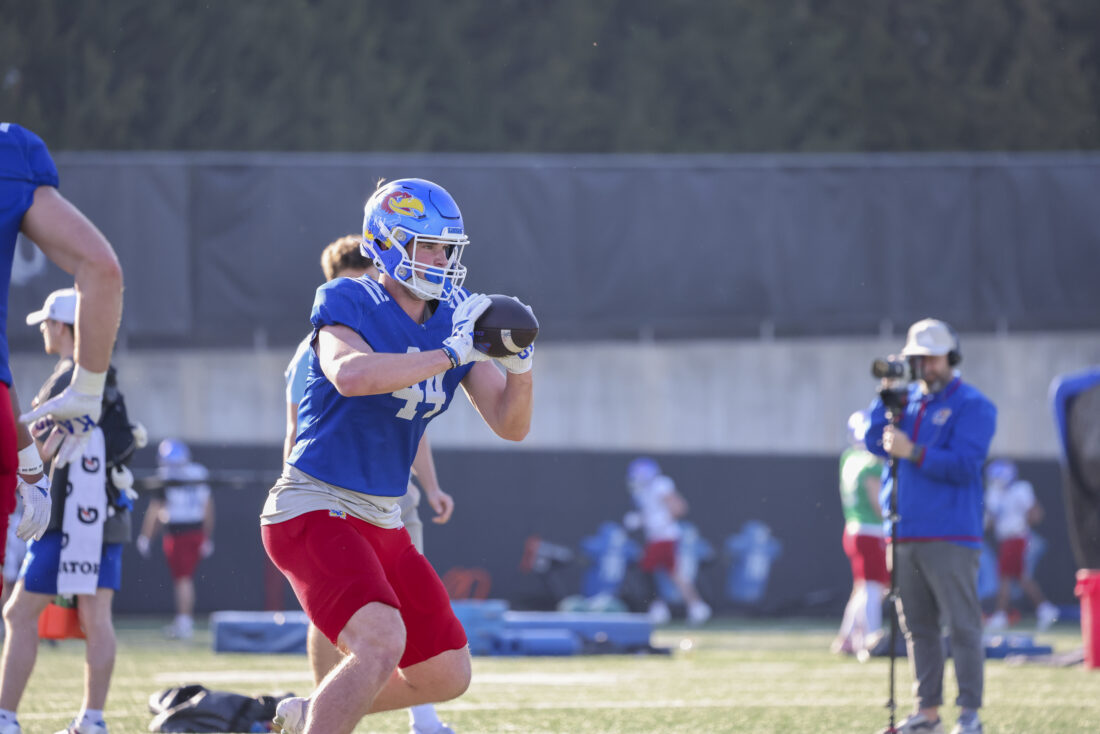
photo by: Kahner Sampson/Special to the Journal-World
Kansas tight end Carson Bruhn participates in Kansas football’s spring practice on Thursday, March 26, 2026, in Lawrence.
Tight ends: Amid a high level of play-calling turnover in recent seasons, KU has remained the sort of offense that regularly deploys as many as four tight ends. It should have little trouble continuing to do so in 2026, even if there might not be a clear No. 1 option. The closest thing to it is Carson Bruhn, an imposing 6-foot-6, 259-pound redshirt sophomore who showed promise in his first extended action but suffered a season-ending injury in October after making just five catches for 55 yards.
KU also brings back sixth-year senior Leyton Cure, who snagged his first touchdown at the Division I level in the 2025 finale. He’ll be vying for snaps with a pair of unproven but intriguing transfers. Jailen Butler is a former junior-college basketball player who started 21 games at Old Dominion but only got targeted 32 times in the passing game, according to Pro Football Focus. Carter Moses was relied on much more heavily at Albany, where he tallied 27 catches for 338 yards and three touchdowns in 2025, but hasn’t played at the FBS level until now.
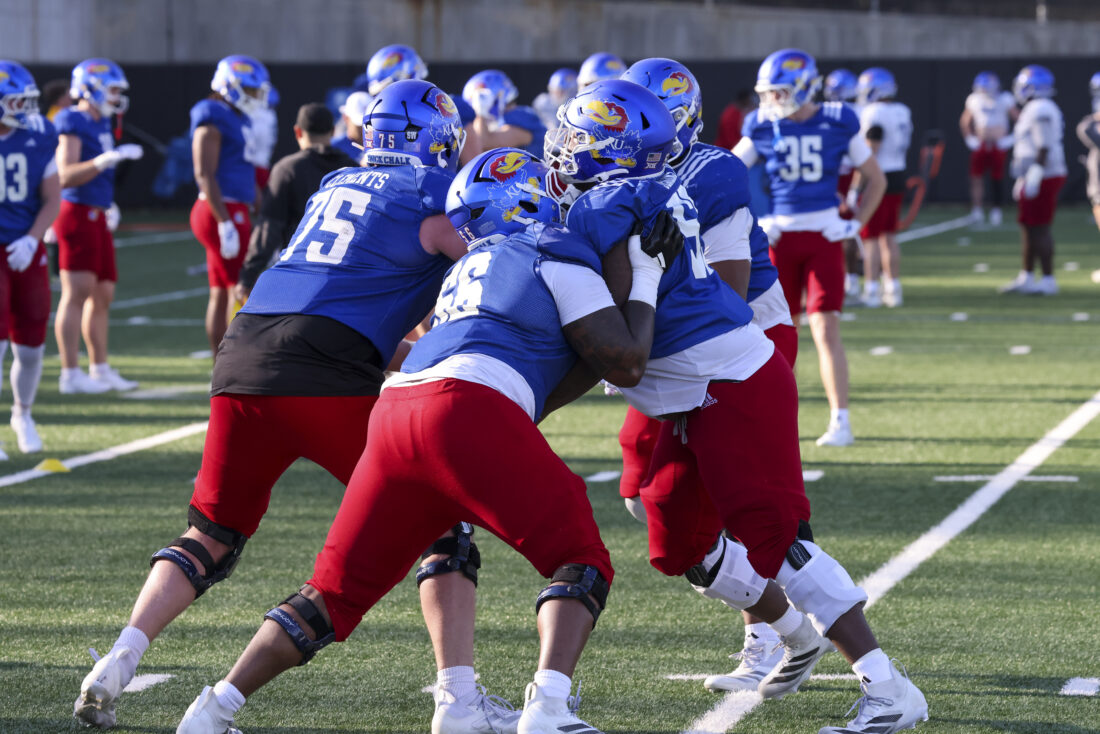
photo by: Kahner Sampson/Special to the Journal-World
Kansas offensive linemen Calvin Clements, Amir Herring, and Trezelle Jenkins Jr. (left to right) participate in Kansas football’s spring practice on Thursday, March 26, 2026, in Lawrence.
Offensive line: Position coach Daryl Agpalsa can feel confident in the left side of his line, which returns both starters in tackle Calvin Clements and guard Amir Herring. Clements, a Lawrence native, experienced some lows in his first year as a full-time starter, but improved his form by season’s end and looks poised for a leap forward as an on- and off-field leader. The former Michigan transfer Herring is now firmly ensconced as a starter after winning a job in camp last fall.
Two more spots along the line will be filled by members of this year’s transfer class. After Bryce Foster’s apparent successor Tyler Mercer left for Oklahoma State to play for his former North Texas coach Eric Morris, the Jayhawks responded by grabbing an OSU center, Kasen Carpenter. Anderson Kopp will back up Carpenter in the middle. Over at right tackle, Nick Morrow will adapt to a new angle after two years as Cal’s starter on the blind side.
Uncertainty remains at right guard, where returning reserve Tavake Tuikolovatu will battle Texas transfer Connor Stroh, although both will surely rotate during the season regardless of the eventual outcome.
Jack Tanner and Missouri transfer Brandon Solis are next up at tackle.
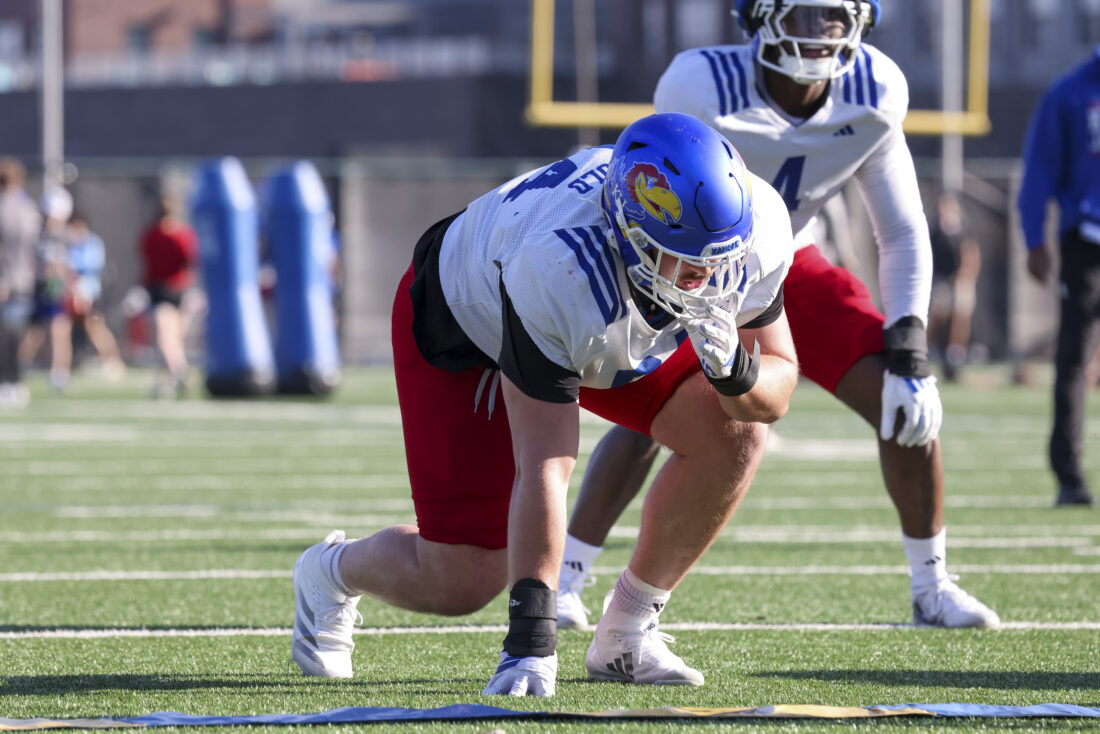
photo by: Kahner Sampson/Special to the Journal-World
Kansas defensive tackle Blake Herold participates in Kansas football’s spring practice on Thursday, March 26, 2026, in Lawrence.
Defensive line: The Jayhawks have had another offseason to adapt to McDonald’s deployment of multiple fronts and bring in the requisite personnel to smooth that transition. In the meantime, they have also cultivated some budding stars.
Blake Herold, now a redshirt junior, has risen to become one of the top players on KU’s roster. The understated tackle from Shenandoah, Iowa, is growing into a more vocal presence, which is much more important now that the Jayhawks have graduated longtime fixtures at his position like Tommy Dunn Jr., D.J. Withers and Kenean Caldwell. Herold has consistently served as one of KU’s top pass rushers despite playing on the interior and is no slouch against the run either.
His classmate Marcus Calvin cracked the rotation for the first time in 2025 and has a chance to play alongside him a lot more when KU runs its four- and five-man fronts this year. Exactly how much that will happen depends on the Jayhawks’ transfer additions.
Redshirt senior Tre’von McAlpine was one of KU’s earliest acquisitions in the winter, a former second-team all-conference nose tackle for College Football Playoff participant Tulane. But a springtime ACL injury knocked him out for the season. Eamon Smalls made 50 tackles at UAB last season and is a lock for a big role, while Jibriel Conde (Grand Valley State) and the young Kevin Oatis (Arkansas) will surely get their own chances in McAlpine’s absence.
At defensive end, KU has plenty of reason for excitement. Last year, Leroy Harris III came out of nowhere — or more accurately Chattanooga — to lead the Jayhawks in sacks and pass deflections. Even now that he’s up to 270 pounds, Harris has the agility to excel as an outside rusher and drop into coverage if needed. His junior season should provide him a chance to become a big name in the Big 12. Run-stopping strong-side end Alex Bray had a quiet first season at KU, but his stock has risen in the offseason ahead of his senior year — and he’ll have one more season to play past 2026 due to new eligibility rules.
The depth is strong too, with former well-regarded recruit Dakyus Brinkley having come on strong late in 2025 and Michigan State transfer David Santiago poised for significant snaps based on his ability to play on either side of the line.
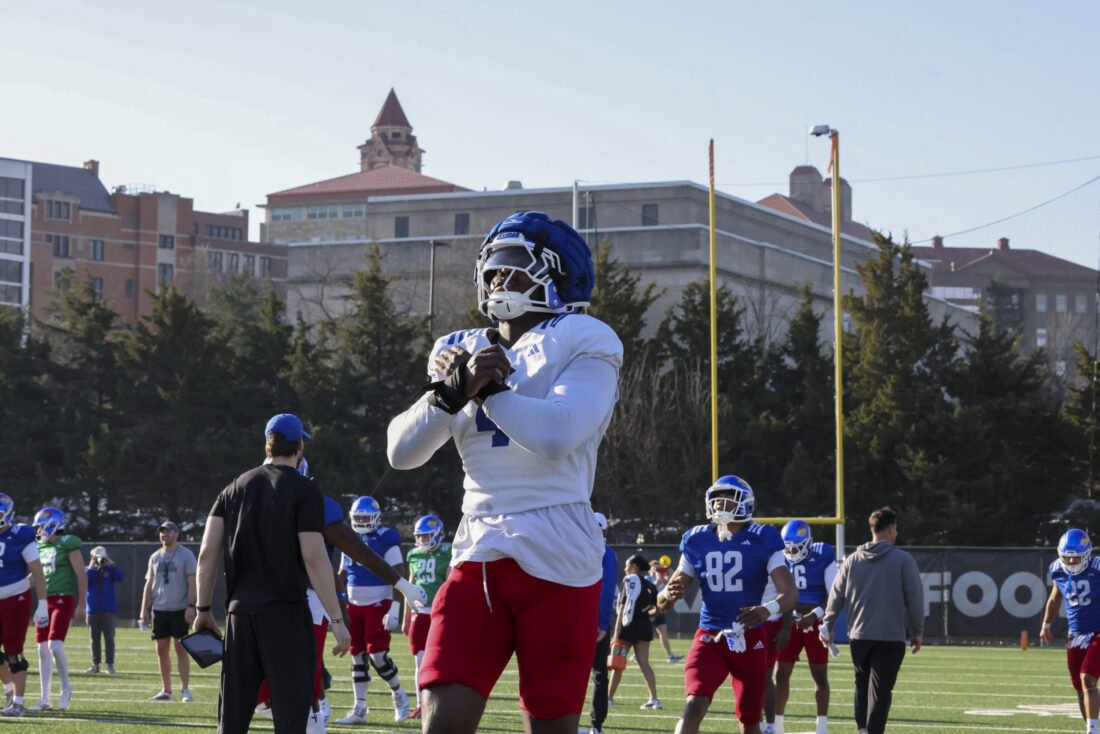
photo by: Kahner Sampson/Special to the Journal-World
Kansas linebacker Trey Lathan participates in Kansas football’s spring practice on Thursday, March 26, 2026, in Lawrence.
Linebacker: It might have been a totally fresh start for KU at this position had Trey Lathan not reversed course and opted to return to Lawrence rather than enter the transfer portal. KU’s leading tackler, who played more defensive snaps than any other Jayhawk in 2025, ultimately decided he wanted to reap the rewards of a second straight year in the same scheme.
Injuries plagued the linebacker room last year and made it difficult for the Jayhawks to remove Lathan from the field at any point. In revamping the room, KU acquired many transfers. Quincy Davis, a rotational player at New Mexico State, proved to be one of the surprises of the spring as he adapted quickly and showed he has a nose for the football. He’ll play extensively, as will Bam Crouch (Boston College); KU has to figure out the right combination of two players — McDonald primarily runs a 4-2-5 — which could end up being Crouch alongside Lathan with Davis the first option off the bench at either spot.
Jibreel Al-Amin and Jaron Willis bring athleticism and SEC experience, respectively, and Malachi Curvey, well liked by KU’s coaching staff, returns as a redshirt freshman after spot duty on special teams in 2025.
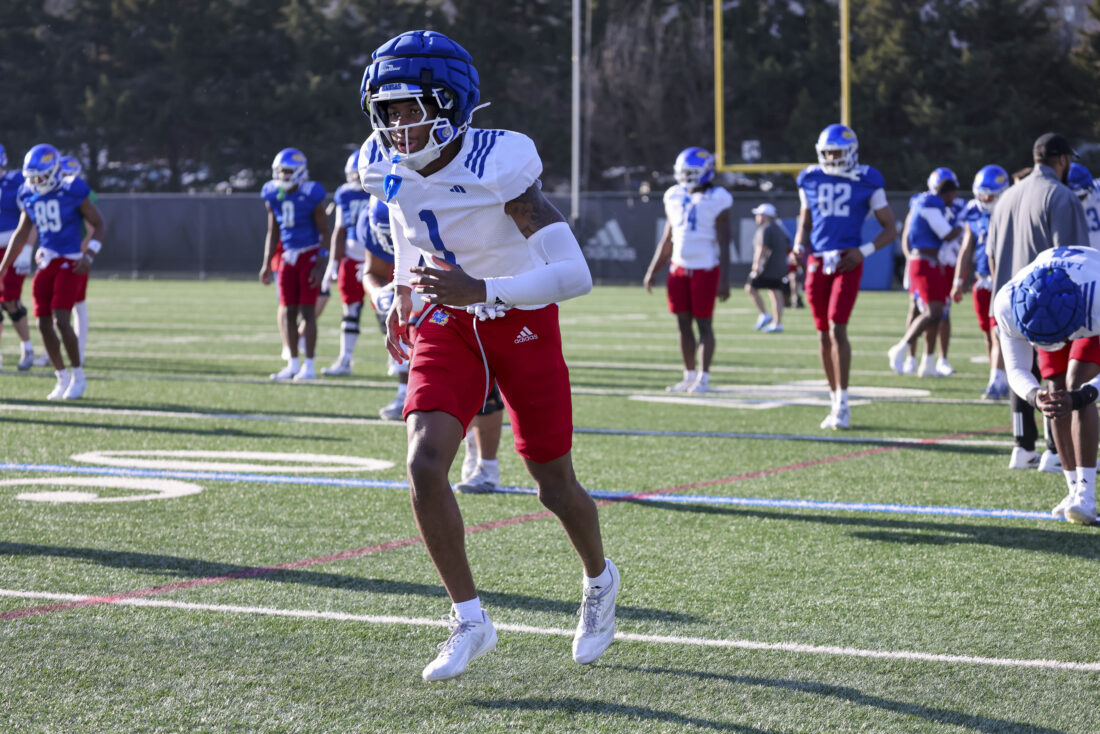
photo by: Kahner Sampson/Special to the Journal-World
Kansas cornerback Jalen Todd participates in Kansas football’s spring practice on Thursday, March 26, 2026, in Lawrence.
Cornerback: Jalen Todd and Austin Alexander took their lumps while starting as a true sophomore and a redshirt freshman, respectively. Todd was solid, but he had to spend some of the year playing nickel due to injuries at that position; he should be able to more comfortably return to the outside as KU’s top corner. Alexander was a bit more erratic, both as a tackler and in coverage.
Exactly how the rest of KU’s corners will figure in is not quite clear; it wasn’t last year, either. Former Rhode Island and Georgia Tech transfer Syeed Gibbs began the year backing up safety Mason Ellis at nickel and moved outside later on, while Alabama transfer Jahlil Hurley never acquired a consistent role.
Now newcomers Elijah Cannon (Mississippi State) and Roman Pearson (Ball State) enter the mix, with Pearson likely a contender to challenge for significant playing time after starting over the course of his last three seasons, the first two at Bucknell.
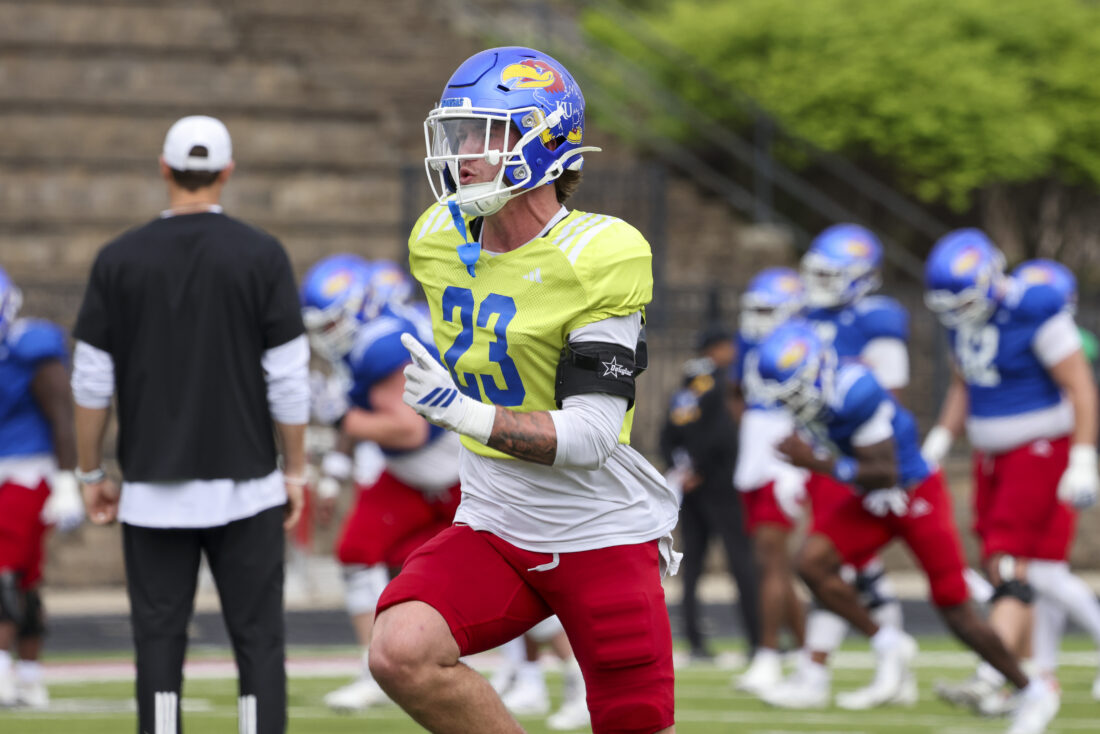
photo by: Kahner Sampson/Special to the Journal-World
Kansas safety Mason Ellis partakes in sprints during KU Football’s spring practice at Lawrence High School on Saturday, April 11, 2026 in Lawrence.
Safety: KU rebounded nicely after Lyrik Rawls transferred to bring in power-conference talent in the form of Khijohnn Cummings-Coleman (Iowa State), Corey Gordon (Louisville), Jaden Harris (Georgia) and Christian Pritchett (Georgia Tech), supplementing returning starter Taylor Davis, who should get the chance to operate more in run support and less in coverage as a boundary safety this year. Harris, a former starter at Miami, will push him for snaps, while Gordon, who has Big 12 experience from his time at Baylor, looks like a plug-and-play starter.
The nickel, the fifth defensive back, looks a bit uncertain. Ellis started 2025 there but moved back to a more traditional safety role after returning from injury. He could figure in again this season, as could Cummings-Coleman and redshirt freshman Brandon Schmelzle.
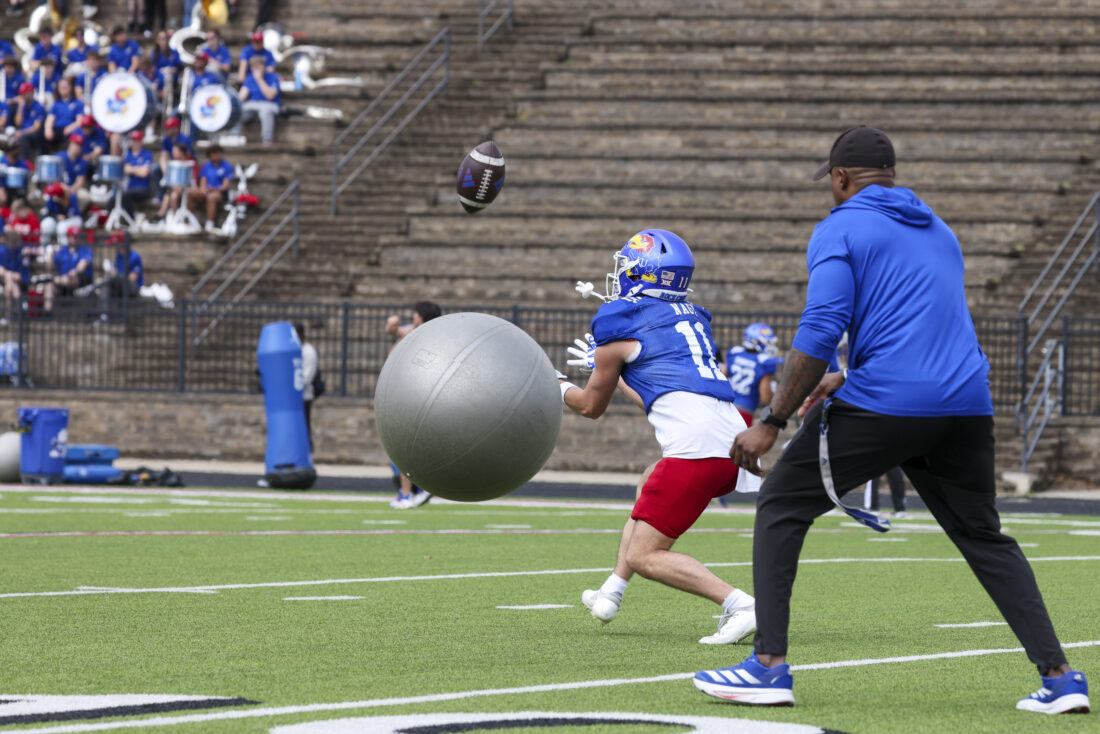
photo by: Kahner Sampson/Special to the Journal-World
Kansas receiver Tate Nagy works on returns during KU Football’s spring practice at Lawrence High School on Saturday, April 11, 2026 in Lawrence.
Special teams: It’s another overhaul in the specialist group for KU after it took a step forward in this realm in 2025. For Taiwo Onatolu, who is now solely a special teams coordinator after previously also serving as defensive ends coach, the offseason included the acquisitions of a transfer-portal kicker (Martin Connington of Michigan State) and long snapper (Rino Monteforte of Cal), as well as an Australian punter making his American football debut in Matt Gill.
Connington went 12-for-16 as a redshirt freshman for the Spartans, while Monteforte has years of experience including a national-championship berth during his time at Notre Dame; Gill is an enigma coming out of the Australian Kicking Academy. All three should slide into starting roles, although KU also has a trio of walk-ons in redshirt freshman kicker Dane Efird, redshirt sophomore long snapper Hollis Moeller and freshman punter Ben Shipley.
In the return game, it is safe to say the Jayhawks will attempt to get Edwards the ball however they can. Nagy is the incumbent punt returner after his successful 2025 season.
KU Football
Kickoff time announced for KU football game against Middle Tennessee
What did we learn from KU’s loss to Arizona State?
Jayhawks’ skill-position depth getting tested already
Quick recap: KU’s defensive effort for naught in 24-17 loss to ASU
2 Jayhawks ruled out for Union Jack Classic