KU’s run defense ready for a challenge against Arkansas in Liberty Bowl

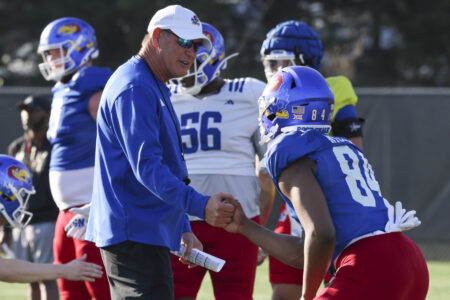
Kansas defensive lineman Jereme Robinson (90) celebrates after dropping Tennessee Tech quarterback Jeremiah Oatsvall (4) for a stop on third down during the first quarter on Friday, Sept. 2, 2022 at Memorial Stadium.
If the Jayhawks want to come out on top in their first bowl game since 2008, they’ll have to do something they’re struggled mightily with all season — stop the run.
Kansas (6-6) was one of the worst-performing teams in the country this season (119th out of 131 FBS teams) in rushing yards surrendered per game. The Jayhawks gave up an average of 202.9 rushing yards per game and 4.8 yards per rushing attempt.
Unfortunately for them, their opponent in today’s Liberty Bowl — Arkansas — excels on the ground.
“If we can’t stop them from running the ball, we don’t have a chance to win,” defensive coordinator Brian Borland said. “So we are going to have to do it.”
The Razorbacks owe much of their 6-6 record this season to their rushing attack. Only eight teams in the country averaged more rushing yards this season than Arkansas, which posted 225.8 yards per game.
Two of the most important players in Arkansas’ ground game are quarterback KJ Jefferson and running back Raheim Sanders, and they aren’t opting out of this bowl game. Between them, they were responsible for nearly 2,000 rushing yards and 17 touchdowns this fall.
Now, it’s up to Borland and his defense to find a way to slow them down.
“They are a good running team, and I’m sure they are going to run the ball,” Borland said. “We certainly have to be able to be physical up front and match that physicality. We have to be able to hit them, wrap them, and get them on the ground. Those are big challenges for us, and we’re aware of that, and we’re working in that direction.”
Arkansas’ physical style of play is most evident on the offensive line. Four-year starter Ricky Stromberg (center) is headed to the NFL draft and won’t play against Kansas, but the Razorbacks are expected to have their other four starters from this year’s offensive line, and that could mean trouble for KU in the trenches.
Analytics site College Football Data publishes a statistic called “line yards per rush,” which essentially measures how many yards a line produced or gave up. The Razorbacks’ offensive line produced 3.2 line yards per rush this season. KU’s defense, meanwhile, gave up 3.5 line yards per rush.
KU’s defensive linemen have had more than a month to prepare for this matchup, however, and they know what to expect.
“You can’t play D-line soft; you are going to get moved up out of there,” defensive lineman Jereme Robinson said. “(We) just have to hone in on, ‘OK, we have to be physical and we have to stay low. We have to get off these blocks.'”
Robinson said it would be important to show Arkansas that KU wasn’t going down without a fight.
“They are going to run the ball a lot until we can prove that we can tackle them,” he said.
To do that, they’ll have to find a way to control Jefferson and Sanders, the Razorbacks’ most potent weapons.
From a production standpoint, Sanders led the way this season with 1,426 yards and 10 touchdowns on 219 rushing attempts. He opened the year with three consecutive 100-yard performances. And although he only hit triple digits once in his last four games, that game was a season high: 232 yards in a win over Ole Miss.
But most game plans start with the quarterback, and that’s especially true with Jefferson and this Arkansas rushing attack. Jefferson, who is 6-foot-3 and 242 pounds, has a bigger frame than most QBs, and he uses that to his advantage, punishing linebackers in the run game.
Jefferson recorded double-digit rushing attempts in six of his last seven games, including 18 attempts for 105 total yards during a loss to Texas A&M.
“We really have emphasized just making sure we wrap and roll on the quarterback,” KU defensive lineman Caleb Sampson said. “Their quarterback is a big piece of their run game. He’s really elusive and he can bounce off of guys. We just have to emphasize everyone getting to the ball, so we know it isn’t one person taking him down.”
Arkansas ended the year with three straight games of 200 yards or more on the ground, but some teams have succeeded in containing its run game. The Razorbacks only mustered 91 rushing yards against Liberty in a 21-19 loss on Nov. 5.
If KU can contain the rushing attack or force Arkansas into more passing situations, it might prove to be the difference between a disappointing loss and a bowl triumph.
KU Football
KU football’s quarterback competition well underway during spring practice
Veteran long snapper Monteforte hoping to make more memories at KU

How KU’s new Australian punter Gill became an American football player
Another offseason brings development for last year’s breakout player Harris
Edwards enjoying early days at KU after offseason move from K-State