
The choice to specialize: How young athletes decide between playing multiple sports or just one
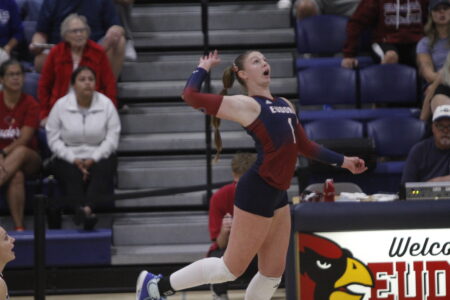
photo by: David Rodish/Journal-World
Eudora junior Braydee Miller jumps for a kill in the substate volleyball tournament on Saturday, Oct. 24, 2026, in Eudora.
For Eudora High School junior Braydee Miller, volleyball has been part of life since she was 6 years old.
After years of playing school and club volleyball with year-round competition, Miller decided to stop playing basketball after her freshman year and focus on volleyball alone. She believed she had the ability to play at the next level and wanted to give herself the best chance to get there.
“That was really hard for me, just because a bunch of my friends play basketball and I had played basketball forever,” Miller said.
Her decision paid off when she committed to Missouri State University in July. But specializing in volleyball has also meant a demanding schedule, with limited time away from the court.
Miller’s experience reflects a choice facing young athletes: focus on one sport to improve their skills and pursue collegiate opportunities, or continue playing multiple sports for variety and different athletic experiences.
YEAR-ROUND COMMITMENT
Miller’s volleyball schedule extends well beyond the high school season, which usually runs from August through October.
During the school season, practices can last two and a half to three hours, with tournaments taking up every other weekend. When the school season ends, club volleyball begins.
Although Miller usually gets a break of about three weeks in May, she continues working on her skills independently. Club competition resumes in the summer, leading into national tournaments.
“I usually hit that burnout right before the three-week break because there’s so many tournaments and so many practices and you don’t do anything else,” Miller said.
Miller believes focusing on one sport gives her an advantage, allowing her to refine her mechanics and take specialized lessons while other athletes are busy with several sports.
Eudora senior Izzy Brunkow has taken a different approach. She participates in volleyball, basketball and track, including pole-vault and sprint events.
Her schedule has required compromises, too. She stopped playing club volleyball after her freshman year and club basketball after her sophomore year because of the demanding schedule and conflicts with track.
“Having the ability to finish a sport and have the next one waiting for me, I really like that, because it’s something new for me to do,” Brunkow said.
DOES SPECIALIZATION LEAD TO SUCCESS?
For athletes hoping to compete in college, specializing can seem like a necessary step. However, research suggests that focusing on one sport early is not a guaranteed path to athletic success.
A study published in the American Journal of Sports Medicine surveyed 1,550 former NCAA athletes and found that only 18.1% had specialized in a single sport before age 15. Researchers found that athletes who specialized early were just as likely to earn college athletic scholarships as those who specialized later. However, burnout was more common among early specializers, reported by 10.5% of those athletes compared with 7.0% of those who specialized later.
Cara Kimberlin, Eudora High School’s athletic director, has worked in the district for 28 years, including 17 years as athletic director. From her perspective, college coaches increasingly recruit athletes at club events rather than relying on high school coaches to identify prospects.
“I would say that probably 90% of their recruiting of kids is because they’ve seen them at big tournaments,” Kimberlin said.
Still, Eudora’s coaches do not encourage students to specialize. The school promotes involvement in multiple activities, and coaches recognize that skills from one sport can benefit another. For example, Kimberlin said, wrestling can help football players develop balance, agility and hand strength.
Maggie Bowen, director of operations for University of Kansas volleyball, has worked with recruits and their families through campus visits and has seen how athletes navigate the transition to college. She said the club volleyball scene has become more concentrated compared with high school sports over the past 10 to 15 years.
Despite that shift, Bowen said KU’s volleyball staff does not believe athletes need to specialize in one sport.
“The ideal situation for our staff is that if they want to be a multi-sport athlete, that’s great,” Bowen said. “It’s not anything we’re advising them that they need to do, to only focus on volleyball 12 months in a year.”
The transition to college also involves more than athletic development. Some KU volleyball players choose to graduate from high school a semester early and join the team in January. Four freshmen joined the program in January 2026, giving them several months to adjust to college classes and practices before the fall season.
Bowen said the early start can help players acclimate to college life and prepare for competition, but the decision is not forced on athletes. Instead, it is a choice made by players and their families based on their academic circumstances and goals.
PHYSICAL AND MENTAL COSTS
Jessica Spencer, a doctor of physical therapy at Lawrence Memorial Hospital, said the physical risks depend on an athlete’s age, training volume and recovery time. Research commonly defines early specialization as focusing on one sport before age 12.
When young athletes practice the same movements repeatedly without enough time to recover, they can place additional stress on developing bodies. Spencer said this can increase the risk of overuse injuries, including tendon and ligament problems.
“The younger we are when we specialize, the more skeletally immature we are, the higher risk of injury,” Spencer said.
Spencer said persistent pain is one of the most important warning signs. Pain that does not improve with rest, declining performance, fatigue and changes in mood or attitude can also indicate that an athlete is not recovering adequately.
Playing multiple sports can help young athletes develop a wider range of movement patterns, Spencer said. Different sports teach athletes how to jump, cut, slow down and react in different situations, building general athletic ability instead of repeatedly training the same skill.
However, participating in multiple sports does not automatically prevent injuries. Overlapping seasons and demanding schedules can still leave athletes with too little time to recover.
A research review published in the journal Pediatrics in 2018 supported concerns about the physical risks of sports specialization, conducting a meta-analysis of several prior studies and concluding that highly specialized young athletes had a higher relative risk of overuse injuries than moderately specialized athletes, who in turn had a higher relative risk than those with low specialization.
Spencer said reducing risk involves more than choosing one sport or several. Strength and conditioning, learning proper movement mechanics and building recovery into training can all help athletes develop safely.
“For most kids, playing sports should be fun,” Spencer said. “It shouldn’t be a job, it shouldn’t be something that they dread.”
FINDING BALANCE
For Miller, specializing in volleyball has meant giving up other sports and committing to a demanding, year-round schedule. But that commitment has also helped her pursue her goal of playing at the collegiate level.
Brunkow has found a different kind of fulfillment in moving from one sport to the next, embracing the challenges each season brings.
Their experiences reflect the different paths young athletes can take as they pursue their goals. Whether specializing in one sport or competing in several, athletes must weigh their ambitions against the demands of training and the importance of enjoying the game.
Other Sports
The choice to specialize: How young athletes decide between playing multiple sports or just one
Eudora wins 4A substate tournament to advance to state tournament for the first time in three years
Photo Gallery: Eudora beats Tonganoxie, Ottawa to win substate volleyball tournament
Baldwin High already has won $25K and is competing for $1M through national sports program
Pete’s NFL experience adds to Native athlete pride on Indigenous Peoples Day