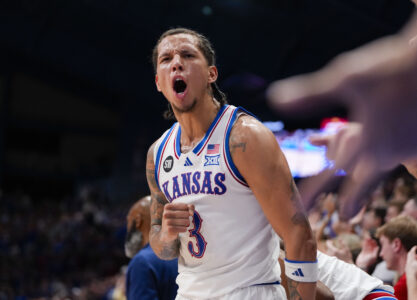
Year in review, Part 3: A look ahead to 2026

photo by: MultiStudio/University of Kansas
A rendering shows how a $300 million development project on the east side of David Booth Kansas Memorial Stadium could look from the intersection of 11th and Mississippi streets.
It may not feature quite as much upheaval as 2025 — accounting for the House v. NCAA settlement while opening a new stadium was certainly quite a lot to handle for the Kansas athletic department — but 2026 will still be a year of change for KU.
The university’s Gateway project is really only just beginning, as it embarks on a second phase with quite a broad scope, well beyond simply fixing up the east side of the stadium that KU has already knocked down.
On a broader level, administrators and staff will have to continue to adjust to the new era of revenue sharing and name, image and likeness payments that coexist and each play key roles in player retention and acquisition. And recruitment and transfer-portal windows and guidelines still seem to be in a constant state of flux — just take a look at the recent surge of NBA G League players into the college men’s basketball ranks.
The year 2026 will be pivotal for several athletic programs within KU, too. The perennial powerhouse men’s basketball team will look for greater success after consecutive years with disappointing records and anticlimactic NCAA Tournament conclusions — its nonconference schedule has engendered plenty of optimism — and the football team will attempt to return to a bowl game following a pair of losing seasons. The baseball, men’s and women’s golf, soccer, tennis and volleyball teams, among others, will look to build on recent momentum, while softball and women’s basketball angle for postseason bids of their own.
A lot of intrigue awaits when the calendar flips to January.
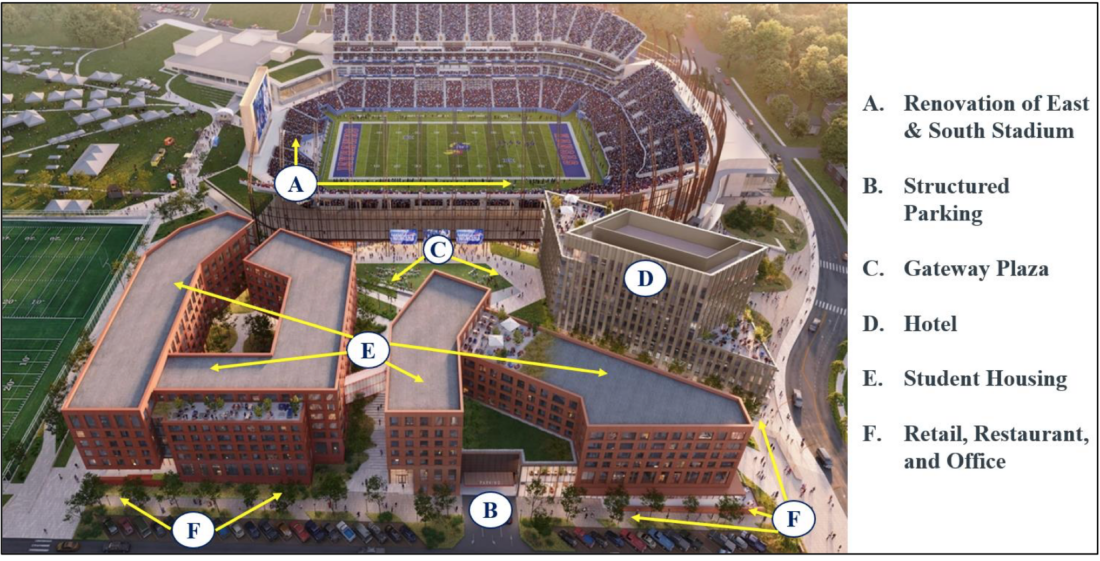
photo by: University of Kansas
A concept of KU’s Gateway District, as provided to the Lawrence City Commission for review.
How does the second phase of the Gateway project proceed?
Demolition is well underway on the east side of David Booth Kansas Memorial Stadium as KU proceeds with the second phase of its Gateway project, which as of October was expected to cost about $360 million, stretching the overall cost of the project above $800 million.
Already in place are the west side of the stadium and the new conference center in its north end, which opened midway through the fall football season. Now, much remains to be revealed about the upcoming phase, but it is slated to include the following: a hotel adjacent to the conference center, student housing, a parking lot and space for retail, restaurants and offices. Construction on these components will stretch well beyond 2026, but KU has committed to completing all its development by December 2028, as the Journal-World has reported.
One key difference between phases one and two: KU will continue to play its football games at David Booth Kansas Memorial Stadium for the 2026 season. Recall that in 2024 the Jayhawks temporarily moved home games to Children’s Mercy Park and GEHA Field at Arrowhead Stadium while phase one was in progress, because KU thought playing within the stadium would have too severe of a negative effect on the timeline for its construction.
This time, home games against Long Island, Middle Tennessee, Missouri, Baylor, BYU and UCF, on a schedule that largely has yet to be revealed, will take place before a reduced-capacity crowd right at home in Lawrence. (KU is giving up one home game against Arizona State to take part in the Union Jack Classic in London.) It will all make for what is essentially the fourth different stadium experience — location notwithstanding — for the Jayhawks and their fans in the span of four seasons, with more changes yet to come.
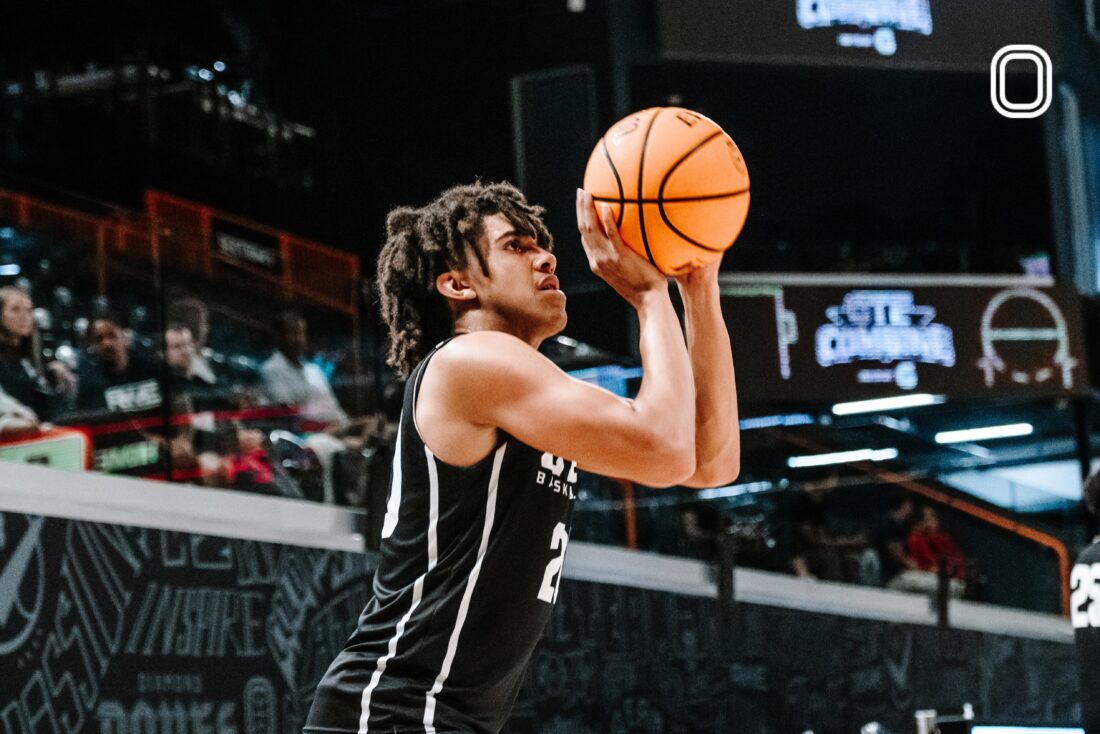
photo by: Overtime Elite
Taylen Kinney lines up a shot at the Overtime Elite combine on Tuesday, Sept. 24, 2024, in Atlanta.
How does Kansas men’s basketball complete its 2026 recruiting class?
KU’s existing set of 2026 signees is already fairly well regarded nationally — it ranks No. 2 in the nation on 247Sports, No. 4 on ESPN and No. 8 on On3. It’s a well-rounded group headlined by five-star Taylen Kinney (Newport, Kentucky), a potent scorer at the point guard spot, with strong complementary pieces in lengthy lefty power forward Davion Adkins (Arlington, Texas), pure shooter Luke Barnett (Laguna Niguel, California) and athletic wing Trent Perry (Frisco, Texas).
Combine that with the large number of highly touted players on this year’s roster who could make a leap with another year in the Jayhawks’ program — Kohl Rosario and Bryson Tiller come to mind — and the 2026-27 roster is shaping up quite nicely.
But even in the wake of signing Adkins, Barnett, Kinney and Perry, KU coach Bill Self said he felt the group of incoming freshmen was “probably a player away from it being an elite, elite class.”
If that’s the case, the Jayhawks could go a number of directions to add their final piece. The most obvious one would be following through on moving up Javon Bardwell, a long-discussed reclassification candidate who is already committed to KU in the 2027 class. Bardwell is a five-star scoring wing from Harlem, New York, who plays with Kinney in Overtime Elite.
But whether that is KU’s ultimate choice could depend on how the Jayhawks fare with the big-name prospects who remain uncommitted in 2026. Forward Tyran Stokes, the consensus top prospect in the class, is a longtime KU target who has visited campus and kept KU in contention for his services despite signing a deal with Nike. His recruitment has taken some unusual turns, such as a transfer to Rainier Beach High School in Seattle and a recent offer from Vanderbilt. Then there’s Bruce Branch III, who already reclassified from 2027 to 2026 and recently told On3 he watches Kansas closely because Darryn Peterson is his “favorite player.” And one report in November suggested KU was recruiting Cameroonian center Amadou Seini.
Whatever happens, it could take a while — KU’s 2025 freshman class featured one addition in May and two more late in the summer — but it could also dramatically reshape the outlook for next fall.
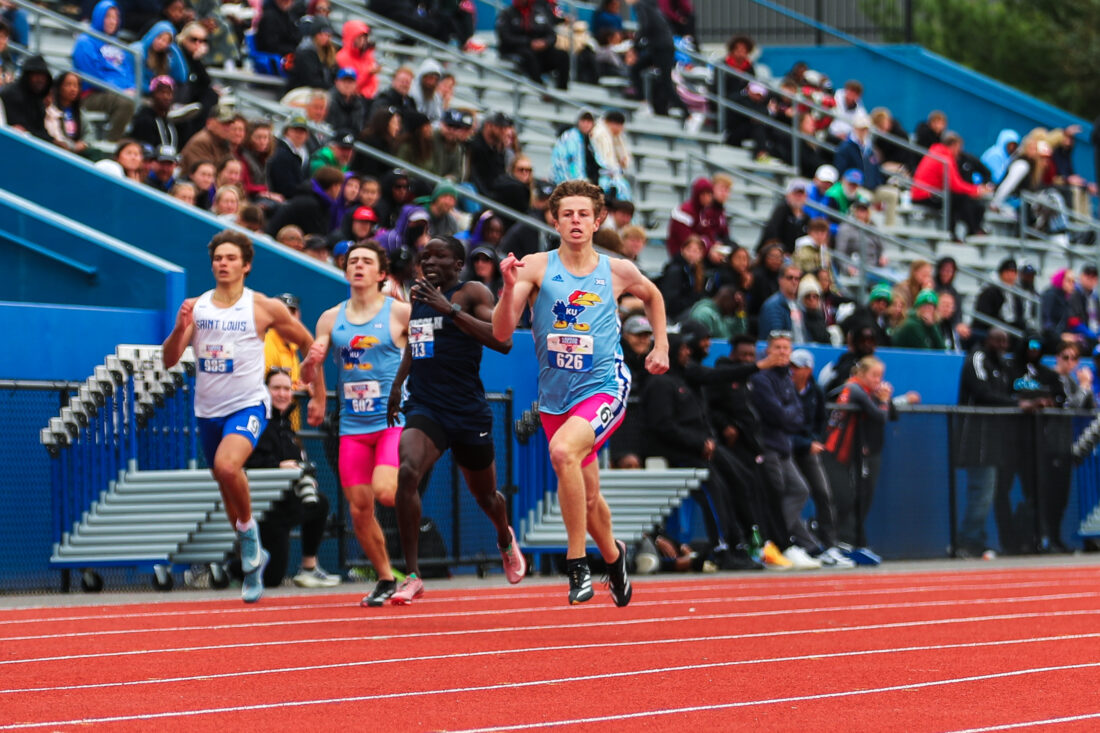
photo by: Sarah Buchanan/Special to the Journal-World
Grant Lockwood won the men’s 400 meters at the 102nd Kansas Relays on Saturday, April 19, 2025, in Lawrence.
What’s next in the world of cost savings?
The KU athletic department had to take some drastic measures in 2025 in order to conjure $20 million with which to pay its athletes — all after it had experienced somewhat decreased revenues as a result of playing football games off campus in 2024. So it tried to find ways to reduce costs.
The Journal-World reported extensively over the course of 2025 about what unfolded as a result. The steps KU took included everything from a reduction in department staff by about 30 employees as a result of a hiring freeze, voluntary separations and layoffs to the cancellation of the 2026 Kansas Relays (with the century-old meet’s long-term future uncertain) to the removal of a featured performing artist for Late Night in the Phog. As athletic director Travis Goff put it, the money an artist would cost would be better spent on players for the men’s and women’s basketball teams.
In all, Goff said in June at a KU Athletics board meeting that over the course of the preceding nine months, KU had found ways to reduce its expenses by more than $15 million in total, many of which would not come into play until the fiscal year 2026. Despite that, at a later board meeting in October, directors approved a budget projecting a $14.9 million deficit for that fiscal year. The department plans to account for it using a line of credit, and the idea seems to be that it will make money again beginning in the fiscal year 2028 with a fully operational Gateway project.
In the meantime, Goff has said KU proceeded through its cost-management exercise “with the objective to not have to continually find ways to create new dollars through cuts,” even as the revenue-sharing cap increases each year. Evidently, 2026 will provide the first test of whether KU can in fact avoid cutting additional aspects of its department.
In the meantime, it will have to deal with the consequences of the actions it has already taken. For example, Kansas State recently announced the creation of what it is calling the inaugural K-State Relays, which will take place around when KU has held its own event in years past. It’s only a high school meet, so it doesn’t entirely replace the Kansas Relays, but it will undoubtedly attract many of the athletes from those ranks who would otherwise have been competing at Rock Chalk Park.

photo by: AP Photo/Kirsty Wigglesworth
Fireworks before the English FA Cup final soccer match between Crystal Palace and Manchester City at Wembley stadium in London, Saturday, May 17, 2025.
How will the Union Jack Classic unfold, and how will it affect the KU football program?
The general proliferation of international competition in American sports, and especially American football, now provides a landmark opportunity for Kansas. The Jayhawks will take part in the first high-major college football game played in the United Kingdom, and the first college football game of any kind there since 1988, when they face Arizona State in the Union Jack Classic at Wembley Stadium in London on Sept. 19.
KU coach Lance Leipold has described an international game as a rare chance to create a memorable experience for his players, as well as a chance to promote the sport of college football and the Big 12. Goff, for his part, besides touting the opportunities to market the university and engage international alumni, has declared it a “financially beneficial move” for the university. He has also characterized 2026 as the optimal time for KU to essentially surrender a home game because 1) it would have seven in 2026 under normal circumstances, so it still gets an acceptable six and 2) it will be operating with reduced capacity during the season due to the aforementioned second phase of the Gateway project.
There is a key logistical consideration still at play. KU was originally supposed to host Middle Tennessee on the same date, Sept. 19. The last time Goff spoke to reporters, at Big 12 basketball media days, he said KU was still waiting on a waiver to move that game to the so-called “week zero,” the week before most teams begin their season, the same week in which the Jayhawks played Fresno State in 2025. (By the way, that’s also the week in which most international games take place; will KU’s matchup in London receive the same sort of attention if it has to compete with a regular schedule of games on Sept. 19?) Goff said that KU and Middle Tennessee have a contingency plan in place if that does not work out.
KU will also need to devise a travel schedule to and from London that handles the considerable time change and manages the logistics of the event in such a way that it does not impact the Jayhawks’ preceding or successive games.

photo by: Kahner Sampson/Special to the Journal-World
The KU softball team huddles around head coach Jennifer McFalls after defeating Kansas City 8-0 on Wednesday, April 2, 2025, at Arrocha Ballpark in Lawrence.
Can KU softball build some momentum?
The Kansas softball team came incredibly close to the postseason back in 2024. The Jayhawks had positioned themselves well for NCAA Tournament contention when they proceeded to lose 10 games in a row between late April and early May. Six of those were against top teams in Texas and Oklahoma State, but KU also lost a midweek matchup against Kansas City and all three games of a home series against BYU.
After going 1-1 at the Big 12 tournament in Oklahoma City that year, KU came up empty in the postseason selection show. The Jayhawks gathered in head coach Jennifer McFalls’ basement and experienced the pain together. McFalls said later she felt that the returning players decided they never wanted to feel that way again.
But instead of making an extra leap in 2025, KU took a step back. The Jayhawks went 22-28 overall in the reconstituted Big 12, including 6-18 in Big 12 play, with just one league win at home. In all, its home record of 4-13 was the worst since Arrocha Ballpark opened in 2014. With a new hitting coach in the fold, KU ranked at or near the bottom of most offensive categories in conference play despite hitting 24 home runs in those 24 games, and despite consistent production from two-way standout Olivia Bruno, shortstop Hailey Cripe and center fielder Presley Limbaugh.
What will 2026 hold? McFalls is entering her eighth season and looking for her first postseason berth. In their batting lineup, the Jayhawks bring back nearly every major contributor besides Bruno and catcher Natalie Marshall. They have a wealth of pitching options at their disposal, including several freshmen and could get second-year leaps from the likes of Kaelee Washington and Kennedy Diggs; Wichita State transfer Chloe Barber could figure in prominently if she regains her early-career form. KU also made the somewhat atypical addition of a pair of JUCO players from McLennan Community College: outfielder Tehya Pitts and pitcher/utility player Ellie Loveless.
It remains to be seen whether it will amount to on-field success.
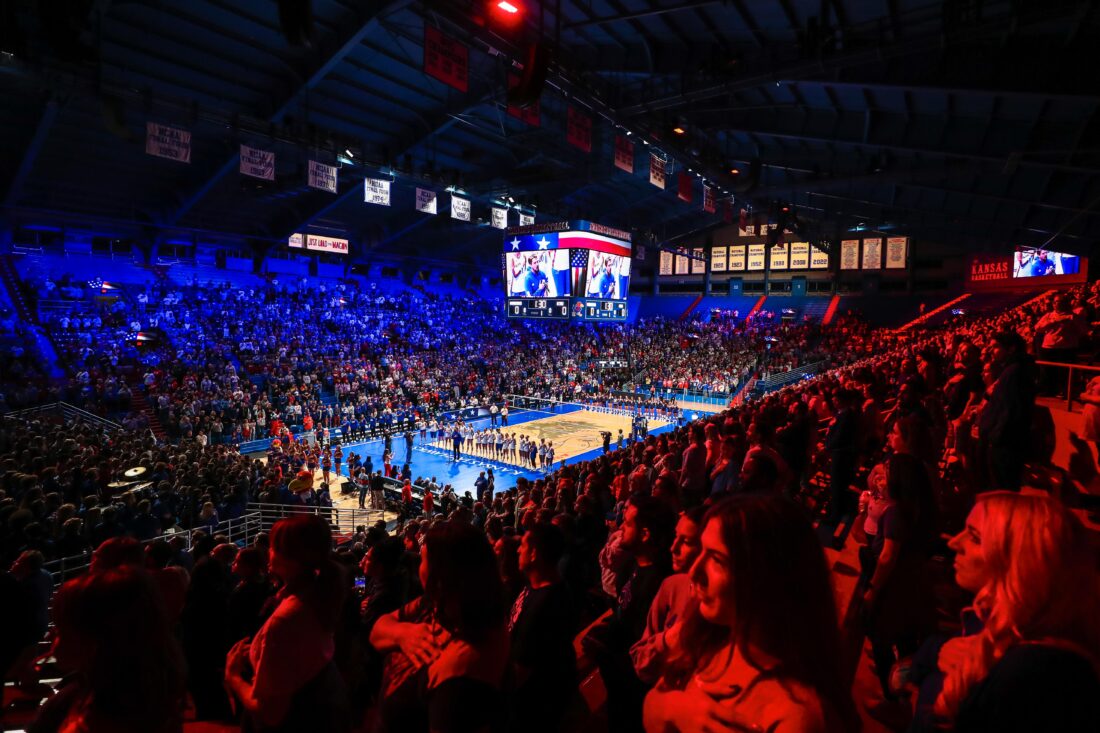
photo by: Sarah Buchanan/Special to the Journal-World
Kansas volleyball coach Matt Ulmer sings the national anthem prior to the match against Kansas State on Friday, Oct. 24, 2025, at Allen Fieldhouse.
Rapid fire
• How does the World Cup impact KU? It will become apparent quite early in 2026 just how involved Lawrence will be with the ongoing festivities of the 2026 World Cup next summer. The city’s long-running campaign to serve as a base camp for one of the nations taking part in the competition is probably going to be successful, as at least one KU official said he would be shocked if a team doesn’t pick the Lawrence site, which features The Oread hotel and Rock Chalk Park and benefits from its central location on the continent, KU’s resources and its proximity to Arrowhead Stadium. The official notification is expected in late January. Countries that have matches at Arrowhead on their schedule, and especially Algeria, which has two, seem like strong candidates. Then it’s a matter of figuring out how the city of Lawrence and the KU campus can accommodate the influx of visitors this summer and best take advantage of the rare opportunity they present.
• Will more volleyball be played at Allen Fieldhouse? KU coach Matt Ulmer wanted to play a match at Allen Fieldhouse — the first the Jayhawks had hosted since 2013 — because he wanted to get a sense of the true appetite for volleyball in the region beyond the couple thousand fans that Horejsi Family Volleyball Arena accommodates. For a Friday night matchup with Kansas State on Oct. 24, they brought in 7,550, just about half the capacity of the historic venue. The outcome didn’t go the Jayhawks’ way, as the Wildcats snapped a lengthy losing streak against KU, but that doesn’t necessarily mean the Jayhawks won’t toy with hosting the occasional match there going forward — at least when basketball schedules don’t interfere.
• How does Andrew Derrick do in his first spring season? As Chancellor Douglas Girod has said, Goff is “batting a thousand” with his head-coaching hires. Indeed, Leipold (football), Lindsay Kuhle (women’s golf), Dan Fitzgerald (baseball), Nate Lie (soccer) and Ulmer (volleyball) all hit the ground running and in many cases have lifted their respective programs to new heights. Derrick could follow a similar pattern to Kuhle, Lie and Ulmer, as he was a sitting coach on a well-respected team — in his case, Gonzaga — from whom KU sought insight on its coaching search, and he ended up becoming quite interested in the opening himself. Goff has expressed his belief that KU can become a top program in the Midwest and has said he isn’t interested in “settling for rowing to be in the 40s or low 50s across the country.” Derrick brought Gonzaga a set of four straight conference titles, and it finished in the top 20 nationally each of those four years. Can he put KU on the path to such success?
• Will Leipold’s vision for state football championships at KU come to fruition? The KU football coach said prior to the start of the 2025 football season that he and then-Kansas State coach Chris Klieman had discussed the prospect of attempting to host high school football state championships in alternating years at David Booth Kansas Memorial Stadium in Lawrence and Bill Snyder Family Stadium in Manhattan. It’s been more than two decades since either city has hosted a state title game, and in recent years such games have occurred in places like Emporia, Hays and Pittsburg. Local high school coaches expressed enthusiasm for Leipold’s idea, but it didn’t seem very far along in the process of coming to fruition, and Klieman retired after the season. KSHSAA Assistant Executive Director Mark Lentz said the association is “always willing to listen and considering offers from the colleges.”
KU Men's Basketball
Bidunga brings Jayhawks to ‘another level’ with dominant performance, interplay with Peterson
Photo Gallery: Jayhawks roll past Bears, 80-62
Peterson, Bidunga lead Jayhawks past Baylor, 80-62
Preview: KU remains at home to take on Baylor
Players-only meeting got Jayhawks on same page before ISU beatdown