

Group helmed by KU associate dean looks to break record for longest baseball game, raise money for charity

photo by: Courtesy of Scott Reinardy
From left, Jerry Weaver, Rob Humble, Victoria Ressler, Bill Hutton and Jesse Aguirre are pictured at the EndlessGame Foundation's inaugural board meeting on Nov. 14, 2022.
Jerry Weaver estimates it was about a month and a half ago that the people at Guinness threw a serious wrench into the EndlessGame Foundation’s world-record bid.
Weaver, the foundation’s vice chair, and its chair, Scott Reinardy, had spent the better part of eight months amassing personnel, wrangling sponsors and selecting charitable beneficiaries for their effort to host a 100-hour baseball game — which would be the longest of all time. Now they were learning that none of the players could physically leave the site of the game for its entire duration.
The player base of the titular endless game is drawn from adult and senior leagues. Some of them are caretakers, Weaver told the Journal-World, who can’t just spend four consecutive days playing baseball.
“Out of the first 60 people I called and asked, I only had one that couldn’t do it and they had a really good reason,” Weaver said. “People jumped in a heartbeat. Where we ran into a challenge was, our perception was we’d be able to play and rotate out and we’d have our 30-man roster and we’d be free to move around.”
Instead, here was Guinness World Records informing Reinardy and company that no one could leave their field at Macken Park in North Kansas City for the entire duration of their effort over Labor Day weekend.
“I said out loud, ‘That’s physically impossible to stay awake for 100 hours,'” said Reinardy, an associate dean in the University of Kansas journalism school.
And so they would have to camp out at the field, which Weaver said “made it a little narrower group of guys that were able to do that.” But as with numerous other logistical issues with the creation of a 100-hour baseball game, the foundation sorted it out. They will have three groups of 10 players rotate in and out in four-hour shifts — maybe shorter depending on heat — while the others eat and sleep at the park, with the help of provided food and RVs.
It’s a small price to pay for the game’s ultimate goal: not just breaking the record, but raising $300,000 for a variety of charities, from Children’s Mercy Hospital to Operation Breakthrough to the Veterans Community Project, among others. All proceeds from the game, which will also feature food trucks and a silent auction, go to these organizations.
Reinardy and Weaver had their own attachments to some of the charities, but the ultimate goal, as the players take the field from 8 a.m. Thursday to noon Sept. 4, is to raise money for causes everyone can relate to. As Reinardy puts it: Who hasn’t known someone who’s had an organ transplant, or a child at Children’s Mercy Hospital? Who hasn’t seen a homeless veteran?
In the meantime, as Weaver puts it, “Now it’s a matter of, we got 60 guys playing baseball. But we’ve got Kansas City (that) is what’s going to raise $300,000.”
Reinardy first got the idea after himself playing three baseball games in a single day. He knew about the longest professional baseball game, a 33-inning marathon in Pawtucket, Rhode Island, Triple-A from 1981, but hadn’t heard of the amateur effort he soon discovered — an 83-hour, 13-minute extravaganza played in Alberta, Canada, in 2019, and recognized by Guinness.
Reinardy brought the idea for a 100-hour game to Weaver, who soon came aboard, and by November the organization started up with a few people in a room in North Kansas City, including Mexican baseball league leader Jesse Aguirre, accountant Rob Humble, lawyer Bill Hutton and city parks and recreation head Victoria Ressler. The leadership team also includes Phil Harris of the Boys & Girls Clubs’ Royals RBI program for youth baseball.
“Having a diverse group of people, first of all, gave us some credibility,” Weaver said.
The strong foundation of leadership, plus Weaver’s enthusiasm, helped them secure sponsors like pipe pile manufacturer Atlas Tube from the early days of the project. In the lead-up to the event, Reinardy said he had to balance keeping a low profile in case the event fell apart while also courting those sponsors and gaining the approval of Guinness.
“You never want to commit to something and not be able to do it, or at least I don’t,” he said.
Reinardy said he never had a specific moment where the project really crystallized for him — it was just “continuous momentum,” although the prospect certainly started to become real when the foundation got a contract with Guinness in May, and when banners started to go up at Macken Park.
Now the event is definitely happening — barring lightning or a tornado or some other incredibly severe weather, Reinardy said — but the momentum needs to continue, because as of Wednesday, the game still needed to fill 34 of its 75 umpire slots, including at times like 12 a.m. to 4 a.m. and 4 a.m. to 8 a.m., ahead of its Thursday start.
Just one of the remaining challenges, along with compiling the extensive video and photographic evidence Guinness requires.
“When you start something of this magnitude, you envision that it’s going to be complex, but you never recognize or realize, because you don’t have the experience, to know how complex it really is,” Reinardy said. “So now we are on the precipice of entering into this endless game, this blank canvas of 100 hours, and trying to sculpt it into raising $300,000.”
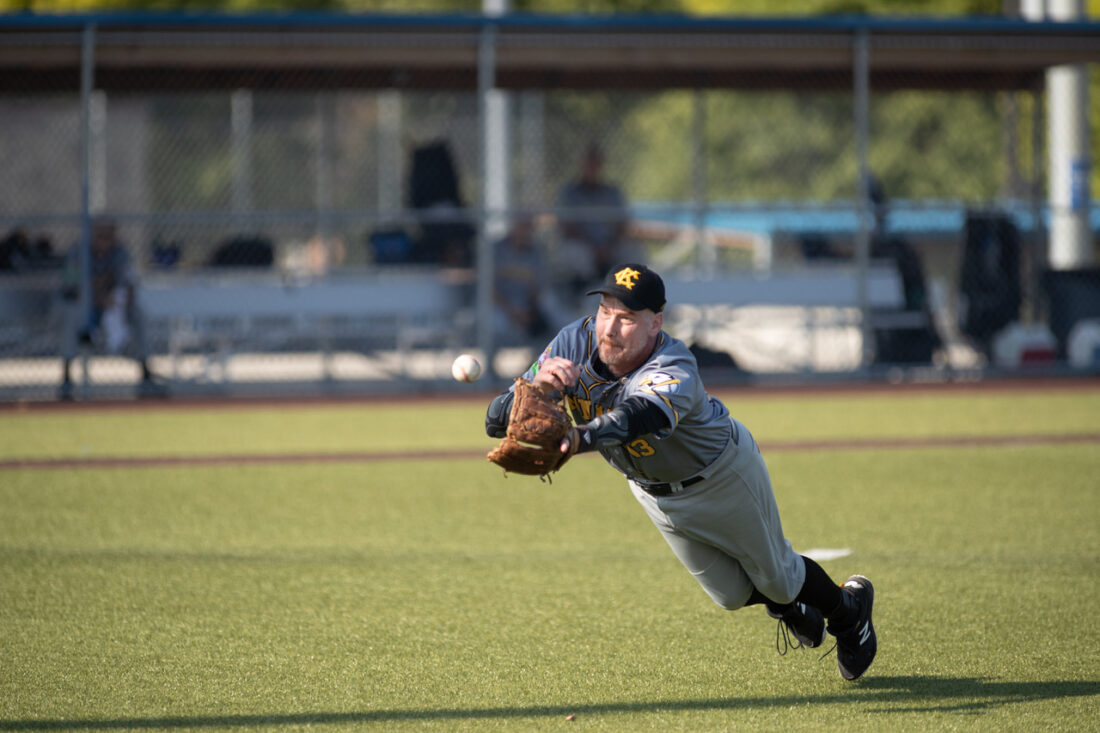
photo by: Brett Pruitt/East Market Studios
Scott Reinardy dives to catch a ball during the Negro Leagues Baseball Museum Summer Classic in 2021. The 2022 edition of the tournament provided the inspiration for the EndlessGame Foundation.