Kansas ag economist says it could take two years to get diesel prices back to normal levels
Kansas farmer uses about 4 gallons of diesel to produce an acre of corn
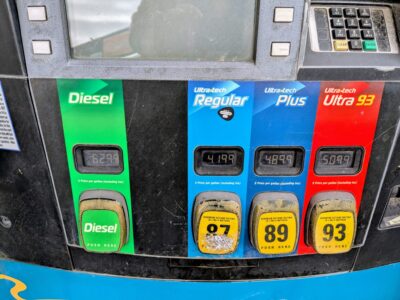
photo by: Tim Carpenter/Kansas Reflector
Gregg Ibendahl, farm management specialist with Kansas State University, says diesel prices paid by Kansas farmers and truckers will remain elevated into 2027 and beyond due to rising crude costs, limits on refining capacity and transport bottlenecks. In this image, the price of diesel in Kansas stands at $6.29 per gallon.
TOPEKA — Diesel costs are likely to remain elevated through next year to the detriment of farmers struggling to turn a profit and consumers grappling with food inflation, a Kansas State University agricultural economist says.
Gregg Ibendahl, farm management specialist with KSU’s Extension Service, said the diesel market was influenced by soaring crude prices, limited refining capacity and supply system interruptions. Consequences of international conflict may sustain those conditions and hold prices at $6 to $7 per gallon into 2027 or beyond, he said.
Shipping in the Gulf region and the Strait of Hormuz has been undermined since February by the United States’ war with Iran. In addition, diesel exports by Russia weakened since its full-scale military assault of Ukraine began in 2022. The only means of addressing pump prices would be to resolve global tensions and resume the regular international flow of fuel, Ibendahl said.
“Even in a best-case scenario, where the war in Ukraine winds down quickly and shipments through the Gulf normalize, it could easily take six months for the market to adjust,” Ibendahl said. “To see prices return to what we had earlier this year could take up to two years, even if everything goes right.”
Ibendahl said diesel costs in Kansas climbed approximately $2.25 per gallon during 2026. In Lawrence on Tuesday, the pump price of diesel stood at $6.29 per gallon. The national average for diesel climbed to $6.51 a gallon, according to AAA.
About one-third of escalation in domestic price was associated with crude oil costs, Ibendahl said.
“The price of oil has gone from the low to mid-$70s to more than $100 a barrel, and that probably explains about 70 cents of the increase per gallon,” he said. “The rest is really because there just isn’t enough diesel fuel in the world right now.”
The bulk of the ballooning cost should be attributed to supply disruptions at the refinery level and transit issues, he said.
“Russia is still producing oil but can’t get it refined easily because of damage to its refineries,” Ibendahl said. “They’ve essentially shut off diesel exports to Europe, and there’s not much moving through the Gulf, either. That’s created a very real shortage.”
U.S. refineries have operated at about 98% capacity, Ibendahl said, but overseas demand has drawn U.S. supplies offshore. An estimated 30% of diesel produced in the United States was destined for export and the tighter domestic supply was reflected in pricing, he said.
Ibendahl said many Midwest farmers returned to fields in the fall on tractors fueled by diesel. A north-central Kansas farmer might use four gallons of diesel to grow one acre of corn, he said. Assuming diesel remained $2.25 above normal, which previously was below $4 per gallon, that extra cost per gallon would add $10 for each acre seeded. So, Ibendahl said, a corn farmer working 2,000 acres would see an instant input cost increase of $20,000.
“For many operations, that can be the difference between having a profitable year and not making anything at all,” Ibendahl said.
Higher diesel prices hit the bottom line of transportation companies, and those costs eventually must be passed to consumers, he said.
“We move practically everything in this country by truck, and almost all of those trucks run on diesel,” he said. “They can’t eat those costs forever. Over time, consumers are going to feel higher diesel prices, even if they’re not buying diesel themselves.”
• Tim Carpenter is a journalist with the Topeka-based news service Kansas Reflector.
State and Region

Trump coming to Wichita for Roger Marshall campaign rally
Hays foundation pledges $1M in matching funds to help save Sternberg museum
TOPEKA — A private foundation offered to match contributions dollar-for-dollar up to $1 million for benefit of ...
Kansas Board of Regents adopts early warning rule for college athletics deals with private equity
TOPEKA — The Kansas Board of Regents amended policy to require officials at the six state universities to notify ...

Kansas State president departs school to become new leader of Virginia Tech

General Election Voter’s Guide