CoreCivic sells Kansas prison, leaving Leavenworth with oversight and financial questions
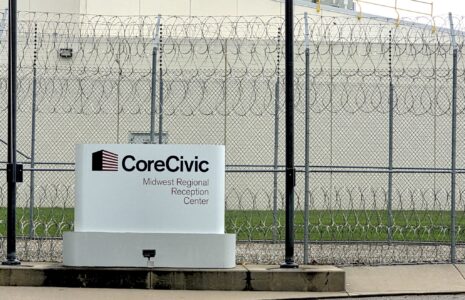
photo by: Morgan Chilson/Kansas Reflector
CoreCivic sold its newly reopened Leavenworth prison facility, the Midwest Regional Reception Center, to the U.S. Immigration and Customs Enforcement, the company announced Aug. 5, 2026.
TOPEKA — CoreCivic on Wednesday announced the sale of its Leavenworth prison to the federal government, likely negating months of negotiations and a legal battle city officials pursued to ensure the humane treatment of immigrants detained there.
Nashville-based CoreCivic announced in a news release that it sold two facilities, Leavenworth’s Midwest Regional Reception Center and the Prairie Correctional Facility in Appleton, Minnesota, to U.S. Immigration and Customs Enforcement. CoreCivic will continue to operate both facilities.
The sale was a blow to Leavenworth City Commissioner Holly Pittman, who only agreed to a special use permit in March that put restrictions and expectations on how CoreCivic would operate the Leavenworth prison because she was concerned the sale would happen.
During negotiations, she said a sale to the federal government would mean the community loses control of how the prison was operated. The special use permit — much debated in contentious public hearings — outlined staffing ratios and allowed city officials oversight of the prison through a community committee.
Now Pittman’s worst expectations may come true, although she said it is too early to fully understand implications of the sale. Federal buildings typically don’t pay property taxes, which means the county stands to lose tax dollars, she said.
As part of negotiations, CoreCivic agreed to make annual payments to Leavenworth to help pay for costs the police, emergency services and others would bear because of the prison. The first payment of $1.5 million was made, Pittman said, but future payments now are in jeopardy.
CoreCivic agreed to pay $250,000 per year as an impact payment and an additional $150,000 annual impact fee to the police department.
“I was concerned that was going to happen, so now we’re just working through what it means for us, what it means for the special use permit, what it means for property tax revenue, what it means for the oversight committee,” Pittman said. “We’ve got a lot of safeguards that were in there.”
The Sisters of Charity of Leavenworth actively fought the reopening of the CoreCivic prison, which closed in 2021 after reports of inhumane treatment of prisoners. The sisters released a statement Wednesday that said the sale was a “significant development.”
“The Sisters of Charity of Leavenworth’s Office of Justice, Peace and Integrity of Creation (JPIC) urges full transparency in this process, including clear public disclosure of the terms, oversight and intended use of the facility,” the statement said. “Decisions that affect people’s lives and communities should be made openly, with accountability and always in a way that upholds basic human rights, compassion and respect for each person’s dignity and inherent worth.”
Pittman said the city learned early Wednesday about the sale, and that city attorneys are working to understand implications for Leavenworth.
“My priorities are with the taxpayers, the residents, to remain protected, and that these safeguards remain there,” she said. “We want to make sure there’s still transparency there, accountability. I don’t know that we’ll have that now with the federal government.”
City manager Scott Peterson confirmed by email that the city is coordinating with its legal team.
“Obviously, that will take some time for them to get everything sorted,” he said.
Midwest Regional Reception Center sold for $238.4 million and the Prairie Correctional Facility for $495.6 million, the CoreCivic news release said.
“After federal and state income taxes of approximately $182.2 million and transaction costs, the Company anticipates its net proceeds from these asset sales to be approximately $522.5 million,” the news release said.
CoreCivic spokesman Ryan Gustin did not answer questions about what will happen regarding Leavenworth’s special use permit, referring Kansas Reflector to media contacts for the federal government. Those contacts didn’t immediately respond to a request for comment.
The background
CoreCivic closed the Leavenworth facility in 2021 after its contract with the U.S. Marshals Service expired. Before that, the prison was operated in a way that caused one judge to call it a “hellhole” and criticize inhumane conditions that put prisoners at risk.
When CoreCivic announced its intention to reopen in 2025 as an immigrant detention facility, many Leavenworth citizens spoke out in opposition. Public meetings were often angry and hostile as city officials sought a way to exercise some control on the facility’s operations.
The city took CoreCivic to court to make it comply with regulations that required a special use permit. The permitting process allowed the city to put requirements in place to ensure sufficient staffing ratios — one of the problems the facility had in the past — and many other safeguards.
City commissioners were sharply criticized by prison opponents when they approved the special use permit. At the time, Pittman said she didn’t support the prison’s use to detain immigrants but that a land-use decision had to be made and she was concerned about extending the legal battle.
“I think the financial consequences could have bankrupted our city,” she said in March, adding that she was worried the U.S. Department of Homeland Security could step in to run the facility.
“Last night for me was not a vote of approval,” Pittman said after approving the special use permit. “It was a vote to protect the city of Leavenworth from financial devastation and basically loss of control of the facility.”
William Rogers, a former CoreCivic prison guard who advocated against reopening the prison, said he wasn’t surprised to hear the news of the sale.
“CoreCivic is notorious for not being forthcoming with events that happen inside their facilities,” he said. “It is my opinion this gives them another layer of security to keep information out of the public.”
Rogers, who told a powerful story as he advocated against the reopening about a young male prisoner dying in his arms when he was a prison guard, said he plans to continue to bring awareness to what happens inside the Leavenworth facility.
“I continue to be saddened by the attacks on brown people in my community and across the nation,” he said.
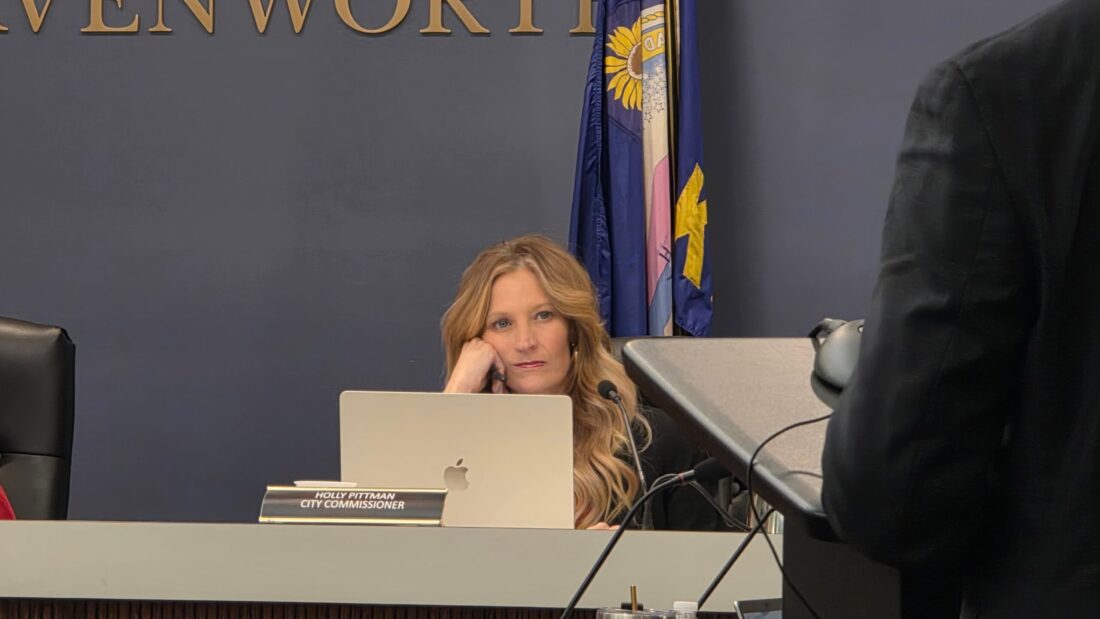
photo by: Morgan Chilson/Kansas Reflector
Leavenworth City Commissioner Holly Pittman listens to a CoreCivic official during a Feb. 25, 2026, hearing on the company’s special use permit.
State and Region
Trump coming to Wichita for Roger Marshall campaign rally
Hays foundation pledges $1M in matching funds to help save Sternberg museum
TOPEKA — A private foundation offered to match contributions dollar-for-dollar up to $1 million for benefit of ...
Kansas Board of Regents adopts early warning rule for college athletics deals with private equity
TOPEKA — The Kansas Board of Regents amended policy to require officials at the six state universities to notify ...

Kansas State president departs school to become new leader of Virginia Tech

General Election Voter’s Guide