

Even with vaccine, nursing home visits will likely be limited
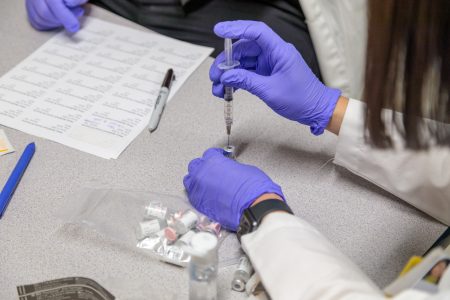
photo by: Truman Medical Center
A worker at Truman Medical Center in Kansas City prepares doses of Pfizer-BioNTech's vaccine against the virus that causes COVID-19 on Dec. 14, 2020.
COVID-19 poses such dire risks to older people in nursing homes that even vaccines won’t guarantee a quick end to their isolation.
Tens of thousands of workers and residents at Kansas long-term care facilities will get vaccinated over the next three months. But families aching to visit after such a long separation may not have easy access to their loved ones for several more months at least.
“We will not be clicking our fingers and returning to normal,” said William Hanage, a professor of epidemiology at Harvard University. “There is not a silver bullet.”
Even for young people, the new vaccines don’t offer a 100% guarantee against contracting the coronavirus. And the shots may be less effective for older people.
That means nursing homes still need to require masks and diligently screen any visitors for the virus or possible signs of it.
As the broader public gets vaccinated and community transmission slows, that will lower the risks that even asymptomatic family members can unwittingly pose. Reaching that point will take at least several months.
The vaccine rollout at nursing homes
Giving shots to tens of thousands of Kansans as quickly as possible is a massive undertaking that comes when health care workers already find themselves battling exhaustion.
But they say this feels like a new phase in a fight they can win.
Lindsborg Community Hospital in central Kansas put its first doses of COVID-19 vaccine into a container labeled “Box of Hope.”
Pharmacists share that sense of coming relief.
“It’s been a really long year for all of us,” Nate Burrell said. He’s a pharmacist who oversees 18 pharmacies for CVS Health in the Kansas City metro area and as far west as Salina. “But I think we all feel kind of energized now.”
CVS Health and Walgreens will help carry out a federal initiative to do the sometimes logistically tricky job of moving temperature-sensitive vaccines to nursing and housing facilities that predominantly serve people over the age of 65.
CVS’ pharmacy teams start fanning out on Monday and must make three trips to each of the 360 sites they’ll visit. People need two doses — administered three or four weeks apart, depending on which brand of vaccine they get. By the end of three months, the teams will have vaccinated up to 40,000 people.
“You think about the disproportionate number of really severe cases or deaths that have occurred in these nursing facilities,” Burrell said. “Quite honestly, I don’t think we can wait to get started.”
Kansas has seen more than 500 outbreaks of the virus in long-term care facilities since the pandemic began. Those clusters — at least two cases each, but sometimes infecting dozens of patients and workers at a single facility — have killed nearly 1,000 people.
That makes such outbreaks the single biggest source of pandemic-related deaths in Kansas, where nearly 2,500 people have died since March.
When the virus surged across Kansas this fall, it found its way into even very rural facilities. Now, most Kansas nursing homes have had cases of COVID-19 among their residents.
The rollout to the wider community
Pharmacies have been preparing for weeks — even months — for the massive vaccination effort. And they still need all the hands they can get — more pharmacists and more pharmacy technicians.
Just taking care of nursing homes involves a lot of skilled workers spending many hours on the road and in the field.
Once communitywide immunization starts, perhaps this spring, pharmacists foresee huge demand.
CVS Health has been ramping up to administer as many as 25 million shots per month at about 10,000 pharmacies nationwide.
Each state sets priorities for vaccination within its boundaries until supplies become widely available. Kansas kicked off its vaccine rollout with those most at risk of contracting the disease, such as health care workers who face COVID-19 exposure on the job.
The pharmacists who will give shots at nursing homes hope to get vaccinated themselves soon. To enter long-term care facilities, they will undergo regular COVID-19 testing and wear protective gear.
Other essential workers and people with medical conditions that put them at higher risk for severe COVID-19 also rank high on the state’s priority list for vaccine access until supplies increase enough to accommodate the wider public.
Vaccine background
The U.S. Food and Drug Administration has approved two vaccines so far for emergency use. It approved Pfizer’s version on Dec. 11 and Moderna’s on Dec. 18.
Kansas got nearly 24,000 doses of the Pfizer version within days. By the end of last week, vaccination had gotten underway in all but a handful of the state’s 105 counties. The state’s first shipment of the Moderna product will provide about 50,000 doses, Gov. Laura Kelly has said.
Unlike Pfizer’s version, which requires extra-cold temperatures that make transportation and storage more difficult, Moderna’s holds up in normal freezers that the average doctor’s office or pharmacy would have on hand.
The medical news outlet STAT has published a side-by-side comparison of the two vaccines, but it reports that limited supplies mean anyone offered shots at this point shouldn’t expect to get a choice between the two.
— The Kansas News Service is a collaboration of KCUR, Kansas Public Radio, KMUW and High Plains Public Radio.
State and Region
Haskell’s Indigenous land stewards embrace cultural and ecological benefit of controlled burns

Sen.-elect Adam Hamilton added to collection of midterm-themed bobbleheads

Documentary about Marion newspaper raids to premiere on HBO

Opinion: California voters rejected the idea of a wealth tax, but Kansas residents are still stuck paying one
Napping driver won’t be charged in deaths after truck accelerated on Wichita soccer field
Council of state lawmakers narrowly rejects proposal to reduce legislators’ pay raise from 4% to 1%
TOPEKA — Leaders of the Kansas Legislature blocked a proposal to slash to 1% the scheduled pay raise for House ...