Watkins, GOP congressional leader split with Trump on birthright citizenship, use of force at border
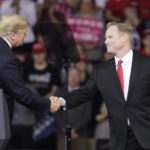
photo by: Mike Yoder
President Donald Trump shakes hands with Steve Watkins, the Republican candidate for Kansas' 2nd Congressional District, during a rally Saturday, Oct. 6, 2018, at the Kansas Expocentre in Topeka.
TOPEKA – The Republican leader of the U.S. House and GOP congressional candidate Steve Watkins split with President Donald Trump on Friday regarding controversial statements the president made this week about citizenship and use of force at the border.
House Majority Leader Kevin McCarthy, R-Calif., was in Topeka, along with other high-profile Republicans, to launch a final get-out-the vote effort for Watkins, who is locked in a close race with Democrat Paul Davis for the open 2nd District seat in eastern Kansas.
“You have to pass that through Congress,” McCarthy said regarding Trump’s assertion that the president has the power to end birthright citizenship by executive order. But he then quickly pivoted to the broader topic of immigration and border security.
“I think the president brings up a very good debate, though,” he added. “This is a debate about securing the border. When we look at a caravan coming across, I don’t think any American believes that that is a way you enter the country. We believe in immigration. We believe in legal immigration. I think the president is raising an issue that needs to be discussed. But I think Congress has a role to look at all sides.”
“I concur,” Watkins said as he too shifted the topic to broader issues. “We’ve talked about immigration before. The most important thing is to secure our borders, first and foremost. That, followed by ending sanctuary cities, chain migration and the visa lottery.”
The 14th Amendment to the U.S. Constitution states, “All persons born or naturalized in the United States, and subject to the jurisdiction thereof, are citizens of the United States and of the State wherein they reside.” The amendment was ratified in 1868 as part of the post-Civil War movement to extend full rights of citizenship to former slaves.
In 1898, the U.S. Supreme Court ruled that the amendment means anyone born on American soil is a U.S. citizen, even if their parents were citizens of another country, a concept now referred to by some as “birthright” citizenship.
But in an interview with the news organization Axios, which was released Tuesday, Trump suggested he could reverse that decision with an executive order.
“It was always told to me that you needed a constitutional amendment,” Trump said. “Guess what? You don’t.”
Legal scholars have said the president doesn’t have that authority, and some Republicans agreed, including House Speaker Paul Ryan, R-Wis. Others, like Kansas Secretary of State Kris Kobach, the GOP candidate for governor, have echoed Trump’s claim.
Trump has also ordered U.S. troops, along with state National Guard units, to the U.S.-Mexico border in anticipation of a large number of migrants traveling from Central America through Mexico toward the United States. And on Thursday, he suggested that soldiers would be justified in shooting people who throw rocks at them.
“Listen, rules of engagement, that’s something I’m intimately familiar with in Iraq and Afghanistan,” Watkins, an Army veteran, said in response to a reporter’s question. “As a general matter, you don’t shoot people who are throwing rocks at you.”
McCarthy added: “If you go to the border today — I don’t know if you’ve ever toured the border, but if you watch — those trucks are protected because rocks are thrown at them quite often. To disperse groups and others, they use paint balls to disperse, and others. They know how to deal with the situation. The challenge is, when you do not have a secure border, you do not have a secure country.”
National
US Rep. Sharice Davids introduces healthcare reform package
TOPEKA — U.S. Rep. Sharice Davids introduced healthcare legislation intended to benefit families grappling with ...
Justice Department won’t enforce registration rules on silencers and certain guns after court ruling
WASHINGTON (AP) — The Justice Department moved Friday to allow more people to purchase firearm suppressors — ...
FBI arrests suspect in hack of the bureau’s jobs portal

Vance expresses doubts about Pentagon plan to livestream Fort Hood shooter’s execution
Hurricane Isaias lashes the US Gulf Coast with wind, rain hours before landfall