

Kansas voters approve measure to tighten language on noncitizen voting
Kansas joins a growing list of states that have passed similar proposals in recent years.
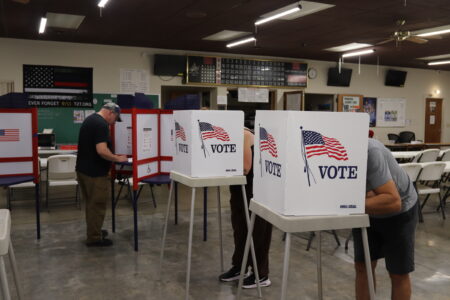
photo by: Josie Heimsoth/Journal-World
Douglas County voters fill out ballots for the primary election on Tuesday, Aug. 4, 2026.
Voters on Tuesday soundly approved a proposal seeking to amend language in the Kansas Constitution to reflect that only United States citizens are eligible to vote in elections, bringing Kansas in tow with a host of other states that have passed similar measures in recent years.
With more than 62% of Kansans voting in favor of the proposal as of 10:15 p.m., the measure reached the simple majority threshold required to pass a constitutional amendment under state law.
The ballot measure, sponsored by Rep. Pat Proctor, the Republican nominee for Secretary of State, asked voters to consider whether Section 1 of Article 5 of the Kansas Constitution should be amended to specify that only U.S. citizens can vote in elections. The goal, supporters of the amendment say, is to remove any ambiguity in the language and put preventative measures in place to prohibit noncitizens from voting in any elections in Kansas, from statewide to municipal elections.
Proctor, who served in the U.S. Army for 25 years, made the argument during a recent rally that it isn’t prudent to wait for a problem to emerge before a solution is offered.
“The first principle of homeland security is you don’t wait until after the plane blows up to stop the bomb from getting on the plane,” Proctor said.
With the passage of the amendment, the constitutional language in question will henceforth read: “No person shall be deemed a qualified elector unless such person: (1) Is a citizen of the United States (2) has attained the age of eighteen years; and (3) except as provided in subsection (b) or (c), resides in the voting area in which such person seeks to vote.”
The Kansas Constitution already prohibits noncitizens from voting in elections, and federal law penalizes those who do — something Proctor acknowledged in an interview with the Journal-World earlier Tuesday.
“The point of the constitutional amendment is not to stop noncitizens from voting; we already have laws in place, and it drives me crazy when I see every article says this is already illegal,” Proctor said. “Yes, it’s already illegal, and we want to keep it illegal.”
He noted that the seemingly minor changes in wording in the amendment are enough to justify an effort to propose such a measure.
“Right now, our constitution doesn’t say ‘only citizens’ can vote; it says ‘every citizen’ can vote.” Proctor said. “And you might think that’s a distinction without a difference, but the states of California, Vermont and Maryland have the exact same language in their constitutions, and all three of those states allow noncitizens to vote.”
Proctor is not wrong. In 2023, voters in Burlington, Vermont, approved a measure that allows legal residents to vote in local elections. And in Chevy Chase, a town of about 10,000 residents in Maryland, the town’s charter does not require voters to be U.S. citizens in order to cast a ballot.
The amendment’s passage means Kansas will be joining a growing list of states that have recently passed similar measures. Iowa, Kentucky, Missouri, North Carolina, Oklahoma, South Carolina, Wisconsin and Idaho have all prevailed in approving such measures in 2024.
On Tuesday, Arkansas and West Virginia joined the list after voters there approved similar amendments. South Dakota, which was still tallying votes as of 10:15 p.m., was on track to approve its own measure, with 61% voting in favor of the amendment. Alaska has a similar proposal on the ballot but official results were not available before publication.
Noncitizen voting is not a common occurrence in U.S. elections. The Heritage Foundation, a conservative think tank that tallies instances of election fraud going back several decades, found 100 cases of documented noncitizen voting between 2000 and 2024. The database, which goes as far back as 1982, lists a total 1,619 instances of voter fraud from that year through 2025, which may include false registration, fraudulent use of absentee ballots, duplicate voting and other types of fraud.
A recent analysis by The Brookings Institute provided a snapshot of instances where noncitizen voting did occur. It found that of the 5,297,264 votes cast during the 2024 general election in Georgia, not a single voter was a noncitizen. In Iowa, an audit by the Secretary of State’s office of the same election found 277 confirmed cases of noncitizens who have registered to vote. Of those, 35 cast ballots during an election where more than 1.6 million Iowans voted.
Proctor, who chairs the House Committee on Elections, fired back at allegations that noncitizen voting is rare. He noted that Kansas officials are currently prosecuting four individuals for voting as noncitizens, and that there are at least 20 more that the Secretary of State’s office has identified that voted as noncitizens.
“How many is too many?” Proctor asked. “Every time a noncitizen votes, they are canceling out the vote of a valid Kansas voter. So I would contend that the number is one — one person voting as a noncitizen is too many.”
The ACLU in written testimony last year said the amendment sets a “dangerous precedent of meddling with the Kansas Constitution,” adding that it is “nothing more than an unnecessary attempt to reinforce what is already established.”
The League of Women Voters Kansas chapter, in a statement on its website, said that though the proposed changes appear subtle, the distinction is “dangerous.”
“The amendment shifts the Constitution’s tone from inclusionary, describing who is included in the right to vote, to exclusionary, describing who alone may be permitted to vote,” the group said. “That shift matters, even where it changes with no immediate legal outcome.”
State Government

Lawrence Democrats keep hold on House district in Douglas County; some Republicans struggle
Pastor Adam Hamilton ousts GOP Sen. Roger Marshall in Kansas Democrats’ 1st Senate win in 94 years
Democrat Holscher hanging on to late lead in governor’s race on a big night nationally for her party
On a big night for the Democratic Party in Congress, Kansas Democrats were fighting hard to hold on to the Kansas ...
Lawrence’s Mann holds narrow lead over Kobach in race to become state’s next attorney general
Current Lawrence resident and former Lawrence police office Chris Mann was in a tight contest to become the ...
Kansas voters approve measure to tighten language on noncitizen voting
Nearby Linwood runs out of paper ballots, causing some voters to leave; more ballots being sent to site
TOPEKA — Susan Schlag went to vote with her husband and 18-year-old son Tuesday morning, only to find that their ...