Kansas Senate, House pass budget bill that pegs raises at 1% for most state employees
Governor now can approve or issue line-item vetos
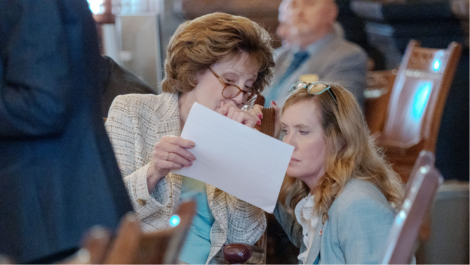
photo by: (PSherman Smith/Kansas Reflector
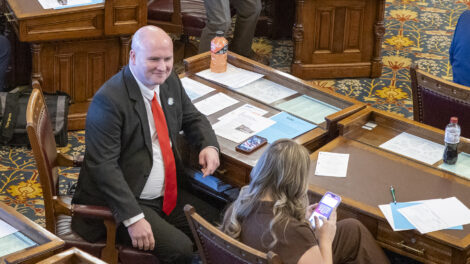
Senate Minority Leader Dinah Sykes, right, reviews a document with Sen. Brenda Dietrich during a March 26, 2026, Senate session. Sykes said the budget’s 1% raise for state employees is a “slap in the face.”
TOPEKA — The Kansas Legislature approved a state budget bill early Friday by working around bipartisan opposition that even lawmakers voting for it could echo.
The Senate passed the bill 23-17 and the House followed at 67-53, but dissenting Republicans and Democrats in both chambers made their displeasure known.
When the dust cleared, thin majorities sent Democratic Gov. Laura Kelly an appropriations bill spending vastly more than the state anticipated to receive in tax revenue during the fiscal year starting July 1. The bill made 1.5% cuts to dozens of state agencies while leaving certain departments unharmed by the budget knife. A major source of consternation during the debate was a 1% raise presented to thousands of executive branch employees.
The bottom line of the 500-page budget was state government in Kansas could spend $475 million more in the upcoming fiscal year than would be generated through all revenue sources. That would represent a 1.7% reduction in expenditures compared to the current fiscal year in which the state remained on track to spend $705 million more than revenue.
If the budget rolled into House Bill 2513 were signed by Kelly, and financial projections proved accurate, it would result by June 30, 2027, in the state having chewed through $1.1 billion in reserve funds over a three-year period.
“I’ve had a few days to think about it,” said Adam Proffitt, appointed state budget director in 2020 by Kelly, in a meeting with Senate Democrats ahead of floor debate. “In my estimation, this is the worst budget I’ve seen come through this building during my time. It’s offensive to me in some spots, too.”
Sen. Rick Billinger, a Goodland Republican and chair of the Senate Ways and Means Committee, said earning a pat on the back from representatives, senators and the governor was an annual challenge. Persistent partisan and ideological divides in the Statehouse accentuated the complexity, he said.
“When we do these budgets, it’s kind of a balancing act,” Billinger said. “We heard across the aisle we’re not spending enough. Now, I just heard … that we spend too much. So, it’s a fine art.”
Rep. Troy Waymaster, a Bunker Hill Republican who presides over the House Appropriations Committee, said the budget would allocate tax dollars wisely and “helps chart a better future for Kansas.”
The governor has traditionally relied on line-item veto authority to reshape budget bills delivered by the Senate and House. If there were vetoes, the Legislature could return in early April to vote on those items.
‘This is just wrong’
Sen. Joe Claeys, a Wichita Republican, fumed about disappearance in negotiations between the House and Senate of the $1 million dedicated for a pilot program to help people with disabilities in Sedgwick County access reliable transportation to job sites. Claeys had drawn $500,000 for the one-year program from state grants to public broadcasting, but negotiators jettisoned the pilot and, to his surprise, added $300,000 to the broadcasting grant.
“They couldn’t find a single dollar to give a disabled Kansan a ride to work,” said Claeys, who reluctantly voted for the bill. “It should be plainly evident that this is just wrong. We’re subsidizing television stations in a world drowning in content.”
A reading of page 132 of the report from budget negotiators revealed maneuvering to direct $10 million to the Kansas Department of Commerce for an undisclosed economic development business deal. It deleted $21 million from the state’s Cooperative Extension Service pending certification of a reorganization plan to better meet needs of the agricultural industry.
Rep. John Carmichael, D-Wichita, said he voted against the bill because it was built on “terrible misallocations of taxpayers’ money.”
“The folks that have lobbyists, vendors with a product to sell … they get their way around here,” Carmichael said. “But when it comes to children, special needs, state employees — I can go on and on down the list — this is absolutely wrong. I think most of us likely know that.”
The document included an item on page 85 granting House and Senate members the privilege of parking from 5 p.m. to 11 p.m. in any state lot or garage not controlled by a gate or barrier arm. The budget debate didn’t reveal which legislator’s parking fiasco led to that.
On page 160, the Kansas Department of Health and Environment was directed to comply with U.S. Centers for Disease Control and Prevention’s vaccination recommendations for students attending schools in Kansas. Standards adopted by the administration of President Donald Trump would compel KDHE to drop three vaccinations and add one.
Rep. Barbara Ballard, a Lawrence Democrat on the Legislature’s six-person budget negotiating committee, said there were enough good things in the bill for her to join GOP lawmakers voting for it. She was disappointed her colleagues didn’t agree to remove provisions forcing state universities to affirm they had eradicated diversity, equity and inclusion, as well as critical race theory, from courses.
Senate’s initial misfire
Early Thursday evening, two Senate Democrats had just wrapped up speeches outlining objections to the budget when Billinger, on behalf of Republicans, withdrew his motion seeking passage of the bill. Sen. Ethan Corson, a Fairway Democrat, said he was prepared to recommend the bill be sent back to negotiators.
Withdrawal of Billinger’s motion avoided potential embarrassment of the bill being prematurely rejected in the Senate.
“This budget is exactly what breeds cynicism in politics,” said Corson, who is seeking the Democratic nomination for governor. “This is not a budget that represents our values. This is not a budget worthy of support of any member of this body.”
He said there would be “real human consequences” to slashing $6 million from mental health services provided to K-12 schools. It could force removal of 3,000 students from a state program. A $6 million increase for special education fell far short of the $50 million surge sought by the governor, he said.
Because Billinger withdrew his motion for Senate passage of the bill, no vote was taken on Corson’s motion to restart negotiations. Hours later, after Senate Republicans gathered for a closed-door meeting, the Senate returned to the bill for a redo.
Sen. Virgil Peck, a Havana Republican who voted against the budget bill, said more talk wouldn’t change the GOP-dominated Legislature’s fundamental problem of overspending.
He said expenditures from the state general fund increased from $8.2 billion in 2022 to $10.9 billion in 2026. The senator predicted the $10.7 billion estimate for 2027 would balloon because of unforeseen costs when the Legislature arrived in Topeka next January.
“Spending is just out of control,” said Peck, who touted credentials of a right-wing conservative. “We cannot be, and we should not be, all things to all people.”
A 1% salary hike
Billinger, the Senate budget chairman, said the bill dedicated $35 million to 1% increase in compensation. He said the House wanted to focus salary funding on workers earning more than 10% below market rates. An across-the-board approach — even at 1% — provided raises to more people, he said.
“I know this is not a lot, but we felt like we value our employees here in the state of Kansas and we wanted to do something,” he said.
Senate Minority Leader Dinah Sykes, D-Lenexa, characterized the single point raise as “a slap in the face” for state employees.
Sarah LaFrenz, president of the Kansas Organization of State Employees, said the appropriation wouldn’t keep up with the 2.4% inflation rate and paled in comparison to the 4% raise for members of the Legislature and a 10% raise for the Legislature’s professional staff. In 2025, members of the House and Senate had compensation increased by more than 90%.
“This is about priorities,” LaFrenz said. “The people making decisions about our pay are taking care of themselves first while asking state workers to fall further behind. That is not equitable, and it is not right.”
In January, Kelly recommended the Legislature approve 2.5% increases for more than 30,000 employees in the executive branch. She recently complained the Legislature had again waited until the end of session to consider state worker salaries.
Cut 1.5%, and repeat
Sen. Pat Pettey, a Democrat from Kansas City, said she was concerned negotiators hammered 24 state agencies with a 1.5% budget cut but chose to hold some state agencies harmless.
She said reductions, compounded by a 1.5% cut in the current budget, applied to departments of agriculture, aging, environment, children and families, revenue, education, labor, administration and commerce. Cuts were made to offices of the adjutant general, child advocate, historical society, human rights and veteran services, she said.
Pettey said the across-the-board reduction was directed at the office of the Democratic governor, but not Republican Attorney General Kris Kobach or the Kansas Highway Patrol and Kansas Bureau of Investigation.
Pettey also objected to earmarking $200,000 to add two employees — referred to as fiscal integrity auditors — to the Legislature’s payroll. The hires would report directly to the Senate president and House speaker. Their task would be to identify state government waste and fraud.
She said the political appointees would have unprecedented access to state databases containing “highly sensitive” information. The senator said the individuals would have access to personal addresses, bank and tank information, and Social Security numbers for people who worked for the state or did business with the state.
“One wrong keystroke in this system that they are not familiar with and they could permanently delete records,” Pettey said.
• Tim Carpenter and Sherman Smith are journalists with the Topeka-based news service Kansas Reflector.
State Government
Kansas Senate, House pass budget bill that pegs raises at 1% for most state employees
U.S. Supreme Court Justice Sonia Sotomayor to visit KU next month; will speak to students, select guests

Union contract would guarantee KU professors at least $7OK salary; other wage details not guaranteed past first year
Douglas County judge sets hearing over Kansas anti-trans ‘bathroom bill’ for Sept. 29
Senate takes shot at coaxing House to endorse 23-hour alcohol sales for World Cup