

Kansas bill extending executive order on health care staffing shortages wins legislative approval
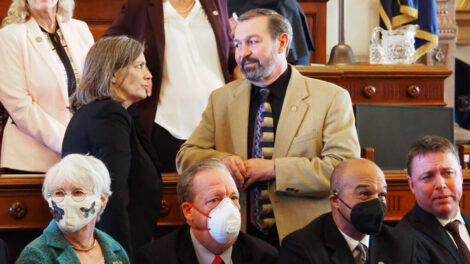
photo by: Tim Carpenter/Kansas Reflector
Sen. Kelli Warren, left, praised a bill approved by the Kansas Legislature for offering health care providers a safety net to address staffing shortages more permanently. An amendment to a different bill from Sen. Virgil Peck, right, would indefinitely extend a proposed tax exemption for agricultural producers on fencing material.
TOPEKA — A bill codifying the bulk of the governor’s recent executive orders authorizing a temporary suspension of regulations on health care providers now heads to Gov. Laura Kelly after approval Thursday by the Legislature.
Legislators applauded House Bill 2477 as a temporary solution to a demanding issue. It is a response to the worsening COVID-19 situation and caseload at many health care sites, and it will extend provisions of the executive order through Jan. 20, 2023.
Primarily, the bill seeks to address staffing shortages and employee workloads by allowing nursing staff with a license that lapsed within the past five years to practice medical services. The legislation also provides for students enrolled in medical programs and certain qualified military personnel to provide medical assistance.
“We heard from hospitals and long-term care facilities as well as nursing home facilities about the complications they face in responding to the high patient demand, in addition to significant staffing shortages,” said Sen Kellie Warren, R-Leawood. “There are staffing shortages for many different reasons, and this bill allows the stakeholders time to work with the Legislature and other stakeholders to find a better solution.”
The Senate approved the bill 36-2, and the House approved minor changes in the the Senate version 96-4, sending the bill to Gov. Kelly. The governor, whose orders expire along with the emergency declaration after Friday, is expected to sign the bill.
Senators also approved a bill providing a tax exemption on any equipment purchased after Jan. 1 used to replace any fencing destroyed by a natural disaster.
As the omicron variant sweeps the state sending sick staff members home, long-term facilities and medical providers are stretched thin. Some hospitals and nursing homes have closed their doors when faced with staffing shortages.
While Sen. Alicia Straub approved of the intent to buoy these facilities, she worried extending the provisions until January of next year was too long to have unlicensed individuals providing care. She proposed a shorter extension until the end of March, as the governor requested.
“We should not get ahead of ourselves,” Straub said. “We should revisit this issue before the end of this legislative session to see if any other issues have arisen out of it.”
The bill also provides relief to nursing homes by allowing temporary nurse aides to provide care for residents.
Changes made in legislative committees also addressed a concern voiced by the Kansas Board of Healing Arts that unlicensed providers may go unnoticed or unmonitored. The amendment requires these providers to give notice to the appropriate regulatory agency within seven days of initiating practice.
“An amendment also clarifies that out-of-state health care professionals that come into Kansas can only come into Kansas for the purpose of preparing for responding to or mitigating” COVID-19, said Rep. Fred Patton, R-Topeka. “So, we narrowed that down a little bit.”
Relief for wildfire damage
In response to the rampant December wildfires which burned more than 160,000 acres across 12 counties, the Senate put its stamp of approval on a bill to provide financial relief to ranchers in purchasing fencing equipment to replace destroyed property.
An amendment offered by Sen. Virgil Peck, R-Havana, would expand the exemption to agricultural producers in perpetuity by removing any sunset on the bill.
“If we had done like some of our neighboring states and had a law on the books that provided a sales tax exemption for our ag producers when they purchase their fencing supplies, the legislation that we had would not even be needed because the fencing stuff would already be sales tax exempt,” Peck said.
According to estimates from the Kansas Department of Revenue, the tax exemption with a sunset would result in the state not receiving about $1.4 million. There was no estimate ready for what the indefinite tax break would cost the state in potential revenue.
The Senate adopted the amendment and passed the bill without opposition. A House committee approved a similar measure earlier Thursday.
Sen. Marci Francisco, D-Lawrence, supported the desire to provide relief for agricultural producers but said the proposal required further vetting.
“I think that this should go through the committee, have a fiscal note and also have more discussion about what other purchases should be excluded or be included,” she said. “This really goes beyond responding to a disaster to changing our sales tax exemption rules.”
Sen. John Doll, R-Garden City, was concerned with what this expanded tax exemption would mean for rural counties.
“Take away sales tax on fencing, they’re going to have to come up with that money somewhere, and we put so many limits I don’t know how counties are going to be able to sustain,” Doll said. “I have 10 counties, nine of them are very rural, a lot of the places only have a co-op open, and I’m just afraid of what we’re going to do to the sales tax in those counties.”
Sen. Caryn Tyson, R-Parker, said other states already do not charge sales tax on fencing material, causing Kansans to cross the border for their needs.
“I kind of joke that my husband and I are probably one of the few that do pay sales tax because we buy it locally, but I can guarantee to you that whatever the fiscal note they come back with, it is inaccurate because there are a majority of sales to go across the state line in order to purchase those things,” Tyson said.
— Noah Taborda reports for Kansas Reflector.
State Government
2 Douglas County District Court judges up for retention on November ballot
General Election Voter’s Guide
Two state senators vying to be Kansas governor

14 candidates for Kansas House of Representatives will appear across Douglas County ballots in November. See who they are.
Three candidates vying to become state’s chief election officer
There will be a new Secretary of State in Kansas after the incumbent decided not seek re-election to the post that ...
Voters Guide: Meet the candidates vying to become Kansas’ next Attorney General
Current Kansas Attorney General Kris Kobach is facing off against Democrat Chris Mann for the office. Again. The ...