Kansas will soon disinfect and reuse N95 masks; plan to reopen state coming this week
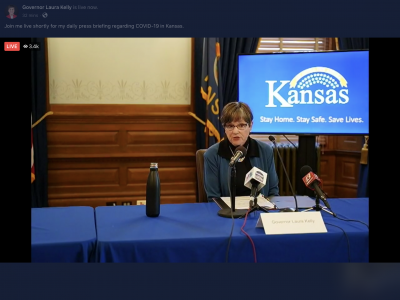
Kansas Gov. Laura Kelly speaks at a COVID-19 press briefing on Monday, April 27, 2020.
Kansas will soon have a system to decontaminate N95 masks crucial to protecting health care workers from COVID-19, Gov. Laura Kelly announced Monday.
Called the Battelle Critical Care Decontamination System, the technology — which Kansas received from the Federal Emergency Management Agency — will allow the state to safely reuse up to 80,000 masks per day once the system is fully operational. A single mask can be safely reused up to 20 times, Kelly said.
Since the pandemic took hold in March, Kelly has long voiced her concerns about a lack of personal protective equipment in the state. The BCCDS isn’t a cure-all, Kelly said, but it addresses the key need of protecting health care workers.
“While this new system won’t fully resolve the shortage, it will go a long way in protecting our frontline workers,” she said in her daily COVID-19 press briefing.
Also on Monday, Kelly said state officials were continuing to formulate a plan to begin a phased reopening of the state economy, and they hope to release the plan later this week. Kelly said she participated in a call with the White House earlier Monday in which President Donald Trump outlined his administration’s plan to reopen the country’s economy.
That plan, Kelly said, highlighted a blueprint for testing and rapid response programs. It also emphasized the importance of the roles for federal, state and local governments, in addition to private partners.
“We are in agreement that we do need to work together to prioritize testing. It’s the only way we can safely reopen our economy,” Kelly said.
The Kansas Department of Health and Environment on Monday began releasing new data about COVID-19 cases in the state, including more detailed information on hospitalizations and comprehensive information on virus-related deaths.
Since the pandemic took hold, Kansas has hospitalized 496 people of 2,541 cases where data is available. Of those, KDHE said Monday, 180 have required admission to an intensive care unit, and 81 have needed to be on ventilators.
KDHE has documented 241 patients who have been discharged from hospitals since getting the virus, but said more could have been released but they just don’t have the data yet.
Of the 120 deaths attributed to the virus in Kansas — up two from Sunday — the ages range from 42 to 99, with the median age of 83, according to KDHE.
Statistics also show that black Kansans are eight times more likely to die from COVID-19 than white Kansans.
Kansas has now tested 27,167 people for the virus and increased its testing rate per capita to 9.33 per 1,000 people; it had previously been between six and seven people per thousand. As of Monday, 3,328 people, or 12.3%, had tested positive.
KDHE Secretary Dr. Lee Norman said Monday that the increase in the number of cases was expected since the state has expanded its testing capacity. What’s more encouraging, he said, is that the hospitalization and death rates continue to slow — a key metric in beginning to reopen the state.
“You have to read just beyond the numbers to see what the trend lines are,” Norman said.
The state is tracking 55 clusters, which can be traced to the following locations:
• 18 from long-term care facilities, resulting in 401 cases and 68 deaths;
• two from group living facilities, resulting in 28 cases and zero deaths;
• one from a correctional facility in Lansing, resulting in 115 cases and one death;
• two from health care facilities, resulting in 16 cases and zero deaths;
• six from religious gatherings, resulting in 99 cases and eight deaths;
• 20 from private gatherings, resulting in 170 cases and four deaths;
• six from meat-packing plants, resulting in 378 cases and zero deaths.
The department, Norman said, is beginning to train workers to conduct contact tracing to better understand where the virus may have spread, with the goal of ultimately staffing a team of 400 tracers.
State Government

Business owners hurting from Wakarusa Drive closure say they’re getting no answers, no signs, no accountability

Opinion: Republicans and Democrats should come together to make voting as easy as buying a gun

Opinion: Lawrence’s data center moratorium is wrong in one way, but right in the most important
Constitution Day program goes global with mock trial for third graders
Records request shows questions about how transgender voters must register for elections
TOPEKA — A Kansas Republican Party officer called the Secretary of State’s Office in July to ask why a new ...