Lawrence school district to recognize Indigenous Peoples Day as a holiday starting next school year
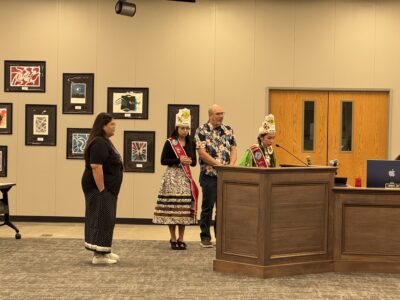
photo by: Josie Heimsoth/Journal-World
From left to right, Shayla Chickaway, NASS administrative assistant; NaFehna Farve, 2025-2026 Miss Indian Youth of Lawrence; David Farve, NASS coordinator; and Riley Alva, 2025-2026 Jr. Miss Indian Youth of Lawrence are pictured on Monday, Feb. 9, 2026.
Starting next school year, the Lawrence school district will recognize Indigenous Peoples Day, the second Monday in October, as a district holiday and a day off for students and staff.
District calendars with the holiday were approved by the Lawrence school board at its meeting on Monday night, at which board members also heard an update from Native American Student Services about the district’s American Indian and Alaska Native student population.
The calendar change means students and staff will have the day off on Oct. 12 of this year across all schools in the district. It will require some tweaks elsewhere in the calendar to add the holiday in while maintaining the required number of instructional days, though. The end of the 2026-2027 school year has been extended by one day from the previously proposed calendar to accommodate it, and the final day will now be on Wednesday, May 26.
Nine-month classified staff will be paid for the holiday, and all other employees will adjust their schedules without added compensation.
The new calendars that the board approved on Monday were for the 2026-27 and 2027-28 school years. The first full day of school for K-12 students in the 2026-2027 school year will be Aug. 13, and the next school year will run from Aug. 12, 2027, to May 23, 2028. For both upcoming school years, the calendars will continue with a full week off for fall break and a 10-day winter break for nine-month staff, while aligning spring break with the Board of Regents and the University of Kansas.
…
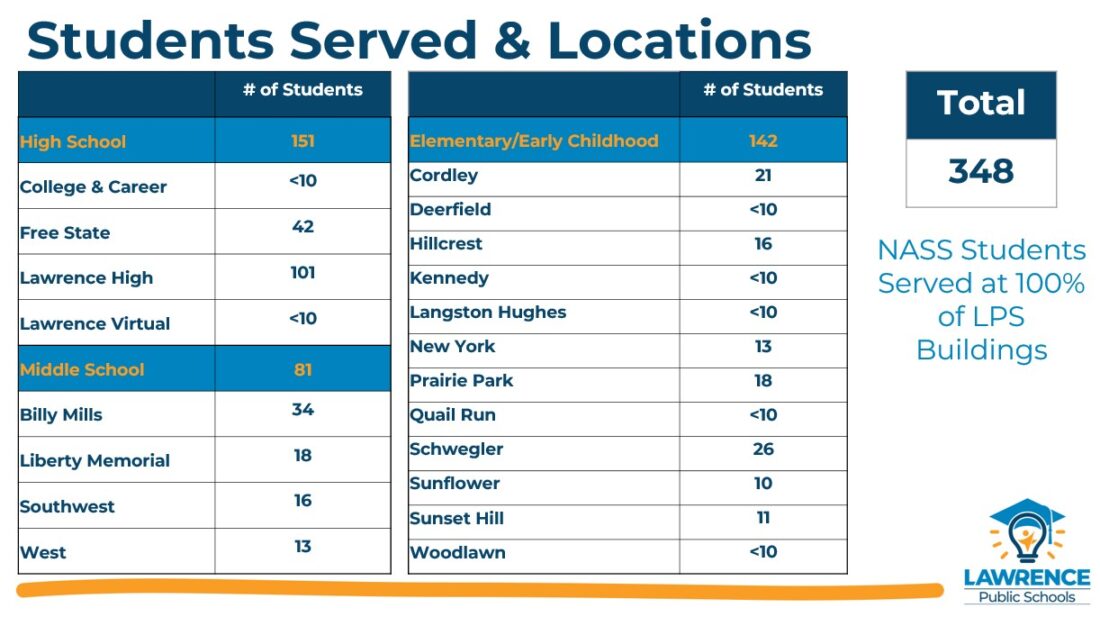
photo by: Lawrence Public Schools screenshot
The number of Native American Student Services students and the schools they attend in the Lawrence school district in 2025-2026.
On Monday, board members heard an annual report from Native American Student Services, or NASS, about the district’s American Indian and Alaska Native student population and the services they receive.
In a presentation by David Farve, NASS’ coordinator, the board heard that American Indian and Alaska Native students make up around 8% of the Lawrence school district’s total enrollment, and NASS serves around 350 students who represent more than 70 tribal affiliations. The school with the most NASS students – more than 100 – is Lawrence High School. The number of students who self-identify as American Indian or Alaska Native is larger than the number served by NASS, at around 810 students.
Farve said that NASS provides academic, social and cultural support to Native students, offering things like tutoring and mentoring, cultural programming and school supplies. It does this using federal grants that are a partial fulfillment of treaty obligations.
Specifically, NASS uses government funding from Title VI and the Johnson-O’Malley Act to address the distinct cultural, language and educational needs of American Indian and Alaska Native students. Farve said Title VI helps pay for the tutoring that NASS offers, but the bulk of funding comes from Johnson-O’Malley, providing money for school supplies, student activity and sports fees, cultural activities, art classes and more.
Last school year, the eligibility requirements for Johnson-O’Malley programs went through some changes, Farve said. To be eligible for the programs, according to the NASS presentation, students must now have “… a link to a Tribal member (through descendancy) that is within a certain proximity, meaning the student has at least one parent or grandparent (living or deceased) who is a member of a federally recognized Tribe.”
Farve also noted a cultural event coming up at Lawrence High: the Intertribal Club Powwow, which will be on Saturday, Feb. 21, at the high school, 1901 Louisiana St., with a gourd dance beginning at 3 p.m. and a supper at 5 p.m. The event is free and open to the public.
IN OTHER BUSINESS, BOARD MEMBERS:
• Authorized the superintendent to complete the requirements for a $50,000 noncompetitive grant for the Pathways to a Healthy Kansas Incubator Kitchen Package. The grant, funded by LiveWell Douglas County and a Blue Cross Blue Shield of Kansas initiative, will support the Community Connections bakery and Empowering Brew Coffee Shop at Pinckney, where students with special needs in the district’s C-Tran program will work and gain job skills.
C-Tran students have already begun job shadowing in the bakery and will also develop skills to operate the coffee shop, selling made-from-scratch baked goods produced at Community Connections. The grant funds will be used for equipment upgrades to ensure food safety and support the coffee shop operations. A previously awarded $100,000 Kansas Department of Agriculture grant will serve as the required match, with no additional match needed.
• Approved the purchase of PowerSchool Talent Perform Solution, a tool designed to improve employee evaluations, at a total cost of $74,310 over a three-year period. During fall 2025, district officials reviewed two such tools and selected PowerSchool Perform because of its alignment with the district’s existing PowerSchool platforms. A full rollout to principals is expected in time for the 2026-2027 school year.
• Accepted a bid from McElroys Inc. for the Lawrence High School chiller replacement project in the amount of $352,076, plus a 10% contingency of $35,207, for a total project cost of $387,283. The board’s meeting agenda said that after evaluating existing mechanical equipment, the replacement of one chiller at Lawrence High was “determined to be necessary.”
• Accepted a bid from Pro Circuit Inc. to purchase and install an emergency standby generator at the Educational Support Center, 110 McDonald Drive, in the amount of $140,700, plus a 10% contingency of $14,700, for a total project cost of $155,400. The meeting agenda said the existing generator has reached the end of its useful life and must be replaced.
• Approved a multi-year agreement for Turf Tank equipment with an initial cost of $17,700 for the first year and an annual fee of $16,000 for two subsequent years. The Turf Tank is robotic equipment that paints athletic fields and parking lots, and the purchase is meant to save employees’ time and resources.
• Held an executive session for the purpose of evaluation of Superintendent Jeanice Swift. No action followed the session.
K-12 Education

Four Lawrence High School students win gold medals at national art competition

Lawrence school district appoints five leaders to new roles for 2026–2027, reshuffles roles without adding staff
New classroom materials, graduation pathways and more are part of Lawrence school district’s plan to improve instruction

Lawrence school board to consider more than $1M of running track replacements at LHS and Free State

Kansas students can’t have their cellphones during the school day starting this fall