

Lawrence school district staff outlines committee’s path to an AI policy for staff and students by next school year
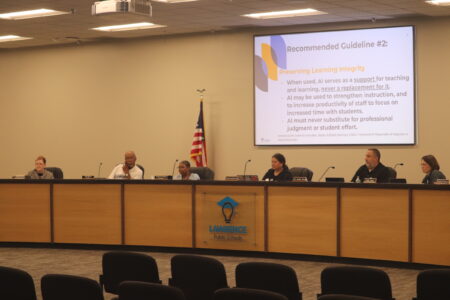
photo by: Josie Heimsoth/Journal-World
Lawrence school board members meet on Monday, Aug. 24, 2026.
Lawrence school board members on Monday heard about the principles that will guide the district in creating a new artificial intelligence policy, which is expected to be proposed before the next school year.
Although the board is still some time away from seeing a draft of the policy, district staffers presented three guiding points that will help shape the work of the AI advisory group that’s developing it, and they asked board members for feedback. Those guiding points are:
• AI usage in the district will comply with existing student data protection laws, such as the Family Educational Rights and Privacy Act, Children’s Online Privacy Protection Rule, Individuals with Disabilities Education Act and Section 504 of the Rehabilitation Act. This also includes not placing any personally identifiable information into any AI platform.
• AI usage will serve as a support for teaching and learning and not a replacement for it. The platform is not allowed to substitute for “professional judgment or student effort.”
• Users of AI “will be trained” to use the platforms responsibly, continue to build AI and information literacy skills, evaluate outputs for accuracy and bias and identify when a tool is being misused.
James Polk, the district’s senior director of data, assessment & information technology, said that these points can also be used for teachers and staff in classrooms for the upcoming school year as the AI advisory group continues to work on a larger policy.
Board member Kelly Jones said she was glad to see the three guiding points, especially since the use of AI and the technology continues to evolve.
Board member Shannon Kimball said the advisory group may face some challenges from future decisions by the Kansas Legislature. She said the use of AI continues to be discussed there, especially after state leaders passed a bell-to-bell ban on cellphone use in schools.
There were some benefits and risks of AI use identified in Monday’s presentation to board members. The benefits include using AI as a “recommendation engine” and as digital assistants to enhance learning. Some of the risks associated with AI include academic dishonesty, an overreliance on AI and student data breaches.
There are 21 members of the AI advisory group, including eight parents/guardians, four community members, seven district staff members and two district students. The group met four times during the 2025-2026 school year, according to Monday’s presentation.
Board members first floated the idea of creating an ad-hoc group to address AI and evolving technologies in June 2024. The committee was originally set to begin during the tenure of former Superintendent Anthony Lewis. It was anticipated to be formed by May 2025, but Lewis resigned before the group was scheduled to begin its work.
The AI advisory group is currently scheduled to share recommendations with the school board for a potential policy in March 2027. The school board is anticipated to review and adopt an AI policy in the spring or summer of 2027.
IN OTHER BUSINESS, BOARD MEMBERS:
• Approved a new district policy that prohibits staff and students from communicating privately via social media in order to comply with state law. Examples of prohibited interactions online – during and outside of the school day – include private or direct messaging, comment-based conversations and other individualized messages with a student.
As the Journal-World reported, the policy states that the expectation for employees is to only use board-approved communication tools for district business. Social media can be used by district staff to promote school programs, activities, events or broadcasting one-way, public communications.
• Approved publishing notices for public hearings on the district’s 2026-2027 budget and its intent to exceed the revenue-neutral property tax rate – which is the tax rate that generates the exact same amount of property tax dollars as the previous year, based on the current year’s total property values.
The revenue-neutral rate for the district is 49.613 mills. One mill is equal to one dollar of property taxes for every $1,000 of a property’s assessed value. In addition, as the Journal-World reported, the district’s maximum mill levy is 52.204 mills. The maximum mill levy means the district can decide on a mill levy lower than this amount, but it cannot go higher.
The budget has not yet been adopted. Public hearings on exceeding the revenue-neutral rate and on the adoption of the 2026-2027 budget itself are scheduled for Sept. 14 during the school board’s regular business meeting.
• Approved the second phase of furniture for the Centennial Choice Campus in the amount of $89,323. The Choice Campus is the district’s new personalized, flexible and nontraditional high school option. The furnishings will go towards two different classrooms, including a “coffeehouse-style” setting for students to collaborate with their peers and teachers in small groups, according to the agenda, and a space for independent reading, research and focused work. In July, board members approved the first phase of furniture for the new space.
• Approved the property and temporary construction easements to the City of Lawrence at the Lawrence school district offices at 110 McDonald Drive with the fair market value payment of $5,400. As a part of the 2025 Safe Routes to School Improvement project, the city plans to install new sidewalks on West Second Street, from McDonald Drive to Michigan Street. The work is scheduled to begin in winter 2026 and continue into summer 2027.
Other News

‘One of a kind’: Sale at the Lawrence Arts Center will find new homes for late musician’s unique custom guitars

Go, See, Do: KU homecoming, Halloween happenings and other events
Student-run coffee shop opens at Community Connections at Pinckney, teacher receives surprise $1,000 award

‘This is for all of us’: Midco Prairie, an oasis of native plants in downtown Lawrence, opens to the public
Douglas County commissioners express interest in fireworks sales dates that include a weekend
