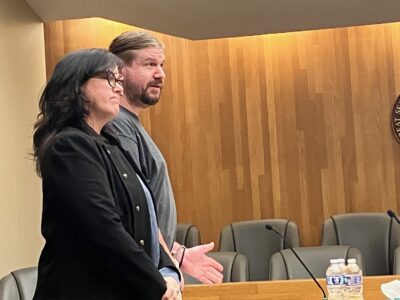
Hundreds of residents urging Douglas County sheriff to oppose ICE bill; Armbrister says law would not boost ICE locally

photo by: Chad Lawhorn/Journal-World
Douglas County Sheriff Jay Armbrister takes the oath of office on Jan. 13, 2025.
Hundreds of local residents want Sheriff Jay Armbrister to oppose a bill on how much sheriffs must cooperate with ICE agents, but the sheriff is backing the bill.
Armbrister told the Journal-World on Tuesday that he is supporting the bill because he is confident that it will give his office the legal backing to maintain current practices, which involve only cooperating with Immigration and Customs Enforcement officials in limited instances.
“As I have said from the very beginning, our agency will only interact with ICE on administrative immigration detainers if an individual has been booked into our jail on local charges and is still in custody when ICE sends the proper detainer paperwork,” Armbrister said via email.
Douglas County residents have created a petition urging Armbrister to oppose House Bill 2771.
HB 2771 which would would require county sheriffs who run jails to comply with ICE, specifically honoring ICE detainer requests, and allow sheriffs to enter into cooperation agreements with ICE, even if the county’s county commission objected to such cooperation agreements. The bill also mandates that certain insurance providers must cover local law enforcement agencies when they have an official agreement with ICE to carry out certain immigration enforcement duties.
In addition, the bill requires the state to help cover certain legal judgements and provide legal representation for officers enforcing federal immigration laws.
However, the Kansas Legislature already has discarded HB 2771 and replaced it with a similar bill containing many of the same provisions. That new bill, which has been approved and is awaiting Gov. Laura Kelly’s signature, is HB 2372. Organizers of the petition — listed as the Lawrence Community Alliance — have not updated the petition to reflect the new bill.
As of Tuesday afternoon, the petition had surpassed its goal of 400 signatures. Now, it is aiming to receive 500 signatures.
The petition is asking Armbrister to take a stance against the legislation by publicly opposing the bill and ensuring Douglas County does not expand its role in immigration enforcement, and using his influence within the Kansas Sheriffs’ Association to withdraw support. It also calls on him to not enter any voluntary 287(g) agreements with ICE and to advocate for the bill’s repeal or veto, even if it is passed.
The petition said ICE operations are “endangering citizens and non-citizens alike,” and it has resulted in communities losing trust in local law enforcement. It has also resulted in lawsuits against local authorities cooperating with ICE.
“We recognize that you have historically opposed involving our county jail in ICE matters,” the petition said, referring to Armbrister. “We are calling on you to stand firm in that commitment and to take immediate action to oppose this dangerous legislation.”
As the Journal-World reported, Armbrister has said multiple times that immigration enforcement is the job of the federal government and not local jurisdictions. He said that beyond honoring valid ICE warrants, he instructs his deputies to avoid getting involved with ICE activity unless necessary.
Armbrister reiterated his position to the Journal-World on Tuesday, and said the proposed legislation gives him the legal ability to continue operating with ICE exactly as he currently does. Those practices revolve around the idea that an individual must already be in the custody of Douglas County on local charges before the Sheriff’s Office will honor any request from ICE to detain an individual for alleged federal immigration violations.
In other words, if a person already is in jail for local charges when Douglas County receives the detainer document from ICE, Armbrister’s office will keep the individual in custody to give ICE officers time to detain the individual. However, Armbrister said he is strict about how long he will keep the individual. The department’s practice is to keep no one longer than 48 hours while awaiting ICE.
“If they do not arrive to pick the individual up by 48:00:01, the person will be released,” Armbrister said.
Armbrister added that the only other way the agency would interact with ICE is if they or community members call to report an emergency that requires immediate attention.
“And even if a situation like that occurs, our role will be to maintain peace and safety for all people involved,” Armbrister said.
Armbrister did not submit testimony to the Kansas Legislature during the public hearings for either of the bills, but the original bill did receive support from Sedgwick County Sheriff Jeffrey Easter – who is the chair of the Kansas Sheriffs’ Association. The KSA was also involved in creating the bill.
The testimony outlines how local law enforcement agencies can participate in federal immigration enforcement through three types of 287(g) agreements with U.S. Immigration and Customs Enforcement: the Jail Enforcement Model, the Warrant Service Officer, or WSO, model, and the Task Force Model.
In Kansas, the WSO model is most commonly used, allowing ICE to identify individuals in jail who may be in the country unlawfully and issue 48-hour detainers for local deputies to serve.
A concern raised in the KSA’s testimony was the legal risk faced by local law enforcement when cooperating with ICE, pointing to lawsuits in other states where sheriffs were sued for honoring ICE detainers and were not defended by the federal government.
The KSA also mentioned a 2023 habeas corpus case involving an ICE detainer at the Douglas County Jail. Judge Carl Folsom III ordered the release of a woman, Anabel Alonso-Martinez, who was being held in jail on an ICE detainer after posting bond on local charges, as the Journal-World reported.
Armbrister said the bill reaffirms statutory authority for a sheriff to hold for that 48 hours he mentioned and puts in protections for a county should it be sued for holding on that 48-hour period beyond the local charges.
“This new bill actually creates a very solid space for me to NOT enter into a 287(g) program,” Armbrister said in the email. “This statute allows me to continue to operate as I have for five years as your Sheriff and as previous Sheriffs have for many years before me.”
Armbrister added that he is opposed to entering a 287(g) program and “will never enter one willingly.”
“I personally have seen pressure from state and federal government officials aiming to remove that choice from elected sheriffs including by threatening to cut state and federal funding to public community programs and entities,” Armbrister said. “This legislation gives me solid legal ground to stand on as a Sheriff especially to avoid entering into a 287(g).”
Public Safety
Hundreds of residents urging Douglas County sheriff to oppose ICE bill; Armbrister says law would not boost ICE locally

Nonprofit plans a full slate of events for Sexual Assault Awareness Month, including trivia, art auction, vigil for survivors

Local law enforcement leaders to answer questions about ICE, traffic stops, other issues at NAACP event

Douglas County judge opts to seal rather than redact more arrest affidavits, keeping them entirely from public

Document challenges claim that baby’s heart valves were donated, potentially lending support to natural causes, not abuse, as cause of death