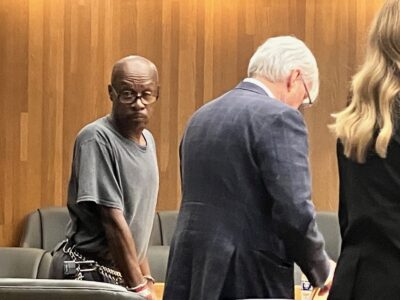
‘It would be absolutely reckless of you’: Kansas Parole Board hears a wall of opposition to Lawrence rapist’s potential release
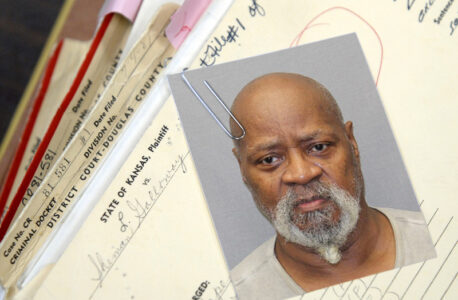
photo by: Journal-World Photo Illustration
Sherman L. Galloway, pictured in this photo in 2022, was convicted of sodomizing and raping two University of Kansas students in 1981.
Paula Kissinger is in her 70s now, but she vividly remembers responding to a call as a Lawrence police officer in the summer of 1981: A young student had been brutally raped at knifepoint by a stranger on the KU campus and had barely escaped with her life.
Kissinger took the initial crime report, collected evidence and accompanied the victim, Jean Rhea, to the hospital, where Kissinger saw bite marks on her body — among an array of other physical injuries and profound mental trauma.
Kissinger was convinced from the get-go that Rhea’s attacker was a “sociopath.” Forty-five years later, she’s still convinced of that, perhaps even more strongly. On Wednesday, she pleaded with the three-member Kansas Parole Board to keep the rapist, Sherman L. Galloway, locked up for as long as humanly possible.
“It would be absolutely reckless of you, the board, to release him,” Kissinger, now long retired, said during a public comment session via Zoom.
She told the board how after she left Rhea at the hospital she went to the crime scene, the area behind KU’s Snow Hall along Memorial Drive, where Galloway, wielding a knife, had raped and sodomized Rhea, who was out for an evening run. He assaulted her there and in another spot down the hill toward Potter Lake, where she had briefly escaped to, despite his multiple threats to slit her throat. As she got free once more, Galloway ran after her with the knife, until a passing motorist saw the unclothed, frantic woman and drove her to safety.
At the crime scene, Kissinger said, she found a six-pack of beer — “Schlitz, I believe” — that was only partially consumed beneath a tree. Investigators believed this spot, where four beers remained unopened and abandoned, was where Galloway had sat that July night “watching and waiting for a potential victim.”
Kissinger, like many who have spoken about Galloway’s possible May release — should the board agree to it — noted that Galloway has never, in nearly half a century, expressed remorse or apologized to Rhea or to another KU student whom he was also convicted of violently raping the same year at Lawrence’s Clinton Park near Sixth Street.
“After his conviction I promised Jean I’d do everything in my power to keep him incarcerated for the rest of my life,” Kissinger told the board. And if that means addressing the board again in her 80s or 90s, she’ll do it. She’ll do it until she dies.
So will Rhea, of course, who spoke last week to the Journal-World about the ordeal of pleading with the board every time Galloway is considered for parole, which happened first in 1996, 15 years after the crime, then again in 1999, 2004, 2005, 2007, 2012, 2019 and again now.
On Wednesday she told the board that Galloway was “a serial, violent sexual predator” and that she feared he would attack more women and would seek retribution against her if he were to be released. She pointed out that he was on parole for a violent crime when he attacked her — his parole card was in his wallet found at the crime scene — suggesting that another parole would culminate in similar brutality.
“The level of violence” that Galloway inflicted “was horrific and brutal and terrifying,” she said, and it took her 20 years to really start putting her life back together after the attack. The post-traumatic stress has affected her — and her family — to this day, she said, and she might never have made it past that night if she hadn’t received strong support from law enforcement and many other supporters.
Rhea said that back in 1981 law enforcement officials had told her that at least a dozen other women had “probably” been raped by Galloway but were too frightened or felt too stigmatized to come forward. Resources available to rape survivors were far fewer then, but if just one of those women had felt comfortable in pursuing a case against Galloway — if they had had the kind of support she had — she and other women might have been spared his violence, she said.
Like everyone else who addressed the board — six appeared Wednesday via Zoom, plus more spoke at an earlier hearing and others have submitted written comments — Rhea has been most struck by Galloway’s refusal to take responsibility and to apologize in the face of overwhelming evidence against him and the overwhelming harm he has caused.
Shelley Diehl, a former Douglas County prosecutor who reviewed the case years later as Galloway sought DNA testing and who has spoken at every parole opportunity thereafter, said it was clear to her that Galloway was “unsocialized” and was incapable of operating in society.
“He simply doesn’t live in a world of rules,” she said. “I think that he should never walk amongst us again. He is a risk to the public.”
Diehl said she had never seen any indication that Galloway had completed counseling “or anything that would show that he has had any insights” or acquired any skills that would make him a productive member of society at 66 years old.
“The only thing he was really good at was stalking, raping and sodomizing women,” she said.
Diehl said that she still lives in Lawrence and frequently drives near the areas where the two rapes Galloway was convicted of occurred.
“It makes me ill,” she said, as images of what the women endured flash through her mind.
And they are not even her own memories. They belong to Rhea, who is grateful for the capacity of others to imagine her experience and to understand what’s at stake.
As she concluded to the parole board, “It takes a village to keep a sexual predator in prison.”
After she spoke, Mark Keating, one of the parole board members along with Jeannie Wark and Carolyn Perez, thanked her for participating.
“Your strength and courage is nothing short of amazing,” he told Rhea.
Two of Riling’s siblings and a brother-in-law also spoke out Wednesday against Galloway’s release. Rhea’s brother said Rhea’s parents were dead now but that they had previously attended every session to speak against the man who had so hurt their daughter.
“I saw what it did to them,” he said.
In Rhea’s case, Galloway was sentenced in 1981 to 30 years to life in prison, with the possibility of parole after 15 years. Three years later, the same judge ordered another 30-to-life sentence in the other woman’s rape, with Galloway still being eligible for parole 15 years after his first conviction. At the time of the rapes, Galloway was on parole for a violent aggravated battery committed in 1979.
Galloway is incarcerated at the Ellsworth Correctional Facility. If the parole board finds in his favor, he could be released as early as May 1. The board will conduct a private hearing with him in April. The board can make one of three decisions after that. It can either grant parole, continue the process to gain additional information, or “pass” on parole again and determine when he should next be considered for potential release.
After Galloway’s 2019 hearing, the parole board denied release, citing Galloway’s history of criminal activity; the violent nature of his crimes; his denial of responsibility; and others’ objections to his release. In setting his next parole opportunity seven years out — to this year — the board noted that Galloway didn’t have a parole plan “to meet his needs or to provide for public safety”; he had committed new crimes while incarcerated or paroled in the past; the community had been “exceedingly opposed” to his release; and he hadn’t demonstrated “behavioral insights necessary to decrease his risk to re-offend.”
Public Safety
‘It would be absolutely reckless of you’: Kansas Parole Board hears a wall of opposition to Lawrence rapist’s potential release

Meth possession charge turns into interference with law enforcement plea deal; state is recommending probation
Some fire stations in Lawrence respond to fewer calls than others; a look at the data and whether it means anything for Station 6
Traffic affected by grass fire on U.S. Highway 59 south of Lawrence
Woman who pulled knife on store clerk is not immune from prosecution, judge rules