

Judge opts for secrecy in crash that killed actor, offers no explanation of order sealing defendant’s arrest affidavit; also seals unrelated affidavit

photo by: Contributed
Judge Stacey Donovan
A Douglas County judge has opted for secrecy in the case of a driver accused of killing a local actor.
Without providing any explanation for her ruling, Judge Stacey Donovan issued an order Monday saying that the arrest affidavit for Eliseo Munoz, accused of murder in the death of Louise ImMasche, “shall be sealed and not released.”
Donovan apparently signed the order on March 6, 13 business days after it was requested. Under state law, a judge has 10 business days after receiving notice of an affidavit request to issue an order. Though signed late last week, Donovan’s order regarding the affidavit was not publicly available until this week.
Judges have the option of redacting sensitive details in an affidavit or hiding the document entirely from the public. Donovan chose the latter and did not, as some judges do and as Donovan herself has sometimes done, indicate to the public why she did so. The state law dealing with affidavits outlines numerous reasons for a judge to redact or seal an affidavit, including, among others, safety, privacy and interference with an investigation, but Donovan did not list any.
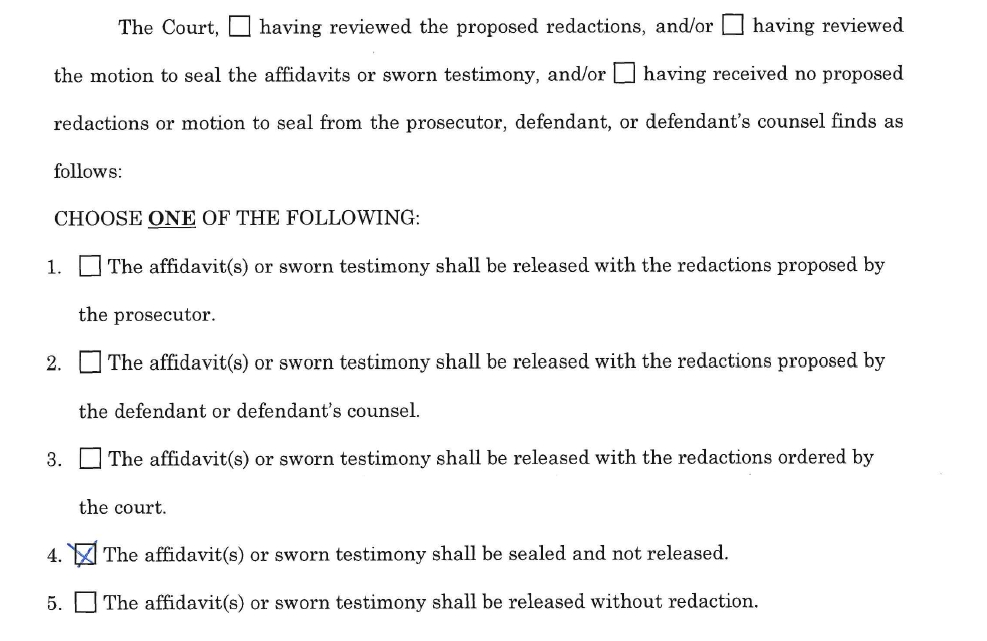
Judge Stacey Donovan’s order in the Eliseo Munoz case.
An arrest affidavit is a sworn document compiled by law enforcement officers that explains why they believe they have probable cause to deprive a person of his liberty.
As the Journal-World reported, Munoz’s attorney, Michael Clarke, asked Donovan to keep the document entirely under wraps, saying that it includes alleged admissions by his client as well as toxicology results and how fast he may have been driving on Oct. 24, 2025, the night that 41-year-old ImMasche was killed in a head-on collision on the South Lawrence Trafficway. The crash occurred after ImMasche’s performance in “The Rocky Horror Show” at Theatre Lawrence.
Clarke argues that the public didn’t need to know any more details than were provided in the charging document, which lists only the names of the parties, the date and the charges: second-degree murder, one count of circumventing an ignition interlock device, one count of reckless driving and one count of driving with a suspended or revoked license.
If the public were to know the allegations in the affidavit, Clarke argued, Munoz would suffer “prejudicial pretrial publicity.”
Clarke himself, however, noted in his motion that sensitive information could be redacted. If the court would not agree to keep the affidavit completely hidden from the public, it could release a redacted version — one that would be “narrowly tailored to the least prejudicial information.” Specifically, he asked the court to redact things the defendant is alleged to have said, toxicology details and information related to “technical evidentiary assertions,” which would presumably include information such as his vehicle’s speed.
The Douglas County District Attorney’s Office had asked Donovan to release the affidavit to the public with only dates of birth redacted. Donovan’s order, however, reflected her apparent belief that no part of the affidavit should be released.
In addition to the murder charge, Munoz, 24, is also facing charges of a third DUI and driving while suspended in a separate case from March 2024. In that case, the charging document indicates that his blood alcohol level was 0.24, which is three times the legal limit.
Munoz is being held on a bond of $750,000 in the murder case. Prosecutor David Melton told a judge at a recent hearing that Munoz posed “an extreme risk to the public” if he were to be released.
At his court appearance Tuesday morning via video from the jail, Donovan set his preliminary hearing for April 15. At such a hearing she would decide if probable cause exists to order Munoz to stand trial.
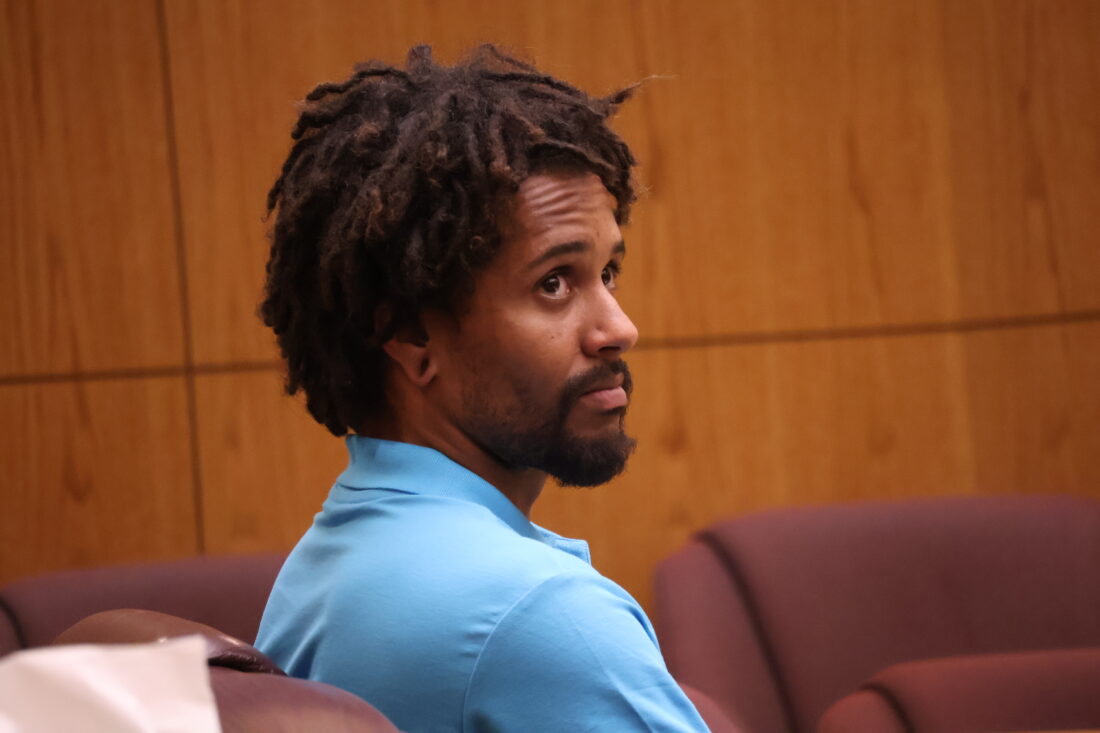
photo by: Chris Conde/Journal-World
Brandon Snow appears on June 5, 2024, in Douglas County District Court.
Donovan on Monday also signed an order to seal an affidavit in another defendant’s case — that of Brandon Eugene Snow, a homeless resident who is accused of aggravated assault with a baseball bat. That affidavit, like Munoz’s, also was requested in mid-February.
In that case, Snow’s appointed attorney, Razmi Tahirkheli, said release of the affidavit would taint the potential jury pool and could allow inmates to use information in the affidavit against Snow to benefit themselves. The state’s opinion on the matter is not reflected in publicly available records. As in the Munoz case, Donovan evidently believed no part of the Snow affidavit should be released, but she did not reveal any reasons for her belief.
Public Safety
Judge opts for secrecy in crash that killed actor, offers no explanation of order sealing defendant’s arrest affidavit; also seals unrelated affidavit
DA’s office will not file charges in fatal shooting at Lawrence City Hall
Man who was accused of damaging vehicles with ukulele takes a plea deal that resolves 4 criminal cases
More information now public about accused child rapist in Lawrence cold case; defendant out on $100K bond, has hired attorney
Retired Lawrence police officer who was accused of hitting man pleads guilty to disorderly conduct, faces 1 year of probation
