

Girl confronts ‘monster, rapist, pedophile’ in Lawrence courtroom before he’s sentenced to nearly 25 years

photo by: Kim Callahan/Journal-World
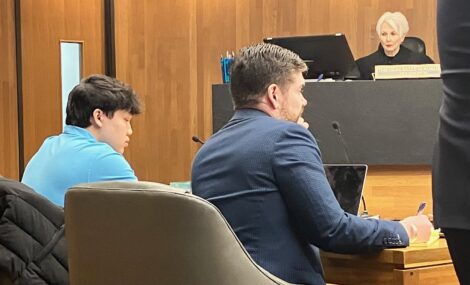
Adrian Wisdom leaves a Douglas County courtroom on Friday, Jan. 16, 2026, after being sentenced to nearly 25 years for rape. His attorney, Michael Clarke, is at left. Prosecutor Todd Hiatt is at right
A Douglas County judge on Friday praised a teenager’s courage for recounting the nightmare she said she had endured for years at the hands of “a monster, a rapist and a pedophile.”
“To say those things in a room full of people” took a commendable amount of strength, Judge Stacey Donovan told the survivor, who detailed at length the abuse she suffered at the hands of Adrian Raye Wisdom, who will now spend more than two decades in prison.
“I hope it’s freeing for you,” Donovan told her. “You should be very proud of yourself.”
Donovan sentenced Wisdom to 24.5 years in prison on Friday, rejecting the defense’s request for a shorter sentence of 20.5 years for two counts of rape. Wisdom originally faced two counts of rape, nine counts of sodomy and three counts of aggravated indecent liberties with a child before he accepted a plea deal in November. If he had been convicted under Jessica’s Law, he would have faced life in prison.
Defense attorney Michael Clarke told Donovan that four years should be shaved off the sentence requested by the state because his client has a profound intellectual disability that bears on his “functional culpability.” In support of the request Clarke had filed a number of documents under seal attesting to his client’s intellectual impairment.
But prosecutor Todd Hiatt disputed the characterization of Wisdom as substantially developmentally impaired, saying that the IQ score of 60 cited by Clarke was given when Wisdom was 15 — “an IQ test for children.” Hiatt said that Wisdom had been “somewhat slow in school” like a lot of people but that he had made relatively good grades in school and had been functioning “just fine” as an adult.
“His crimes don’t show an unsophisticated thinker,” Hiatt said, adding that, “It’s frankly almost insulting to those who struggle with (intellectual impairment) every day, and yet they don’t go around raping people.”
The teen girl, who had an unstable and neglectful home life, told the court that from the time she was 8 years old through her teens that Wisdom had manipulated her into a long and harrowing list of sex acts, oblivious to her physical and emotional pain and taking advantage of her loneliness.
“I was nothing to no one,” she told the court. “I was an object,” “like trash.”
But also: “I was a child.”
She told the court that she had always been scared to tell people what was happening to her and that when she did tell she wasn’t listened to.
“But I can’t be scared anymore,” she said, thanking the Douglas County DA’s Office for supporting her.
A court appointed special advocate for the teen, who said she had been suicidal and despondent when they first met, told Donovan that the girl — a “kind, giving, loving person” — is trying to reclaim her life, but “she needs to see the justice system work for her.”
When given an opportunity to speak, Wisdom, 29, read clearly but briefly from a piece of paper, telling the court, his victim and his family that he was sorry. Though his face had remained expressionless as the girl graphically recounted his sex crimes, he said he was “taking responsibility” for his actions and working to become a better person.
Donovan noted that Wisdom’s intellectual disabilities were “real” but that they didn’t amount to “substantial and compelling” reasons, as required by law, to shorten his sentence — seeming to echo in legalese an earlier question posed by the survivor: “So what if he’s special in the head? What about me?”
Public Safety

Want to learn more about local law enforcement? Apply for this year’s Citizen’s Academy
Judge orders alleged naked home invader to trial on aggravated indecent liberties charge, says it will be close call for jury

Lawrence teen to stand trial for alleged sex crimes against 5-year-old

Man who evaded gun ‘finding’ in shooting back in jail after new charges of violence while on parole

Organization says it has confirmed ICE detainments in Lawrence; sheriff criticizes ICE’s tactics
