‘Is this a serious prosecution by the state?’ Judge expresses dismay at how attorneys are handling activist’s felony interference case
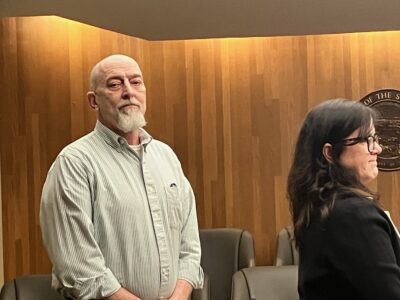
photo by: Kim Callahan/Journal-World
Phillip Michael Eravi appears Thursday, Feb. 26, 2026, in Douglas County District Court with his defense attorney, Angela Keck.
A Douglas County judge on Thursday said she was completely “flummoxed” by yet another continuance being sought — less than two weeks from trial — in a low-level felony case that originated in 2023.
“We are three years into this case, and I am absolutely confused about the manner in which this case is being pursued,” Judge Amy Hanley told the two attorneys arguing the case of Phillip Michael Eravi, who is facing one count of interference with law enforcement in connection with an armed standoff May 19, 2023, between police and a shooting suspect.
Police maintain that Eravi, a local activist and frequent public commenter, walked into a perimeter area that they were trying to keep clear because it was in the line of fire from the suspected shooter’s residence. Eravi has denied the charge, saying he had a right to be where he was.
Hanley noted that defense attorney Angela Keck had requested multiple continuances over the years related to various motions hearings and had asked last November for a delay in the originally scheduled trial, but Hanley also questioned why the state had waited so long to turn over 600 files and to subpoena 20 more witnesses.
“Is this a serious prosecution by the state?” she asked prosecutor Adam Carey with evident dismay. “This is unprecedented.”
Carey reminded the court that he was not the original prosecutor on the case, and said he had spent three solid weeks in December reviewing video related to the 2023 standoff. Hanley seemed unswayed by his explanations, reminding him that “You are the state” and expressing displeasure by how much of the court’s time the case had consumed over recent years.
Carey said he thought it was important to give the defendant “everything,” regardless of whether the material was relevant, useful or potentially exculpatory. Hanley appeared skeptical that such a massive amount of material was necessary to support any theory of the case, and Keck conceded that she had no intention of spending three uninterrupted weeks “watching videos.”
Court records indicate that Carey took over the case from a previous prosecutor a year ago, in March 2025. Hanley noted that his approach to the case differed markedly from a previous prosecutor who had fought some of the defense requests “tooth and nail.”
Keck, two days ago, filed her second motion to continue the trial, which Carey did not oppose. In it she said that she had received discovery from the state as recently as this week and needed more time to review a “voluminous” amount of body camera footage, videos and reports. Keck said that the material included “highly exculpatory evidence,” but when asked by Hanley what that consisted of, Keck said that she had not personally seen it but had been told about it by her investigator.
Keck said that, particularly with her heavy caseload defending high-level felonies, she could not effectively represent Eravi without more time — 60 to 90 days — to prepare for trial. Carey said he supported her request.
Hanley took a 30-minute recess to consider the continuance issue, but before she went into chambers she told the courtroom, “I’ve never seen anything like (this) in the time I’ve been on the bench, in the time I’ve practiced (as a lawyer).”
During the recess, Keck thanked Carey for his “liberal” views on discovery and said, “I appreciate you.”
When Hanley returned to the courtroom, she issued a ruling on a defense expert in the case, limiting his report to precise matters having to do with the police perimeter and zone of fire and excluding materials related to police protocol, policy and other matters. She declined, though, to rule on the continuance request immediately and ordered the parties to reconvene Tuesday for further discussion.
Public Safety
‘Is this a serious prosecution by the state?’ Judge expresses dismay at how attorneys are handling activist’s felony interference case
Sex offender’s sentencing delayed 6 more weeks because of fumbled request for probation
Lawrence Police Department seeking help in identifying two burglary suspects
Rulings expected next week in Hawk shooting cases delayed until mid-April
Attorney says plea deal imminent in Lawrence kidnapping, robbery case