Jurors watch video of man being arrested at standoff scene; teen testifies that it was ‘obvious’ that people should stay away
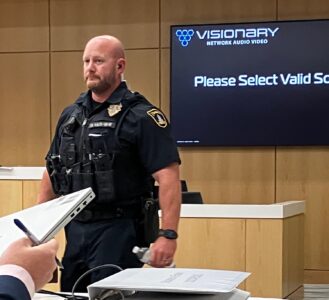
photo by: Kim Callahan/Journal-World
Officer David McShane leaves the stand after testifying at the trial of Phillip Michael Eravi on Tuesday, Aug. 25, 2026, in Douglas County District Court.
A Douglas County jury on Tuesday watched dramatic video of a so-called citizen journalist being arrested for interfering with the duties of a police officer at the scene of a “high-intensity” armed standoff, and they heard from a teen who said it was “obvious” that no civilian should have entered that scene.
In the police body-camera footage, Lawrence resident Phillip Michael Eravi is shown flailing against police officers, calling them obscene names, refusing to identify himself and expressing anger that their response to the reported shooting had awakened him up on the night of May 19, 2023.
“You guys woke me up!” he shouts at the officers, referring to them repeatedly as “mother(expletive)s.”
Prior to the arrest, Officer David McShane, who now works for the Topeka Police Department, told jurors that he was called to the scene in the 1900 block of Heatherwood Drive because a man had reportedly shot at his neighbor and had barricaded himself inside a house. When he arrived, McShane said, he helped set up a perimeter and took up a position to keep the suspect from escaping and others from entering the area, which police considered dangerous because it was in the line of fire.
Several officers had testified that they considered there to be an inner perimeter (nearest the suspect’s house and where the Crisis Response Team was generally located with an armored vehicle) and an outer perimeter that went more deeply into the neighborhood on all sides. Officers testified that the perimeters weren’t physically delineated with crime scene tape — putting up bright tape could endanger an officer in a standoff situation, some said — and weren’t exact but that trained officers generally had a sense of where the perimeters were, even if civilians did not. They also said that perimeters could change in a rapidly evolving situation and that urban environments weren’t always suitable for delineation by tape.
McShane told jurors that he was worried that his pale skin in short sleeves would be visible to a gunman in the house, so he tried to stay in a darker area as he stood watch with his rifle. At some point he got a break on the cold night and went to the command post to wait for further assignment. It was then that he saw a man, later identified as Eravi, walking from the south in a bright green hoodie toward the inner perimeter.
Ordered to stop him, McShane said he shined his flashlight in Eravi’s direction and said “Stop right there,” but Eravi kept moving.
“You can’t be here,” McShane is heard to say in his body-cam footage, to which Eravi replies “leave me alone” — a command he repeats multiple times during the encounter, in addition to calling him a “mother(expletive)” repeatedly.
McShane said that when he saw Eravi “meandering” instead of stopping he cursed under his breath because Eravi’s refusal to comply meant that he would have to move to encounter him and to physically put himself in a danger zone near the barricaded suspect’s line of fire. McShane said that he told Eravi that he was going to have to cover him if he refused to leave and kept walking north.
Eravi said that he didn’t need cover, and he told McShane that he was “a free human,” implying that he could do what he wanted. McShane is heard agreeing that Eravi is a “free human” but that he was still going to cover him. At that point, he said, Eravi stopped walking.
When it became apparent that Eravi wasn’t going to move, the leader of the Crisis Response Team, Sgt. Meagan Shipley, told McShane to arrest him.
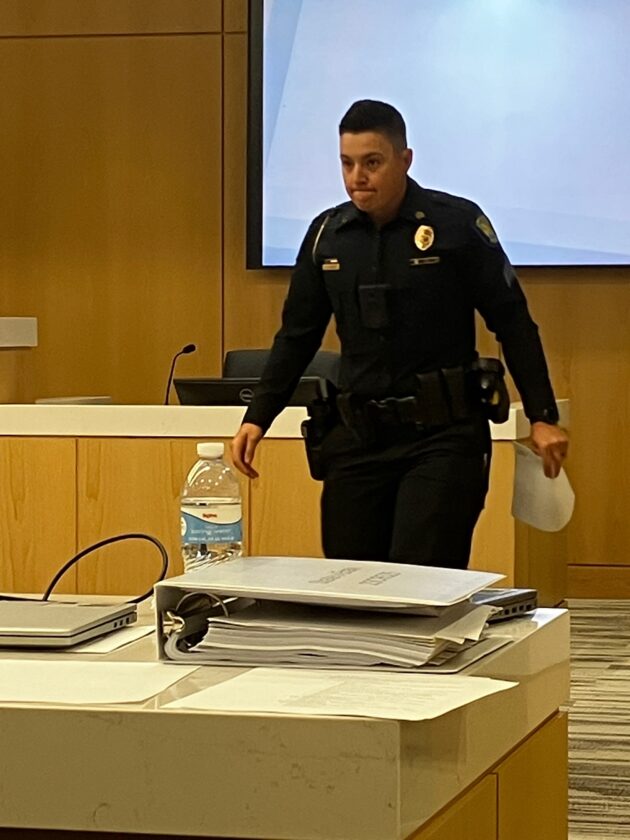
photo by: Kim Callahan/Journal-World
Lawrence Police Sgt. Meagan Shipley leaves the stand after testifying at the trial of Phillip Michael Eravi on Tuesday, Aug. 25, 2026, in Douglas County District Court.
McShane testified that in that situation he would normally take a noncompliant subject to the ground to handcuff him, but he didn’t want to do that in the danger zone, so he and another officer each grabbed Eravi by an arm and “dragged” him to a safer location as he resisted.
At that point, McShane said, other officers approached to assist, temporarily vacating their positions behind the armored vehicle to do so and putting themselves in danger.
After he’s handcuffed, a task that takes multiple officers, Eravi claims in the body-cam video that he wasn’t fighting and that the police had just “grabbed” and “attacked” him. He immediately asks where his phone is, and officers tell him they have it and that it’s probably still running and can remain running, presumably referring to the video feature that Eravi, a self-described citizen journalist and “First Amendment auditor,” uses to record government proceedings and police activity.
McShane said on the stand that he didn’t know that Eravi had been recording at the time. He said that he saw other individuals recording near the scene and that they obeyed him when he said it was fine to record but that they needed to do so from a safe area.
Eravi is breathing heavily in the body-cam footage, and police ask him if he’s OK. Eravi says he is not and that “you guys attacked me for no reason.” An officer explains that the standoff is a “complex situation” and that Eravi was asked to leave for his own safety and that he was arrested because he was interfering with a law officer’s duty.
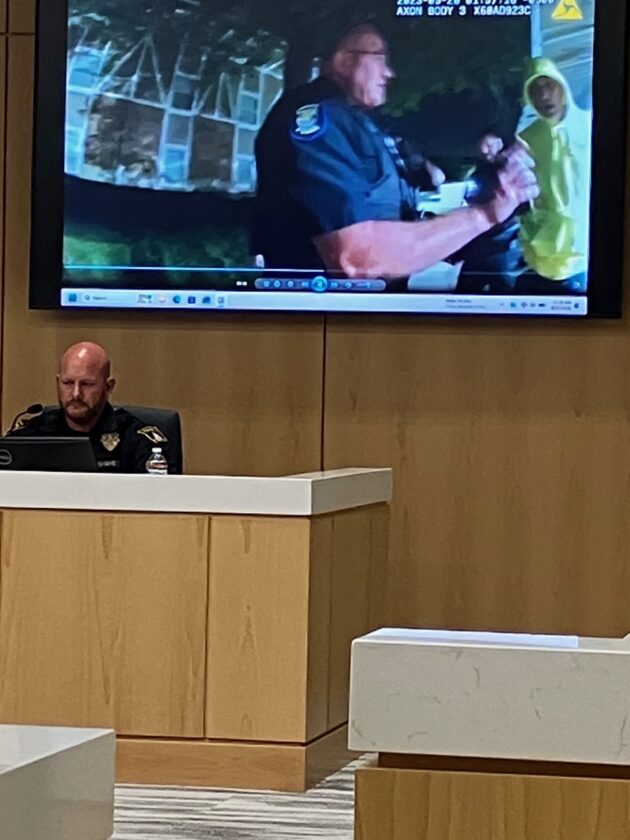
photo by: Kim Callahan/Journal-World
Officer David McShane testifies at the trial of Phillip Michael Eravi on Tuesday, Aug. 25, 2026, in Douglas County District Court. Eravi is the man in the brightly colored hoodie on the video screen, shown during his arrest in May 2023.
Asked by prosecutor Eve Kemple if he had attacked Eravi, McShane said no. He told jurors that the “armbar” technique he and the other officer, Grant Foster, had used was a common escort procedure, but that it was aggravated by Eravi “pulling back the entire time.”
McShane admitted, though, that he wanted to “kick his ass” because he felt Eravi’s behavior had put him in a dangerous situation.
Foster, who also testified Tuesday, described the standoff situation as a “high-intensity” scene, and he said Eravi was exacerbating the situation by refusing to leave and by “aggressively pulling away from us and yelling at us.”
While Eravi’s defense attorney, Angela Keck, has focused heavily on the lack of a distinct perimeter that a civilian would know about, the state has emphasized that it wasn’t Eravi’s knowing about or crossing into a perimeter that was the issue; rather, it was his refusal to leave when lawfully ordered by a police officer to do so.
A 16-year-old girl, who was 13 at the time and lived in a nearby apartment building on Heatherwood Drive, told jurors that she understood immediately that the area Eravi entered was not somewhere a person should go.
“There was an active crime scene,” she testified. “There were cops everywhere,” including lights, sirens, loud speakers and a SWAT team.
It was “kind of obvious you shouldn’t be heading in that direction,” she said.
A video she took that night from her apartment complex and gave to police showed a man in a brightly colored hoodie — presumably Eravi — walking north toward the action as a red light illuminated the sky. The original video contained audio in which someone says, “They need to watch the f–k out. There’s something wrong with that guy.”
The audio, however, was not allowed to be heard by jurors after Judge Amy Hanley concluded outside the jury’s presence that the audio implied that Eravi was dangerous – an implication that she said was so prejudicial to Eravi that it outweighed its “probative” value as evidence.
Prosecutors then played the brief video without sound for the jury.
The girl’s mother also testified that “it was very clear” that it was “an active police scene.”
She too — from the safety of a second-story balcony — saw a man in a bright green hoodie “walking into police activity.”
In her opening arguments Monday, Eravi’s attorney told jurors that her client was not there to obstruct police work but was “a free human being trying to do his job to inform the citizenry” with his journalism.
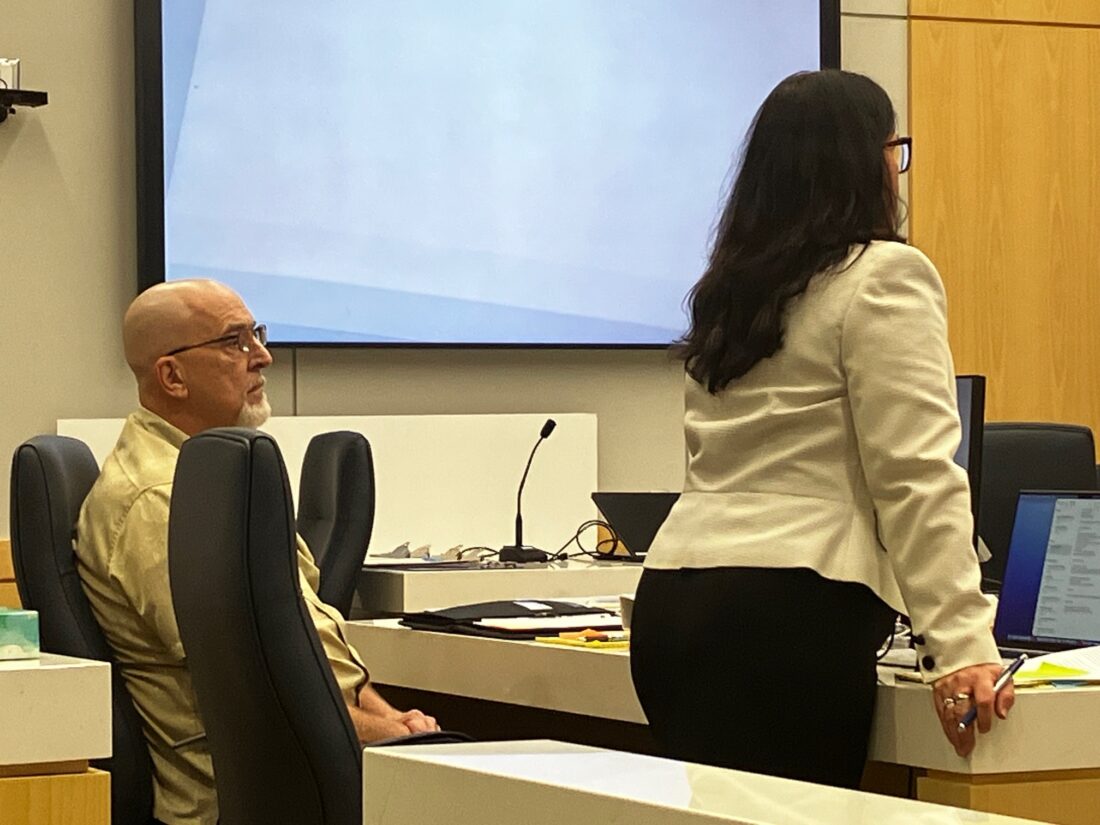
photo by: Kim Callahan/Journal-World
Phillip Michael Eravi is pictured at his trial on Tuesday, Aug. 25, 2026, in Douglas County District Court. Attorney Angela Keck is at right.
Public Safety
Man accused of selling wristbands to enable minors to drink at time of Hawk shootings is sentenced to probation

36-year-old Lawrence man confessed to raping 13-year-old girl, affidavit says
Evacuation drill planned Tuesday at Lawrence City Hall
Douglas County’s newest pro tem judge sworn in

Woman has renewed hope for justice 17 years after reporting rape in Lawrence