After nearly 50 years, court is now adjourned for Judge Sally Pokorny
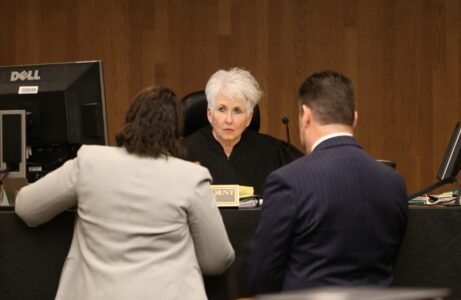
photo by: Journal-World File
Judge Sally Pokorny confers with defense attorney Shaye Downing, left, and District Attorney Charles Branson during the Mass Street murder trial of Anthony L. Roberts Jr. on June 18, 2019, in Douglas County District Court.
When Kris Wilcoxson heard recently that Judge Sally Pokorny would be retiring on April 10, he made a beeline over to the courthouse to thank her.
Pokorny had just wrapped up one of her final sessions of Behavioral Health Court, which she presided over in a multi-zippered black leather jacket — prompting some to ask where her Harley was.
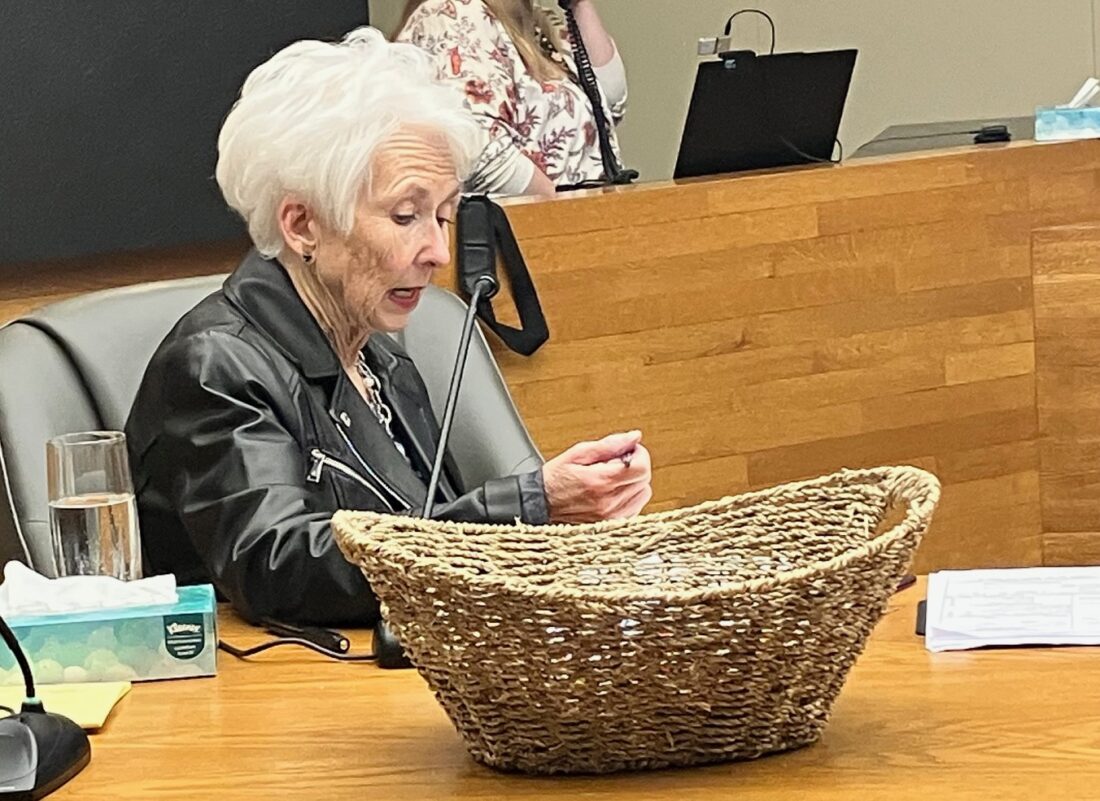
photo by: Kim Callahan/Journal-World
Judge Sally Pokorny is pictured in Behavioral Health Court on April 2, 2026.
As people milled about, Wilcoxson charged up the aisle and affectionately hugged her — a gesture that would have been unseemly had Pokorny been wearing a formal judicial robe or sitting at the courtroom’s elevated bench. But she was doing neither, and she warmly returned the embrace. In Behavioral Health Court, or BHC, she always sat in plain clothes — if you consider a rotating assortment of brightly colored sneakers plain — and at the same table as the people she was hoping to give a second chance.
During a typical session, she would ask the participants for weekly progress updates about whether they had stayed on their meds and had kept various appointments, whether they had applied for a job or had socialized or had found a suitable place to live, and — crucially — whether they needed any kind of assistance from the BHC team of counselors, clinicians and lawyers sitting over in the jury box.
But she also provided snacks — “I forgot the candy!” she said at a recent session before hurrying back to her office to retrieve a big basket — and bantered with participants about movies they’d seen or tasty food they’d eaten. She wasn’t too keen on “all the vampire gore” in “Sinners,” she told one woman, who was a superfan. With another she shared some thoughts on Tinker Bell vs. Peter Pan. She encouraged one young man to share his recipe for a Korean rice bowl and assured another that she would try the hospital cafeteria salmon he had raved about.
RETIREMENT RECEPTION:
The public is invited to a retirement celebration for Judge Pokorny at 3 p.m. Friday, April 10, at the historic Douglas County Courthouse on the corner of 11th and Massachusetts streets. The farewell event will include speakers and refreshments and will be available to watch on the Douglas County Court’s YouTube channel.
Wilcoxson was one of those people once, and the appreciation he has for BHC is “absolute,” he told the Journal-World after he offered his best wishes to Pokorny, whom he still expects to chat with now and then at the grocery store where he works. The “very intensive” BHC — an alternative to traditional court proceedings — turned his life around a few years back when he was battling mental health and addiction issues and wound up facing battery charges. The offenses could have gone on his record, but thanks to his yearlong participation in BHC and graduation from the program, he was able to avoid criminal prosecution and probable recidivism and to learn how to better manage his life.
“She’s a terrific lady,” he said of Pokorny, who started the first BHC in Kansas back in 2016 with a robust team of professionals whom she regularly credits for the court’s success.
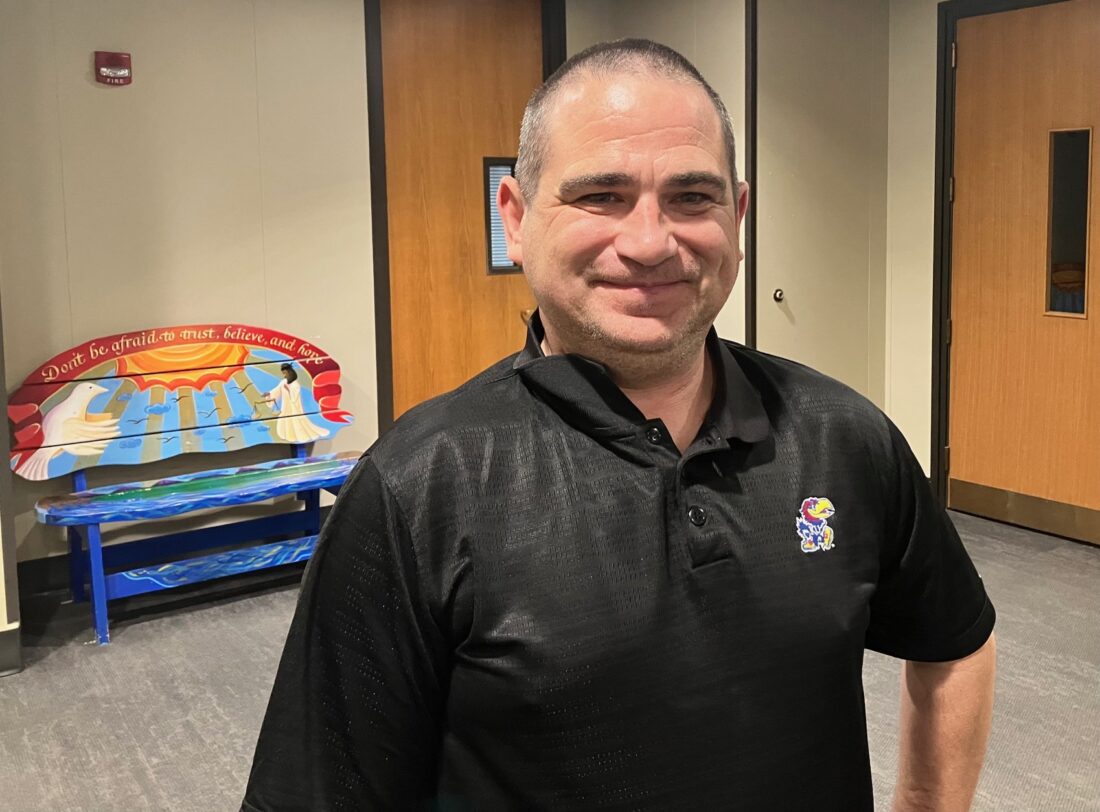
photo by: Kim Callahan/Journal-World
Kris Wilcoxson is a graduate of Douglas County’s Behavioral Health Court.
Another BHC participant, who wished to remain anonymous, chimed in to praise Pokorny’s friendly and down-to-earth — but still “very no-nonsense” — manner, likening her to a wiser relative who’s always rooting for you.
Those are assessments shared by plenty of people in Douglas County, and they’ll have a chance to tell her so in person as she officially adjourns her legal career Friday at a reception in downtown Lawrence.
Ahead of her retirement, Pokorny, the longest-serving judge on Douglas County’s current judicial roster, spoke to the Journal-World about her nearly 50 years in the legal field — some of the things she has seen, such as the rise of women in the profession, and some of the things she hopes not to see, such as the end of specialty courts like BHC.
‘Falling into’ law
Pokorny, from Independence, Kansas, is frank about how she got started. She never thought about becoming a lawyer until she was on the brink of becoming a teacher. A stint of student teaching proved so unpleasant that she was convinced beyond a reasonable doubt that “I am not cut out for this.”

photo by: Contributed
Violinist Sally (Davis) Pokorny, front row, fourth from left, is pictured with the Independence High School Orchestra. Also pictured in the front row, from left, are classmates Kathy Webb, Sheila Bair, Debbie Pasternak and, to the right of Pokorny, Jenni Burkhead.
As she pondered what to do next, the road to law school lay literally in front of her — as in she could actually see Washburn University’s law school from her Topeka house.
“I fell into law school because it was there, and fortunately I loved it,” she said. “It was fascinating” and full of “really smart and interesting people to hang around with.”
At that time, the mid-1970s, only about 20% of law students were female, but even that “felt like a lot.”
“The class before me I think was the first class where it was like ‘oh my gosh, we’re going to have to have more than one (bathroom) stall in the law school for women,'” she said.
Today, the majority of law school students are women, as are half the attorneys appearing before Pokorny. And when she became a judge 17 years ago, her presence tipped the judicial makeup in Douglas County to majority female.
“It’s really different from when I started,” she said, noting that early in her career she was always the only woman in the courtroom and had to travel some distance to meet up with fellow female attorneys, many of whom had been relegated to research positions in law firms, if they were hired at all.
Things gradually improved.
“I was really excited in the ’80s when I was in Montgomery County; there were four of us in the county practicing law,” she said. “The whole county.”
Pokorny had one male attorney warn her: “Nobody will hire a woman.”
But she would prove him wrong.
While still in law school, she got a grant and told the Montgomery County attorney — whose mother was her mother’s best friend — that the grant would pay her “salary” if he could just give her a desk and a chair, and he agreed. Before long, she was trying a case in front of a jury before she even graduated.
Eventually she got a regular position with the county and then branched out into private practice, doing a little bit of everything over the years — insurance defense, criminal cases, divorces, child custody, collections, personal injury, bankruptcy — sometimes while having one of her two infant sons strapped to her chest.

photo by: Contributed
Sally Pokorny, pictured some 40 years ago, with her infant son.
“I took just about anything that came through the door that I could figure out,” she said, “because that’s how you make a living in a small town.”
After her sons moved to eastern Kansas for college, she decided in 2006 to head this way too, hanging out her shingle in Lawrence before Gov. Kathleen Sebelius appointed her to a judgeship three years later.
On the bench
Being a judge rather than an advocate required a mental “reset,” she said, but that happened “pretty quickly.”
“I think I have a pretty neutral outlook on things,” she said, although, like any judge, she encounters routine grumbling, sometimes on the same day, that she is biased toward the prosecution or biased toward the defense.
When asked if she ever reads comments on social media about her rulings, her answer was a resounding “No.”
“Judge (Peggy) Kittel, when I was first sworn in, said ‘do not read the comments,’ and so I didn’t,” she said.
But she is obviously aware that people have perceptions about the justice system that don’t actually square with judges’ actual job requirements and the laws they are sworn to uphold, particularly well-defined sentencing laws.
“People tend to make the assumption that everybody just gets off and they just get probation and get charged again,” she said, but the overall reality is very different. Citing the 80/20 rule, she explained that out of 100 people charged with a crime, 80% you’ll never see in court again, while “the other 20% clog up 80% of your docket.”
There’s a repeat offender cycle, she said, acknowledging that “some people are never going to be helped.”
“That’s why I’m passionate about our specialty courts [like BHC, Drug and Veterans Court] because we aren’t going to solve anything unless we break the cycle,” she said.
Another common misperception relates to the centrality of due process itself, regardless of what one thinks of a defendant.
“I think the hardest thing for people to do is to put themselves in the place of the mother of this person who’s been charged with a crime,” she said. “Do you want the system to just throw away the key, to not treat them fairly, to not give them a fair trial? Of course you don’t.”
Pokorny has sat in front of innumerable mothers — many whose children have committed terrible crimes and many whose children have been terribly victimized — and she has frequently expressed to them that what they want to happen and what counts as justice under the law are often very different things.
Has she ever been taken aback by a jury’s verdict? “Oh yeah,” she said, in a tone implying the question was a bit daft, but when she visited with such juries after the fact she usually gained a clearer understanding of why they voted the way they did.
“Every juror I’ve talked to, all they cared about was doing the right thing,” she said. “They wanted to be right. Even though I haven’t always agreed with the jury’s verdict, I’m still a big believer in the jury system and having 12 people from 12 different backgrounds give this a look and try to come up with justice.”
Although there’s a cliché about people making up ridiculous excuses to get out of jury duty, Pokorny said that in her experience almost everyone who serves appreciates the experience.
“I’ve had two people after the jury trial was over say ‘I wish I wouldn’t have been a part of this,’ but for 99% it’s ‘I learned so much, it was really interesting, I didn’t know things worked this way, I have a lot better perspective now.'”
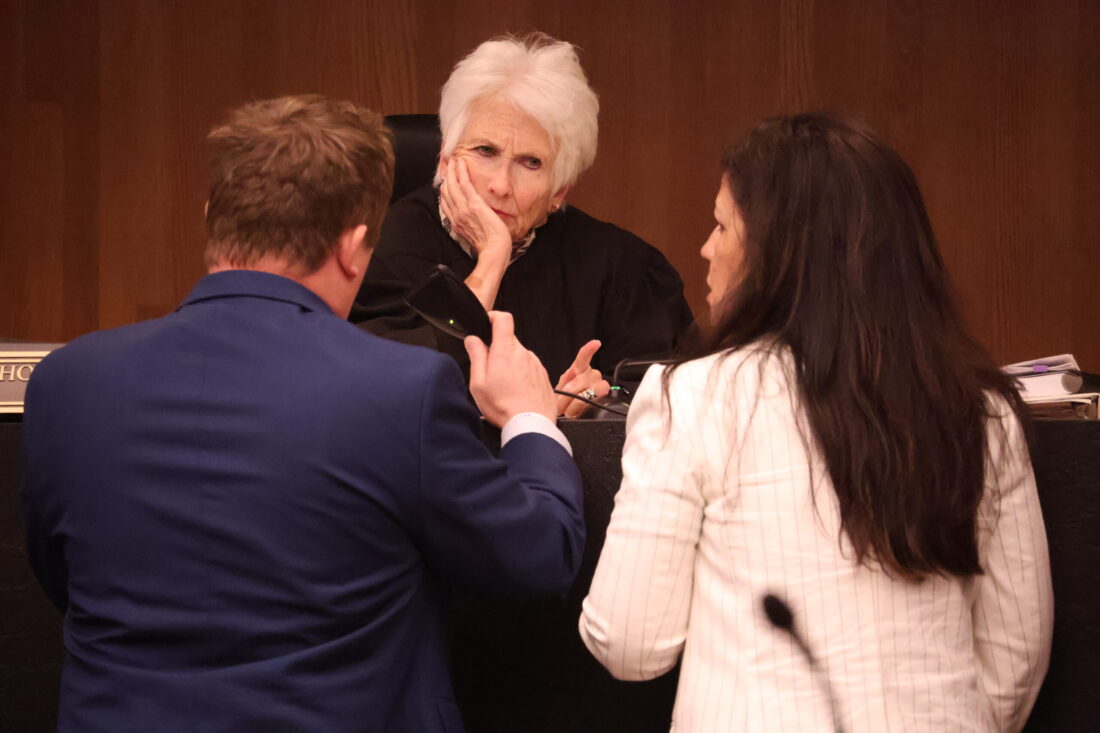
photo by: Chris Conde/Journal-World
Judge Sally Pokorny speaks with former Douglas County District Attorney Suzanne Valdez and defense attorney Dakota Loomis, who is currently DA, during a trial on May 30, 2024.
Pokorny has presided over numerous high-profile cases, including Carrody Buchhorn’s murder trial, Albert Wilson’s rape trial, the Montessori School sex crime case and the Massachusetts Street triple murder case from 2017, to name a few. In the latter she memorably filed a rare and scathing order regarding a defense attorney’s competence. But the 2025 Derrick Del Reed trial stands out as unprecedented.
In that case, in which a white teen, Reed, was ultimately acquitted of fatally shooting a Black teen, Kamarjay Shaw, Pokorny had to deal with a level of raw emotion and unruliness in the gallery that she had never seen in a courtroom before.
While intense feeling was to be expected, “we just didn’t seem to have any cooperation or understanding of how the process should go,” she said.
At one point, as the two sides antagonized each other, Pokorny had to order everyone out, and the entire Judicial and Law Enforcement Center was briefly locked down.
While unsettling, the moment was also memorable, she said, “for how well our court security worked.”
While not a stickler for etiquette, Pokorny always expected decorum in the courtroom, even for far less solemn affairs than murder trials. When defendants appeared via Zoom on her docket, for example, she often had to remind them that even though they weren’t physically present in the courtroom they should still behave as though they were. “No eating lunch, no smoking cigarettes, no applying deodorant” and “no driving” were among a longer list of “no’s” that she’d routinely recite to maintain decorum in an increasingly indecorous and increasingly online world post-COVID.
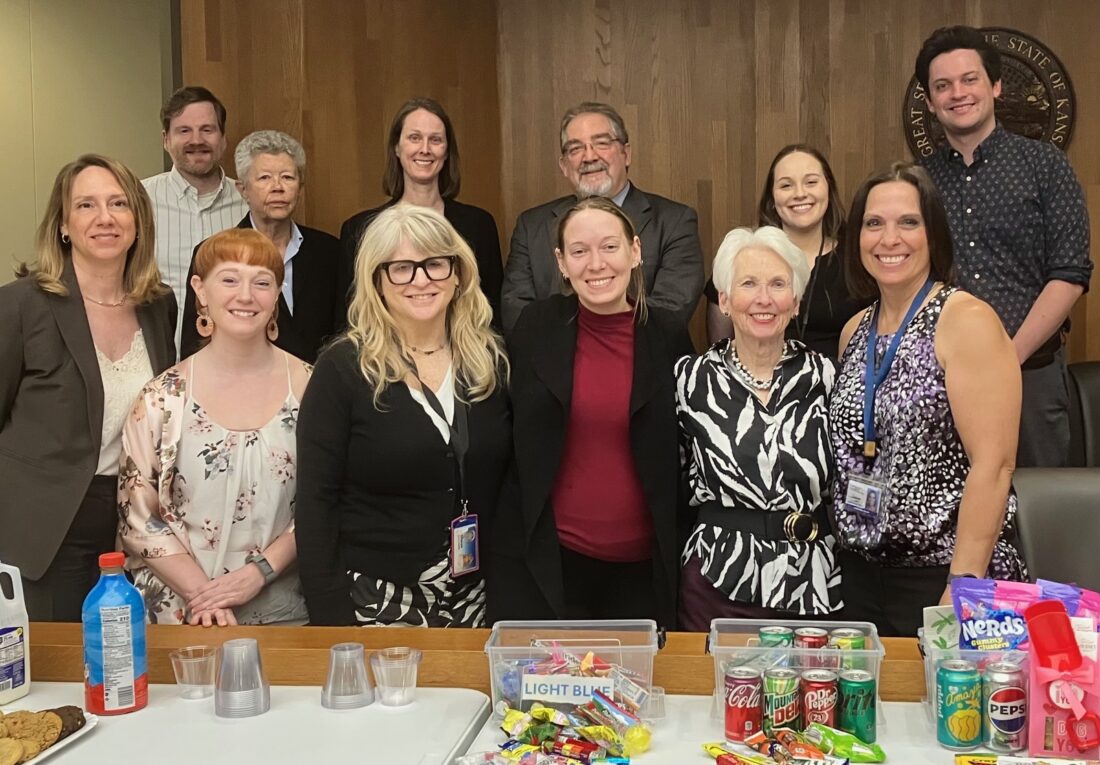
photo by: Kim Callahan/Journal-World
Judge Sally Pokorny, bottom row second from right, is pictured with the Behavioral Health Court team on March 19. 2026, in Douglas County District Court.
‘It’s just been marvelous’
As Pokorny looks back on her long career, her most satisfying accomplishment, hands down, has been the establishment of the Behavioral Health Court, which will soon celebrate its 100th graduate — that is, someone who has devoted a year or more to the program, who has learned critical life skills and whose charges will be dismissed in favor of a fresh start.
“If I’m remembered for anything, I hope that’s the thing because it has just been marvelous,” she said.
At the March 19 session of BHC, she told all the participants and at least one dog — there’s always a friendly dog on hand — that BHC “has been the most consequential program I’ve participated in in my career.”
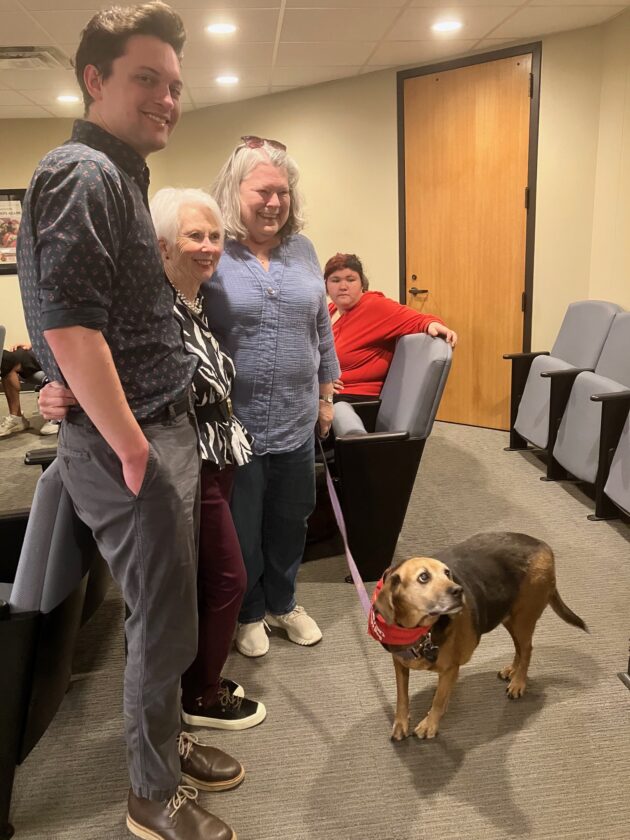
photo by: Kim Callahan/Journal-World
Blair Bracciano, a member of the Behavioral Health Court, left, is pictured with Judge Sally Pokorny, center, Cathy Hilliard and Harley the dog from Loving Paws.
She credited former Douglas County District Attorney Charles Branson and former Assistant DA Mark Simpson, now Douglas County’s chief judge, for seeing in 2014 that “there’s got to be a better way” to deal with defendants experiencing chronic behavioral health issues and to lay the groundwork for BHC. She also credited clinician Sharon Zehr, who’s still on the team, with being the “mother” of BHC.
Pokorny downplayed her own role as “just the talking head,” but literally no one was buying that.
She also shared with them the recent sad but unavoidable experience of having sentenced an individual who didn’t qualify for BHC to a year in prison.
“He is going to come out the same,” she said, “and that’s a failure on the part of our court system.”
She was referring to the fact that the state prison system has no programs that can seriously address mental health and substance abuse issues — programs that professionals agree are necessary to promote recovery and to prevent recidivism.
You may become sober in prison, but it’s a “forced sobriety,” Pokorny noted, not an intentional sobriety that comes with the resources and behavioral changes needed to maintain it.
Pokorny acknowledges that specialty courts are expensive, but she said the up-front money spent on them was put to far better use than the money required to imprison people over and over.
“I am so grateful to our county and their attitude that you can’t incarcerate people into sobriety and good mental health,” she said. “I hope this never ends.”
What’s next
Pokorny doesn’t have a grand retirement plan. She “fell into” law, and she’ll hopefully fall into something she likes just as much, but it probably won’t involve work.
“I’ve been practicing law for 49 years and I’ve been a judge now for 17, and I think if I just don’t do anything else but play for the rest of my life, that’ll be just fine,” she said.
Play might involve more of the bird-watching and yoga she loves, and it will most definitely involve some traveling. The main thing is to not have any commitments for maybe the first time in her adult life.
“I just really want to be in a position of if I wake up and say ‘it’s cold, I think I’m going to drive to Florida,’ I can do it.”
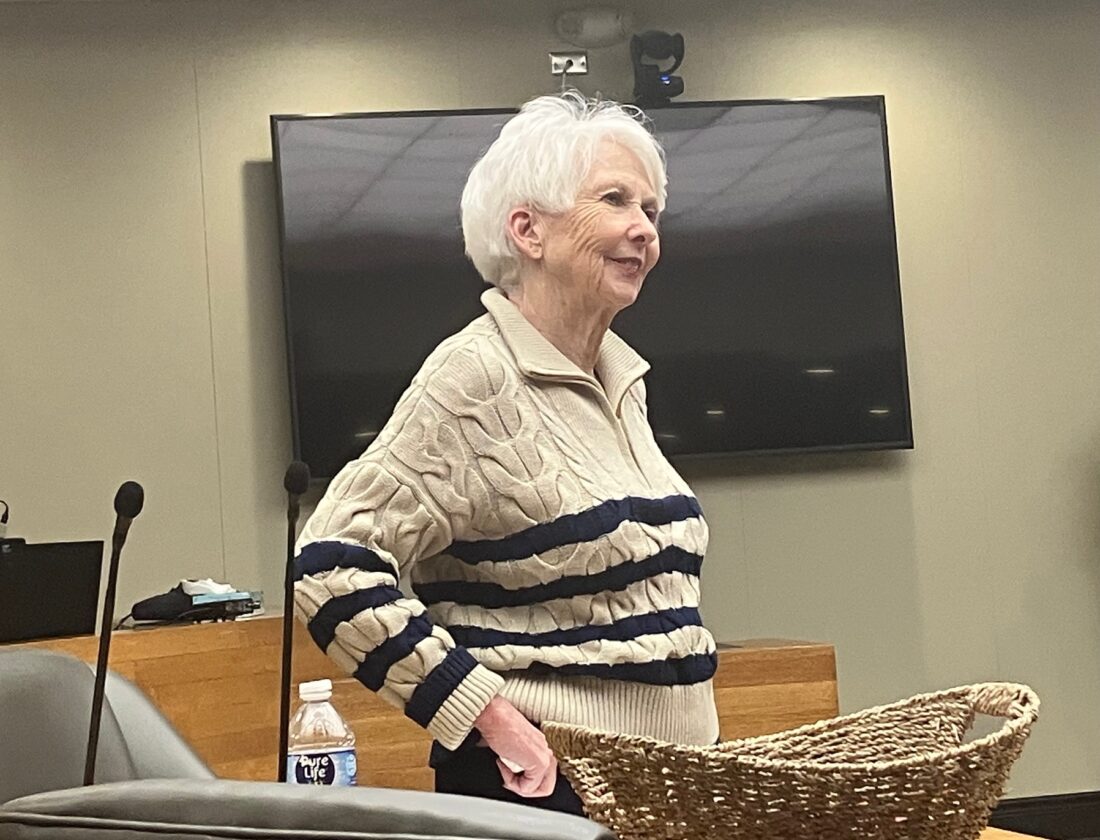
photo by: Kim Callahan/Journal-World
Judge Sally Pokorny is pictured on her last day at Behavioral Health Court on April 9, 2026, ahead of her April 10 retirement.
Public Safety
After nearly 50 years, court is now adjourned for Judge Sally Pokorny
Hispanic workers say armed man’s assault terrified them; he says medical condition caused his crimes

Lawrence Police Department announces 28-year-old officer’s death

KBI investigating deaths of 2 children reportedly shot by their young sibling

Man convicted of trying to kill his grandfather by shooting multiple rounds into his Lawrence home