Hegseth is set to announce more cuts to the military’s leadership
Also: Civilians will no longer get tenure at military academies
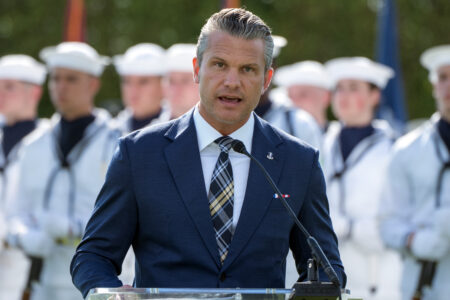
Defense Secretary Pete Hegseth speaks during the POW/MIA National Recognition Day Ceremony at the Pentagon, Friday, Sept. 18, 2026, in Washington. (AP Photo/Mark Schiefelbein)
WASHINGTON (AP) — Defense Secretary Pete Hegseth is planning to announce further cuts to the number of generals and admirals serving in the military in an address set for Wednesday, the Pentagon confirmed.
According to Pentagon officials, Hegseth will direct all the military services to double the 10% reduction that he ordered last spring to the roughly 800 flag and general officer positions, making it a 20% total decrease to be completed by Jan. 1, 2027.
President Donald Trump or Hegseth already have fired or pushed to retire more than two dozen military leaders since taking office, including the Army’s top uniformed officer, Gen. Randy George, in April. They also have fired the only two women serving as four-star officers, as well as a disproportionate number of other senior female officers.
Hegseth plans to make the announcement in a speech to troops at the Marine Corps Base Quantico in Virginia, the second year in a row he will deliver what the Pentagon is calling his “State of the Force” address. Fox News earlier reported the new reductions, which could include any one-star general or above or officer of equivalent Navy rank.
As part of last year’s cuts, Hegseth also ordered the active duty military to shed 20% of its four-star general officers — the highest-level leader — and the National Guard to shed 20% of its top positions, but it is unclear if all those cuts have been made.
Hegseth gathered all the military’s generals and admirals at the same time last year for an address in which he declared an end to “woke” culture and announced new directives for troops that include “gender-neutral” or “male-level” standards for physical fitness.
However, that speech was overshadowed by the attendance of President Donald Trump, who proposed using American cities as training grounds for the armed forces and spoke of needing U.S. military might to combat what he called the “invasion from within.”
When Hegseth first announced the effort to trim the highest levels of the military ranks, he argued it was intended to remove “redundant force structure to optimize and streamline leadership.” In a memo released in May 2025, he said the aim was to free the military from “unnecessary bureaucratic layers.”
The number of general officer positions in the military is set by law, but it is possible to let positions remain unfilled by not submitting replacements to Congress.
Hegseth’s relationship with Congress is already strained, and he faces articles of impeachment from a Republican, Rep. Thomas Massie of Kentucky, over his leadership of the Pentagon and management of the Iran war.
Sen. Jack Reed, a Rhode Island Democrat and ranking member of the Senate Armed Services Committee, said eliminating senior leadership positions must be done in consultation with Congress and warned that the planned cuts “should alarm every American.”
“Congress has been clear with the Secretary that he must consult this body and explain his reasoning for senior officer removals and promotion holds. To date, we have not received satisfactory answers,” Reed said in a statement.
“Our military is conducting major operations around the world, and the force is already under strain,” he added. “Eliminating senior positions and leaders now will add to that strain and disrupt command when continuity matters most.”
Academies to stop giving civilian faculty tenure
The Defense Department will no longer appoint civilians as tenured college faculty at the United States’ military service academies, according to a memo signed Tuesday by Hegseth.
The memo describes the decision to stop granting tenure to civilian faculty as part of an effort to refocus the military academies on warfighting.
“To ensure our educational institutions remain firmly focused on this warfighting mission, we must address the structural mechanisms that have allowed civilian academic norms to dilute our focus on lethality,” the memo said.
The tenure designation generally comes with a career-long academic appointment at a college. Advocates say the job security is a crucial component of academic freedom. Hegseth’s directive apparently would not remove the designation from faculty members who are currently tenured.
The U.S. Military Academy at West Point, the U.S. Naval Academy, and the U.S. Air Force Academy all did not immediately respond to questions, and officials at the Pentagon did not offer further details on the plan when reached for comment.
The percentage of faculty who are civilians varies by military academy. It is highest at the United States Naval Academy, where roughly half of the 600 faculty members are civilians. The academies hire civilian faculty to offer expertise in topics and disciplines that military officers don’t study as part of their careers, such as English and the humanities.
Hegseth’s decision follows broader conservative attacks on tenured faculty appointments in higher education. Those efforts to rein in tenure are often presented as bids to rein in academics with liberal views.
Civilian faculty members often have more teaching experience and credentials than their military counterparts at the service academies, said Eric Merriam, a legal studies and political science professor at the University of Central Florida and a former professor at the Air Force Academy.
The academies have long served a dual role — training the next generation of officers, while providing a traditional, prestigious, four-year college experience, Merriam said. The schools offer a broad, liberal arts education, in recognition that senior leadership must be critical thinkers who can understand different points of view.
Hegseth’s actions signal a shift toward a narrower focus, Merriam said.
“It does seem to me as though it’s a retrenchment,” he said. “It’s a retreat from what I think was positive progress in ensuring that these elite educational academies actually have elite education as part of the program.”
In Hegseth’s memo Tuesday, tenure was described as a factor that contributed to “academic stagnation, faculty complacency, and institutional inability to adapt to emerging needs. Additionally, it contributes to curriculum that drifts from the mission of educating our warfighters to the research priorities of the tenured academics.”
The decision Tuesday is part of a broader push from Hegseth to remake the military’s education apparatus. Earlier this year, the Pentagon severed longstanding ties with prestigious universities that had been a pipeline for military leadership, forging new relationships with Christian schools and public universities.
The Pentagon has also attempted to reorient the K-12 schools it operates for military families. It introduced a course centered on Western civilization and Christianity, part of an effort to redirect the education system toward patriotic values and classical learning.
National

Retired NYPD detective arrested in road rage killing

Chemical tank leak in Ohio forces evacuations as city allows plume to vent

Trump administration asks Supreme Court to lift halt on Big Bend border wall
Supreme Court rebuffs Trump administration restrictions on medical care for transgender inmates
WASHINGTON (AP) — The Supreme Court on Wednesday refused to allow the Trump administration to immediately enforce ...

Yellowstone receives record $105 million gift for infrastructure, conservation, access