

Nation & World: Inaction on COVID relief could be costly, Biden says
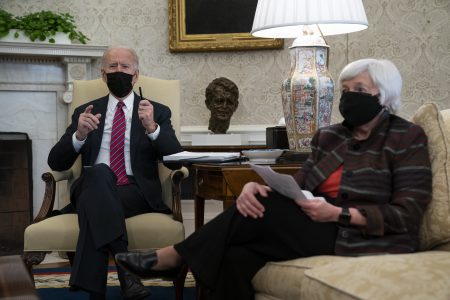
photo by: Associated Press
President Joe Biden meets with Treasury Secretary Janet Yellen in the Oval Office of the White House, Friday, Jan. 29, 2021, in Washington. (AP Photo/Evan Vucci)
WASHINGTON (AP) — President Joe Biden warned Friday of a steep and growing “cost of inaction” on his $1.9 trillion COVID relief plan as the White House searched for “creative” ways to win public support for a package that is getting a cold shoulder from Senate Republicans.
In the age of COVID, it’s not as simple as jumping on a plane to travel the country and try to gin up a groundswell. And at a time of deep polarization, Biden may struggle to convince Republican voters of the urgency when Congress already has approved $4 trillion in aid, including $900 billion last month.
Biden signaled on Friday for the first time that he’s willing to move ahead without Republicans.
“I support passing COVID relief with support from Republicans if we can get it,” he told reporters. “But the COVID relief has to pass. No ifs, ands or buts.”
His message so far has been that a fresh $1.9 trillion in aid would be a bargain compared to the potential damage to the world’s largest economy if it doesn’t pass. An aggressive push for vaccinations and generous aid to individuals would help put parents back to work and let children return to school and improve their lifetime earnings, Biden said at a Friday meeting with Treasury Secretary Janet Yellen. They met in the Oval Office, where the fireplace was lit to protect against the chill in Washington.
“We have learned from past crises that the risk is not doing too much,” he said. “The risk is not doing enough.”
Only a week into his presidency, Biden is confronting the challenge of selling his first major piece of legislation to a country he has pledged to unite. Private calls with Republican lawmakers have yet to produce any progress on reaching a deal, while Senate Democrats are now preparing to pass the measure strictly on partisan lines as soon as next week.
Some Biden allies have expressed frustration that the administration has not more clearly defined what the massive legislation would actually accomplish. The new president instead has largely focused his first nine days in office on signing executive orders rolling back his predecessor’s policies.
In particular, Biden, for whom the widespread distribution of coronavirus vaccines will be a defining test, has not explained what the increased money for testing and vaccination would achieve — including how much quicker the White House believes it would help bring about an end to the pandemic.
Biden’s outreach to senators has largely brought criticism that the plan should be more targeted and that the country can afford to wait to see the effects of the stimulus dollars that were approved in December.
Republican lawmakers see a need for speeding vaccinations, but one Senate aide said their offices are not being bombarded with calls for an additional aid package. Constituents are more focused on the looming impeachment trial, said the aide, who spoke on the condition of anonymity to discuss private conversations.
This has left the Biden team trying to expand its outreach beyond Capitol Hill.
White House press secretary Jen Psaki said Biden recognizes the importance of speaking directly to the American people about his plan for vaccinations and supporting the economy, but the pandemic has limited his ability to safely travel to drum up support. The administration is relying on TV interviews by White House officials and allies with local media and national shows like “The View,” as well as calls with governors, local officials and progressive and civic groups.
“We’re taking a number of creative steps, a little outside of the box,” Psaki said. “Certainly, his preference would be to get on a plane and fly around the country.”
Part of the challenge is that Biden must convince the public how different components of his proposal would work together. His plan allots $400 billion to spearhead a national vaccination program and the reopening of schools. It also includes $1,400 in direct payments to individuals, which critics say should be more targeted. And it includes a raise in the the minimum wage to $15 and aid for state and local governments, a nonstarter for most Republicans.
Many Republicans are under more political pressure from donors and activists back home to rein in spending than to approve more. Some Republicans particularly object to what are still seen by many as bailouts for cash-strapped state and local governments.
Some do support a deal, just not what Biden is offering. Sen. Rob Portman, R-Ohio, a member of a bipartisan group of legislators contacted by the administration, said he supports funds for vaccine distribution and even potentially extra jobless benefits, but he wants a full accounting of what funding remains from previous aid packages.
“Unemployment insurance, they think it’s an emergency; well, we have unemployment insurance in place until mid-March. Where’s the emergency?” Portman said. “Am I against extending it? No, I’m not. I think we should, based on some economic factors. But it just doesn’t make sense.”
Recent economic reports show the economy is still under severe strain, yet there is also the potential for the strongest growth in more than two decades once the coronavirus is contained.
The Commerce Department said Thursday the U.S. economy shrank 3.5% last year, and on Friday it reported that consumer spending — the main driver of growth — had slumped 0.2% in December. But the consumer spending report also suggested that the expanded unemployment benefits from the $900 billion aid package passed that same month had managed to boost incomes.
Gregory Daco, an economist at Oxford Economics, said, “The COVID relief bill of December essentially addressed the past, the dwindling aid at the end of 2020.” Now the administration must sell the public on what lies ahead.
He said, “The American Rescue Plan — it’s a plan geared toward the future, bridging the gap between January and September, when people will be able to spend more freely.”
BRIEFLY
New study: 1-shot vaccine provides good protection
The first one-shot COVID-19 vaccine provides good protection against the illness, Johnson & Johnson reported in a key study released Friday, offering the world a potentially important new tool as it races to stay ahead of the rapidly mutating virus.
The pharmaceutical giant’s preliminary findings suggest the single-dose option may not be as strong as Pfizer’s or Moderna’s two-dose formula, and was markedly weaker against a worrisome mutated version of the virus in South Africa.
But amid a rocky start to vaccinations worldwide, that may be an acceptable trade-off to get more people inoculated faster with an easier-to-handle shot that, unlike rival vaccines that must be kept frozen, can last months in the refrigerator.
“Frankly, simple is beautiful,” said Dr. Matt Hepburn, the U.S. government’s COVID-19 vaccine response leader.
J&J plans to seek emergency use authorization in the U.S. within a week. It expects to supply 100 million doses to the U.S. by June — and a billion doses globally by year’s end — but declined to say how much could be ready if the Food and Drug Administration gives the green light.
Putin signs bill extending nuclear treaty with the U.S.
Russian President Vladimir Putin on Friday signed a bill extending the last remaining nuclear arms control treaty between Russia and the United States a week before the pact was due to expire.
Both houses of the Russian parliament voted unanimously Wednesday to extend the New START treaty for five years. Putin and U.S. President Joe Biden had discussed the nuclear accord a day earlier, and the Kremlin said they agreed to complete the necessary extension procedures in the next few days.
New START expires Feb. 5. The pact’s extension doesn’t require congressional approval in the U.S., but Russian lawmakers had to ratify the move. Russian diplomats said the extension will be validated by exchanging diplomatic notes once all the procedures are completed.
The treaty, signed in 2010 by President Barack Obama and Russian President Dmitry Medvedev, limits each country to no more than 1,550 deployed nuclear warheads and 700 deployed missiles and bombers, and envisages sweeping on-site inspections to verify compliance.
Biden indicated during the U.S. presidential campaign that he favored the preservation of New START, which was negotiated during his tenure as vice president under Obama.
GameStop surges again; Wall Street bends under pressure
Another bout of selling gripped the U.S. stock market Friday, as anxiety mounts over whether the frenzy behind a swift, meteoric rise in GameStop and a handful of other stocks will damage Wall Street overall.
The S&P 500 dropped 1.9%, giving the benchmark index its biggest weekly loss since October. The Dow Jones Industrial Average and Nasdaq each fell 2%.
GameStop shot up nearly 70%, clawing back much of its steep loss from the day before, after Robinhood said it will allow customers to start buying some of the stock again. GameStop has been on a stupefying 1,600% run over the last three weeks and has become the battleground where swarms of smaller investors see themselves making an epic stand against the 1%.
The assault is directed squarely at hedge funds and other Wall Street titans that had bet the struggling video game retailer’s stock would fall. Those firms are taking sharp losses, and other investors say that’s pushing them to sell other stocks they own to raise cash. That, in turn, helps pull down parts of the market completely unrelated to the revolt underway by the cadre of smaller and novice investors.
WHO team visits Wuhan hospital that treated first COVID patients
WUHAN, CHINA (AP) — A World Health Organization team visited a hospital on Friday where China says the first COVID-19 patients were treated more than a year ago as part of the experts’ long-awaited fact-finding mission on the origins of the coronavirus.
The WHO team members and Chinese officials earlier had their first in-person meetings at a hotel ahead of field visits in and around the central city of Wuhan in the coming days.
“First face to face meeting with our colleagues. Correction: facemask to facemask given the medical restrictions,” Dutch virologist Marion Koopmans tweeted in the morning.
She said they were discussing their program of visits and Chinese team leader “prof. Wannian” was joking about some technical glitches, an apparent reference to top Chinese epidemiologist Liang Wannian, who has been a leader of China’s response team.
“Nice to see our colleagues after lengthy Zoom meetings,” Koopman tweeted. The visiting researchers held video meetings during 14 days of quarantine after their arrival in China. They came out of quarantine on Thursday.
Moscow court puts Navalny’s brother, allies on house arrest
A Moscow court on Friday put the brother and several allies of Russian opposition leader Alexei Navalny under house arrest for two months as authorities sought to stymie more protests over the jailing of the top Kremlin foe.
Navalny’s supporters called for rallies on Sunday to demand his release. Tens of thousands of people demonstrated across Russia last weekend to protest his Jan. 17 arrest and 30-day detention.
Moscow police announced that pedestrian movement would be restricted in the city center on Sunday and that subway stations in the vicinity of the planned protest site would be closed. Restaurants and stores in the area also will be closed, mayoral aide Alexei Nemeryuk was quoted as saying by the state news agency Tass.
The 44-year-old Navalny, the anti-corruption investigator and the best-known critic of President Vladimir Putin’s government, was arrested upon returning from Germany, where he spent five months recovering from nerve-agent poisoning that he blames on the Kremlin. Russian authorities have rejected the accusations.
Navalny was jailed for 30 days after Russia’s prison service alleged he had violated the probation terms of his suspended sentence from a 2014 money-laundering conviction that he has rejected as politically motivated.
EU authorizes AstraZeneca’s COVID vaccine
BERLIN (AP) — Regulators authorized AstraZeneca’s coronavirus vaccine for use in adults throughout the European Union on Friday, amid criticism the bloc is not moving fast enough to vaccinate its population.
The European Medicines Agency’s expert committee unanimously recommended the vaccine to be used in people 18 and over, although concerns had been raised this week that not enough data exist to prove it works in older people, and some countries indicated they may not give it to the elderly.
The shot is the third COVID-19 vaccine given the green light by the European Medicines Agency after ones by Pfizer and Moderna. The EMA’s decision requires final approval from the European Commission, a process that occurred swiftly with the other vaccines.
Hours later, the EU gave its backing for the vaccine’s use throughout its 27 nations.
“I expect the company to deliver the 400 million doses as agreed. We will keep on doing all we can to secure vaccines for Europeans, our neighbours & partners worldwide,” tweeted EU Commission President Ursula von der Leyen.
With trials showing about 60% efficacy, the vaccine appears to offer less protection than ones already authorized, but experts have said any vaccine with an efficacy rate of over 50% could help stop outbreaks.
National
Deportations climb, but fall short of White House target, a new report finds

Judge orders Trump to sit for a deposition in his defamation lawsuit against the BBC by Dec. 11

Retired NYPD detective arrested in road rage killing

Chemical tank leak in Ohio forces evacuations as city allows plume to vent

Trump administration asks Supreme Court to lift halt on Big Bend border wall
Supreme Court rebuffs Trump administration restrictions on medical care for transgender inmates
WASHINGTON (AP) — The Supreme Court on Wednesday refused to allow the Trump administration to immediately enforce ...