Following no confidence vote, Girod sends university-wide message explaining pay strategies, athletic spending
Chancellor, provost urge 'shared facts, mutual respect' going forward

photo by: Chad Lawhorn/Journal-World
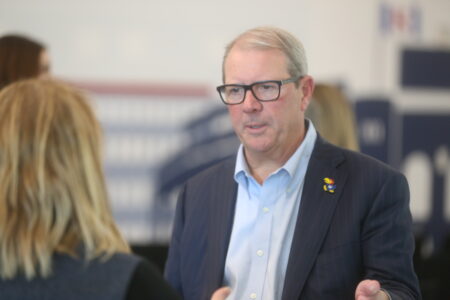
University of Kansas Chancellor Douglas Girod speaks at the FBI and KU Cybersecurity Conference on April 4, 2025.
Days after an informal online poll resulted in more than a thousand votes of no confidence in his leadership, University of Kansas Chancellor Doug Girod sent his own online message to the university community.
Among the themes: Spending on athletics is important, KU has been increasing faculty and staff pay, and the times may be tense but they can still be good.
“What comes next for KU will not be simple and it will not be free of tension,” a university wide e-mail message on Tuesday from Girod and new provost Arash Mafi said. “It can, however, be grounded in shared facts, mutual respect, transparency and a common commitment to the students and communities we serve. If we choose to approach one another in that spirit, KU will emerge from this moment stronger and better prepared to serve the next generation of Jayhawks and Kansans.”
The comments are some of Girod’s first public comments since results of an informal, online poll organized by a pair of faculty and university senate leaders were released. Numbers from the survey — which wasn’t scientific and let anyone vote — showed just more than 2,000 people responded to the survey, and nearly 80% registered a vote of no confidence in Girod and Jeff DeWitt, the university’s chief financial officer.
The section of the survey that allowed respondents to leave comments included many that questioned how much the university was spending on athletics, the football stadium renovation, and why more money wasn’t being directed to staff pay and academic matters.
Tuesday’s email from Girod and Mafi did not mention the recent confidence/no confidence vote, but did quickly mention that “we recognize that everyone may not be fully aware of the facts,” and noted that KU leaders have talked extensively about KU investment decisions and its commitment to academic values.
“But we can always do more, and that is why we write to you today,” the pair said in the message.
Here’s a look at some of the key comments from Tuesday’s university wide message:
• Athletics. Girod and the provost said investing in KU athletics is a critical strategy for the university to continue, as “a strong athletics program is integral to KU’s identity and is a powerful driver of our reputation and revenue streams.”
The pair acknowledged that the university is now providing “institutional support” to the athletics programs in the face of rising costs that have come from a NCAA lawsuit settlement that opens the door for student athletes to receive annual revenue share payments from university athletic programs.
As the Journal-World has reported for months, the university is no longer requiring the athletics department to reimburse the university’s general fund for millions of dollars in services, such as tuition, housing, and meals for student athletes.
Girod and Mafi said KU was fortunate that its athletics department historically had been in a position to make about $15 million a year in payments to the university’s general fund.
“But times have changed and now the university must ensure our athletics program can continue to be viable and strong in this transition by providing institutional support for student-athlete tuition, scholarships and housing,” the pair said in the message.
The message didn’t state the amount of payments the university’s general fund is now forgiving, but the Journal-World reported in September that DeWitt estimated the amount would be approximately $10 million in the current budget year.
Tuesday’s message did seek to clarify one narrative that has been building on campus: That KU is using general university dollars to pay high profile athletes to play for the Jayhawks. Tuesday’s message said KU is not using general university dollars in any direct way to do so. The message said all revenue sharing and Name, Image and Likeness payments to student-athletes “are coming from Kansas Athletics, not the university.”
While not specifically addressed in the message, forgiving approximately $10 million in previously-required payments to the university’s general operations has freed funds within Kansas Athletics to make revenue sharing payments and address other rising expenses.
• Facilities. One other such rising expense within the athletic department will be debt payments for the renovated football stadium. Private donations, state and federal grants and a host of public incentives like STAR bonds, tax increment financing and other such tools are funding a large portion of the stadium renovation, which includes a new conference center and a plan for a hotel, student housing, retail, restaurants and other development around the 11th and Mississippi site.
But as the Journal-World has reported, the project also will require Kansas Athletics to take on new debt, although an exact amount hasn’t yet been announced. Athletic department debt is designed to be paid with revenues generated through ticket sales, donations and other such athletic department revenue streams. Girod has previously said that no tuition or general state operating funds will be used to pay for the stadium project.
While the approximately $800 million cost of the renovation and associated development — collectively known as the Gateway Project — has drawn concerns from many faculty and staff, Tuesday’s message said the changing, more competitive nature of the higher education industry make such projects necessary.
“The emerging national model in higher education makes clear that institutions cannot ignore the cycle of competitive investments in facilities and still expect to remain competitive in recruiting students, faculty and research funding,” the pair wrote.
The message, though, said future years will produce facility projects that aren’t tied to athletics.
“We are deeply committed to strengthening and modernizing our academic infrastructure in the years ahead, ensuring our core academic mission remains at the forefront of these investments,” the pair wrote.
• Employee pay. The confidence/no confidence survey came during negotiations between KU administrators and the new union representing faculty members. The survey launched just days after negotiations between the two parties were nearing impasse. KU’s best and final offer guaranteed a 1% pay increase for faculty members, but held out the possibility for much greater increases to faculty members who were shown to have compensation levels significantly below their peers at other research universities.
That compensation proposal was widely panned as inadequate in the comments section of the confidence/no confidence survey, with many commenters complaining of little to no raises in past years.
Tuesday’s message pushed back on that narrative.
“In fact, from FY 2022-25, cost of living salary increases on the Lawrence campus totaled 9.5%,” Girod and Mafi wrote. “We recognize that more work is needed to address salary compression at the university, and we are committed to doing our best to close this gap as we build our budgets over the next several years.”
Tuesday’s message did not address the issue of administrative pay, which was a frequent point of criticism in the online survey. As the Journal-World reported in June, the Kansas Board of Regents agreed to give Girod a 12% pay raise for the year, following a period of record enrollment at the school. The raise brought Girod’s total compensation to $1 million.
KU has said that its tentative contract with the faculty union will provide more than 10% wage increases to many faculty members who are found to be below market averages, although precise numbers haven’t yet emerged.
Members of the faculty union — United Academics of the University of Kansas — are scheduled to hold a ratification vote on that tentative contract with KU on Wednesday and Thursday. If approved by the union, the contract would go to the Kansas Board of Regents for final approval.
KU
Following no confidence vote, Girod sends university-wide message explaining pay strategies, athletic spending
Nearly 80% of respondents express no confidence in KU leadership, but online survey methods criticized
Florida State research administrator final dean candidate for KU school of education

Jayhawk success in NCAA Tournament can go beyond just local pride; Lawrence leaders believe shared passion boosts community, KU

With $5.2M in federal funds, Dole Institute can digitize thousands of films and tapes from Sen. Bob Dole’s career