Nearly 80% of respondents express no confidence in KU leadership, but online survey methods criticized
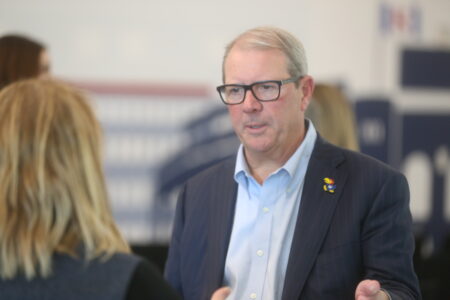
photo by: Chad Lawhorn/Journal-World
University of Kansas Chancellor Douglas Girod visits with a member of the crowd following his State of the University address on Oct. 16, 2025.
More than 2,000 people have spoken in an informal online survey regarding the quality of leadership at the University of Kansas. Most — nearly 80% of respondents — said they had lost confidence in the chancellor and the university’s top financial officer.
How seriously people should take the results, though, has become the subject of its own debate.
A spokeswoman for the chancellor’s office said in a statement to KCUR radio last week that the poll was “entirely unscientific” and the results don’t provide any “representative measure of sentiment across the university.”
One of the two creators of the survey has since made allegations in an opinion article published in the Kansas City Star alleging that university administrators threatened to damage her academic standing if she released results from the poll.
“I received a phone call from the university administration in which I was directly told that if a number came out in the press from our poll, the administration would intentionally focus on discrediting my reputation as a scientific scholar,” Misty Heggeness, president of the KU Faculty Senate, wrote in The Star opinion article.
Heggeness didn’t state in the article whom she received a phone call from, and she had not responded by late Monday afternoon to a request for an interview by the Journal-World. A spokeswoman for the chancellor’s office also did not respond to a request for comment about the survey and its findings.
Here’s a look at several of the results from the survey, and also information about the debate surrounding how it was conducted.
• Out of 2,012 total responses, 79.7% came back with a vote of no confidence in the leadership of KU Chancellor Doug Girod and Jeff DeWitt, the university’s chief financial officer. The survey combined the question, meaning voters had to vote the same way on both individuals. The university has about 15,000 employees and about 31,000 students between its Lawrence, KU Medical Center and other campuses.
• Survey respondents could self-identify as a member of one of five groups: KU faculty, KU staff, KU student, KU alumni or other. The survey did not exclude anyone from voting nor limit how often someone could vote. Each group came back with a vote of no confidence, the organizers said. No confidence totals for the group were: faculty, 81.5%; staff, 67.5%; student, 92.7%; alumni, 68.4%; other, 60%. Faculty members had the highest number of respondents, with 698. That’s about 20% of KU’s approximately 3,400 faculty members.
• Respondents to the survey could leave comments in addition to casting their vote of confidence or no confidence. Respondents identified as faculty members left the most comments, and there were several themes with commenters who gave Girod and DeWitt a vote of no confidence.
About 20% of all the comments from faculty members directly referenced negotiations between KU administration and the new labor union representing faculty members. The survey was launched in the aftermath of an announcement by KU that it had made its best and final offer to the union. That offer included 1% guaranteed raises for faculty members, but held out the possibility for much greater increases to faculty members who were shown to have compensation levels significantly below their peers at other research universities. The university demanded that the union accept the offer, or else the university would petition to have the negotiations declared at impasse, which would open the door for the Kansas Board of Regents to unilaterally adopt a contract. The two parties, as reported by the Journal-World, have since reached a tentative agreement. Union members are scheduled to vote on the contract this week.
The breakdown in union negotiations was a common theme among the comments left.
“The administration needs to negotiate with the union in good faith and stop dragging their feet and union busting,” one of the comments provided to the Kansas Board of Regents via a memo from the survey organizers said.
Other themes included dissatisfaction with Girod’s decision to appoint new a dean of the College of Liberal Arts and Sciences without first advertising that the position was open. Additionally, many commenters expressed frustration with how much money was being spent on the renovation of KU’s football stadium, and with athletic department spending in general.
“KU now basically supports pro athletic teams while academic units remain perilously underfunded,” one faculty member wrote. “It’s absolutely infuriating.”
Among those making a vote of confidence in Girod and DeWitt, several praised Girod for his defense of faculty tenure, pushing back against efforts in the Republican-controlled Kansas Legislature to weaken tenure protections.
Several comments criticized the survey itself and how it was presented. The survey was created by Faculty Senate President Heggeness and Poppy DeltaDawn, who is president of the University Senate. However, the two governance leaders did not seek a vote of their senate bodies before deciding to send out the survey, Heggeness previously told the Journal-World.
“Those who made this survey failed at shared governance procedures and just further alienated the future of collaboration,” one respondent wrote.
The call for people to respond to the survey was made via an email crafted by Heggeness and DeltaDawn. That email has come under criticism for going beyond a simple request asking people to participate in the survey, but rather included statements that were negative toward the KU administration. One part of the email characterized the KU administration’s actions toward compensation as “a lack of prioritizing wages.” KU leadership, however, has strongly disagreed with that assessment, and instead contends that the university has added millions of dollars to pay plans in an effort to address wage gaps between the university and private sectors. The email did not share that view.
“My basic research design class taught me better in terms of not introducing the survey with a clearly biased narrative and then allowing everyone and their brother, including politically-motivated or self-serving individuals to respond as many times as they like,” one respondent wrote. “I would reject any ‘results’ outright, and it makes KU faculty look inept.”
In their summary memo to the leader of the Kansas Board of Regents, Heggeness and DeltaDawn said they chose to use an open method to conduct the survey because “we felt it critical for faculty to have a space where their voices could be heard and brought to leadership.”
The pair, however, also said they would be happy if a more formal confidence/no confidence vote were held.
“At a minimum, offering all staff a standardized universal opportunity to vote on confidence would be a worthy cause for leadership, given the results,” the two wrote in their memo.
The Journal-World first reported on the existence of the confidence/no confidence survey on March 2 after receiving a copy of the email that had been circulating through the university community.
The Journal-World attempted to get results of the vote on two separate occasions from survey organizers. On the first attempt, the Journal-World was told the voting period for the survey had been extended, and thus results weren’t ready to release. On the second attempt, the Journal-World was told that the organizer would not release the results publicly, but instead would share them only with the chancellor’s office and the leader of the Kansas Board of Regents.
The memo the organizers sent to the Kansas Board of Regents became a public document, and the Journal-World obtained the results through the Regents office.
KU
Nearly 80% of respondents express no confidence in KU leadership, but online survey methods criticized
Florida State research administrator final dean candidate for KU school of education

Jayhawk success in NCAA Tournament can go beyond just local pride; Lawrence leaders believe shared passion boosts community, KU

With $5.2M in federal funds, Dole Institute can digitize thousands of films and tapes from Sen. Bob Dole’s career

Kansas House committee makes key changes to bill that will keep KU, other universities under the oversight of Board of Regents