Lt. Gov. Toland tells higher education leaders they need to start having some ‘uncomfortable conversations’
Toland said there is more universities can do to help grow business, jobs in the state
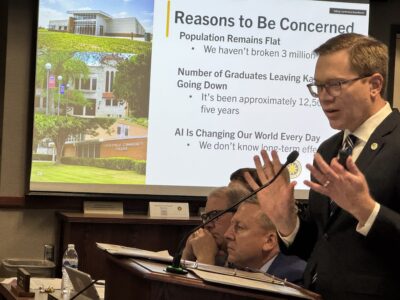
photo by: Chad Lawhorn/Journal-World
Lt. Gov. David Toland speaks to the Kansas Board of Regents on March 11, 2026.
The Kansas Board of Regents — the organization that oversees the leaders who hand out grades to thousands of the state’s college students — had the tables turned on it at Wednesday’s meeting.
Lt. Gov. David Toland, who also is Kansas’ secretary of commerce, came to Wednesday’s meeting and handed out grades on how the state’s major universities are doing in helping attract new businesses and serve existing businesses in the state.
What Regents heard is that the state’s universities are much closer to a ‘C’ student than an ‘A’ student.
“It is too complicated and it takes too long,” Toland told the Regents of the perception that many businesses have of working with the state’s universities on needs for their businesses. “They don’t want to navigate through all of this.”
Toland said he’s seen some of those concerns firsthand. An innovation director in the state’s commerce department sent a simple five question survey to each of the state’s public universities — University of Kansas, Kansas State, Emporia State, Fort Hays State, and Pittsburg State — asking each to identify their five strongest research areas, plus four other similar questions. The survey was meant to give commerce department officials the necessary information to give an “elevator pitch” about how the universities can help companies looking to move or expand in Kansas.
Each school was given nine days to complete the survey, as Toland said he believed the information was of the type that the universities already had compiled for their own uses. However, none of the universities met the deadline, and many were weeks late, he told the Regents.
Toland, in fact, did give grades to specific areas of university operations. He said the CEO of the Regents, the KU chancellor, and university and community college presidents act “at the speed of business,” when the commerce department asks for their assistance in landing a business deal in the state. For that he, said the higher education system’s leadership team deserves an ‘A’ grade.
“Below that executive level, it is not as good,” Toland said.
He rated the overall responsiveness of the system with a ‘C’ grade. He also gave a ‘C’ grade to the higher education system’s ability to easily communicate its research strengths and training specialities.
In fairness, Toland said his Department of Commerce doesn’t deserve high grades in every area either. He said the state’s bread-and-butter recruitment work of companies is currently among the five best operations in the entire U.S., and does deserve an ‘A’ grade. However, he said in areas like highlighting the importance of turning university research into new Kansas companies, the department has fared poorly. He said that effort deserved a ‘D’ grade, and said he was most to blame for not making that a higher priority.
Toland, though, also said the entire state — government and citizens alike — needs to have a change in mindset. He said there needs to be a broader recognition that the state’s demographics are troubling, especially the lack of significant population growth.
“There are a few things that keep me up at night, one of which is we have not been able to achieve the rate of population growth in Kansas that we need,” Toland said. “We have been below three million (people) forever. We need to have the kind of growth that we saw in the Sun Belt 30 years ago with Phoenix and Austin and that is now being experienced in Nashville and markets like that.”
However, he said he’s not sure everyone shares that vision or even thinks it is possible. He said parents have become too comfortable with the idea that their children will have to move away to be successful. He said Kansas could do well to adopt some of the bravado that a state like Texas has, which he said fiercely defends the reputation of its state and has even adopted the motto of “Don’t Mess with Texas.”
“We need to project a different type of confidence and competence,” he said.
Toland also told the Regents that the higher education system needs to make changes in how it helps its students find jobs in the state, making more direct connections with companies rather than relying on old-fashioned methods like job fairs. He also said, with the exception of Wichita State, many of the state’s universities are not doing enough to require students to have internships as part of their education.
But Toland, who has led the state’s efforts on multiple big projects including attracting the $4 billion Panasonic battery plant to De Soto and the Kansas City Chiefs to Wyandotte and Johnson counties, said he’s also confident that Kansas has the right people in place to have more big wins in the future, with higher education playing a big role in new gains for the state.
“I have heard from (the Regents) and all the executive leadership in this room that we want to win,” Toland said. “But we have got to drive this thinking down further in the organization. We’ve got to have some uncomfortable conversations about structures that are 100 years old, and that might not make sense in an economy that’s about to be radically transformed by AI, and we’ve got to make sure that data and facts are what’s driving us.”
State Government
Lt. Gov. Toland tells higher education leaders they need to start having some ‘uncomfortable conversations’
Last-minute bill would strip Regents of many oversight powers regarding KU, K-State, Wichita State

Kansas law targeting transgender people’s IDs and bathroom use will stay in effect, Douglas County judge rules

Clergy-led activists block entry into Kansas Senate in protest over bathroom law

House bill creates authority needed to complete Chiefs deal