

Last-minute bill would strip Regents of many oversight powers regarding KU, K-State, Wichita State
Regents quickly oppose bill, saying it could even allow Allen Fieldhouse to be sold
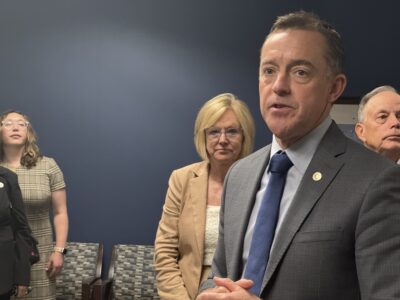
photo by: Chad Lawhorn/Journal-World
Blake Benson, chair of the Kansas Board of Regents, speaks at a board event on Wednesday, Sept. 17, 2025. Regent Alysia Johnston, chair of the Academic Affairs Standing Committee, is pictured to the left of Benson.
A late-arriving bill in the Kansas Legislature has a power struggle brewing between the Kansas Board of Regents and the University of Kansas, among others.
A bill introduced Wednesday morning would strip the Kansas Board of Regents of several key oversight powers related to KU, Kansas State and Wichita State University. By Wednesday afternoon, the Regents had unanimously voted to oppose the bill as it works its way through the statehouse, arguing the proposed law wouldn’t create enough public accountability for the state’s three largest universities.
“I think we owe more accountability to the taxpayers and families who send their kids to these various universities because with public funds you also have to have public trust,” Regent Kathy Wolfe Moore said during Wednesday’s meeting. “You know, in private business it can be done with a handshake. But this is not the same. These are public funds and there has to be accountability over all aspects of it.”
Regents unanimously voted to recommend that lawmakers reject the newly-filed legislation — HB 2798 — and directed Regents staff to testify and take other necessary steps to oppose the bill as it works it way through the final weeks of the Kansas legislative session.
After the unanimous recommendation for denial, though, University of Kansas Chancellor Doug Girod told the Journal-World he does question whether the current amount of state oversight is appropriate, given that state appropriations fund less than 15% of KU’s total budget at this point.
When asked by the Journal-World, Girod acknowledged that KU leaders had been speaking to state legislators about crafting legislation similar to HB 2798, which came forward Wednesday morning at the request of House Majority Leader Chris Croft, R-Overland Park.
“This is something that was discussed with the legislature about how do you help universities be more efficient in operating at the speed of business as opposed to what is the state doing that’s creating bureaucracy that is unnecessary given that they are 14% of our budget,” Girod said in a brief interview with the Journal-World.
The issue of when state funds are used for a university project is key to the proposed law. HB 2798 generally would allow KU, K-State and Wichita State to enter into a whole host of contracts without any approval from the Kansas Board of Regents, as long as no state dollars are being used. Currently most contracts of any magnitude — especially involving construction and real estate — are required to receive approval from the Board of Regents before KU can consummate them.
HB 2798 would also exempt the universities from a host of state laws as long as state funds weren’t directly involved with the matter. One proposed exemption would no longer require the university to get an independent appraisal before selling university property.
“You could have the sale of a property at below-market-value to a donor that we would have no oversight over,” Regent Matt Crocker said during Wednesday’s meeting.
Some Regents went so far as to say that the law technically would allow KU to sell Allen Fieldhouse without approval from the Regents. A more realistic example, some Regents said, would be that KU could enter in an agreement with a private equity firm — an industry that has been eyeing the college athletics industry — that would give such a firm some rights over Allen Fieldhouse.
Blake Flanders, the longtime president and CEO of the Regents, said the proposed law would give the three universities the ability to use private developers to construct new buildings without receiving any approval from the Regents or the Kansas Legislature. Further, Flanders said, the universities then could use state money to ultimately pay the developers.
“Essentially with the new models, I could have a private developer build every building,” Flanders said in a brief interview with the Journal-World, “and maybe later, use state funds to make the payments. But that building is already built and didn’t have any oversight as to whether the university could afford that or if it was necessary.”
When asked about the accountability concerns raised by multiple Regents, Girod told the Journal-World that any system needs to provide assurances of accountability to the public. But Girod also noted that sometimes the university is being asked to comply with multiple levels of bureaucracy both at the state law level and Board of Regents policy level.
“The question is at what level?” Girod said of what bureaucratic approvals should be required. “You know, a lot of board policies backs up state law, so a lot of the bureaucracy is dictated by state law that when in reality, they are funding 15% of the operation.”
The idea that the state is funding a sliver of universities’ total operations but has almost total control over their building and operational matters was a point Girod came back to multiple times when discussing the legislation. However, the idea that the state only funds 14% to 15% of KU’s operations is dependent upon how you define “state money.”
If you are counting state money only as that amount that comes directly from the state legislature — about $330 million in fiscal year 2025, which was up about $25 million from fiscal 2024 levels — KU received about 18% of its revenues from state appropriations.
But the question was raised Wednesday whether tuition dollars received by the universities also should be counted as state support. Tuition essentially is a fee for a state service, and tuition rates are entirely controlled by the state, with the Board of Regents having final authority over tuition rates. KU received more than $376 million in tuition revenue in fiscal year 2025. State appropriations and tuition fees combined accounted for nearly 40% of KU’s total revenues during the last fiscal year.
Flanders said his interpretation of the proposed law is that tuition revenue would not count as “state money,” and thus universities could spend tuition dollars without oversight by the Regents. Girod said he’s believes that point of the bill needs clarification, and he is uncertain what level of oversight the Regents would maintain over spending funded by tuition dollars.
Some Regents said the bill is misguided either way. Regent Alysia Johnston said the role of the Board of Regents has never been limited to just keeping an eye on the dollars and cents of the state’s higher education system. She said the Regents have been tasked with broad oversight authority for reasons that go beyond fiscal matters.
“The Board of Regents has been tasked with the stewardship not just of state funds and assets that go to state universities, but also we are responsible to make sure our state has accessible, affordable, high quality education that feeds the economic engine of the state as well as the cultural engine,” Johnston said during Wednesday’s meeting.”
Blake Benson, chair of the Regents, said he was aware that legislators were working on some proposals that would streamline parts of the university construction process, perhaps removing some requirements related to how architects and other professionals must be approved, for instance. He said Regents are likely supportive of some of those types of changes. However, Benson told the Journal-World that he was not aware that legislators were contemplating wholesale changes that essentially would remove large amounts of Regents oversight of activities that aren’t directly funded by state appropriations. He said he first learned of that provision when the bill was introduced on Wednesday morning.
The significance of the bill caused Benson to immediately ask the Regents whether they were in support or opposition to the bill. While the board was unanimous — one member was absent — in its opposition, Benson acknowledged there may be support for the bill from KU, K-State and Wichita State. But in an interview with the Journal-World, he said he expects all universities to heed the Regents’ unanimous opposition, and respect the fact the Regents are responsible for communicating the thoughts of the state’s higher education system to lawmakers.
“The action we took today was not just for the Board of Regents, but it was for our system,” Benson said. “So our system, as this bill is currently worded, is opposed to this bill.”
The bill is scheduled to get a hearing in a House committee on Thursday afternoon.
State Government

Property tax protest bill would let a few dozen voters block tax increases in some parts of Douglas County

Lawmakers pass bill to create sports authority to oversee new Chiefs stadium in Kansas
Kansas Legislature passes a bill that would give 10% of voters the power to stop some property tax increases
Kansas Senate, House pass budget bill that pegs raises at 1% for most state employees

U.S. Supreme Court Justice Sonia Sotomayor to visit KU next month; will speak to students, select guests
