

KU’s faculty and university senates call for a vote to determine if university community has confidence in chancellor
No confidence vote comes as labor, wage negotiations begin to stall

photo by: Shawn Valverde/Special to the Journal-World
The University of Kansas campus is pictured in this September 2023 aerial photo.
UPDATED 9:35 P.M. March 2
In the wake of stalled labor negotiations, faculty and staff leaders at the University of Kansas are asking employees to consider a vote of no confidence in Chancellor Douglas Girod and the university’s chief financial officer.
In a joint email this week, the KU Faculty Senate President Misty Heggeness and KU University Senate President Poppy DeltaDawn are asking all employees to vote through an online ballot on whether they have confidence in the chancellor and CFO Jeff DeWitt. The online voting is scheduled to end on Wednesday, and the pair said they would deliver results to both the KU administration and the Kansas Board of Regents, which oversees operations at KU.
The email from the senate leaders said repeated concerns have been raised by faculty and staff members about how much the university is spending on athletic projects compared to how much the university is offering in wage enhancements for employees.
“These concerns stem from ongoing arrangements regarding the new football stadium and related development, national policies driving unanticipated changes to the pay structure of student athletes and programs, and a general understanding that the KU academic system has, over the past five years, dug itself out of insolvency only to now be, once again, dealing with major deficits driven by athletics that are negatively impacting academic programs and faculty,” Heggeness and DeltaDawn wrote.
“All this uncertainty begs for the need of an external audit of KU finances and a university-wide vote to identify whether the university community still has confidence in leadership given these recent events,” the pair further stated.
The vote of confidence/no confidence is open to both employees and students, according to a copy of the online ballot seen by the Journal-World. The online ballot simply asks the online user whether they have confidence in Girod and DeWitt, who as chief financial officer has been responsible for putting together multi-year budgets for the university. The online survey then asks the user to identify how they are associated with the university, with choices including professor, staff, student, alumni, or other.
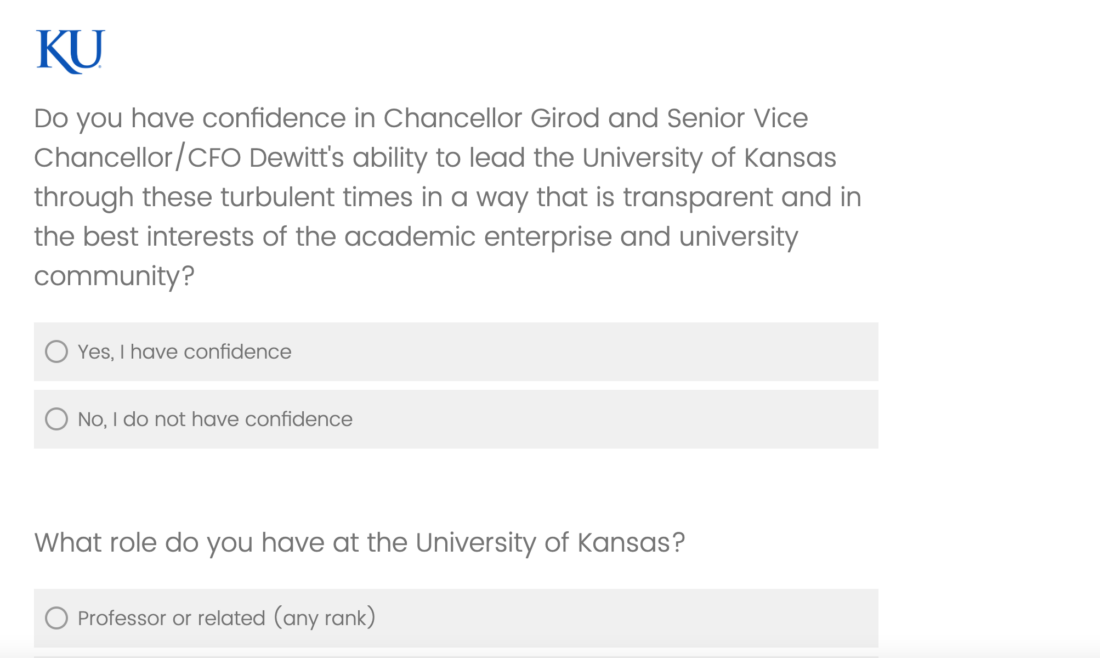
photo by: Journal-World screenshot
A screenshot from an online survey asking people connected with KU to vote on whether they have confidence in the KU chancellor and the university’s chief financial officer.
The survey — which has some technological functions to determine if many votes are coming from the same IP address — gives the user the option of attaching their name to their vote, but it is not required. In an email to the Journal-World on Monday evening, Heggeness said the vote is obviously non-binding, and is meant to send a signal to university leaders as to whether the university body is in support of their actions.
Heggeness said she and DeltaDawn sent out the call for the confidence/no confidence vote in their roles as university governance leaders, but did not seek a formal vote on the matter from the two senate bodies they lead.
“Poppy and I have at heart the interest of our academic colleagues and a strong desire to make sure that decisions around the distribution of university finances are made in a transparent and forthright fashion on behalf of those who breathe energy and heart into the core functions of the university,” Heggeness said via email.
Both the Faculty Senate and the University Senate have largely stayed on the sidelines of negotiations between the KU administration and the UAKU labor union. But on Thursday the Journal-World reported that the union negotiations are nearing impasse.
KU leadership last week rejected a wage proposal from the union and delivered the university’s “last, best and final offer” on wages. That proposal from KU could leave some faculty members receiving a wage increase as little as 1%, though KU leaders contend many faculty members will receive a greater increase — more than 10% in some cases — if their positions are deemed to be at wage levels that are below prevailing wages in the region for similar positions.
But the proposal from KU leaders did not provide a dollar amount that KU expected to provided in wage increases, and the proposal was only for one year. The union had been seeking at least a three-year agreement on wages.
The university gave UAKU seven days — starting last Thursday — to accept the offer. If an agreement can’t be reached, KU intends to file a petition with the Kansas Public Employee Relations Board seeking that an impasse be declared in the labor negotiations. The impasse would require both sides enter mediated negotiations, but if those mediated sessions don’t produce an agreement, a unilateral settlement could be declared by the Kansas Board of Regents, which governs KU.
The email from Heggeness and DeltaDawn referenced last week’s breakdown in negotiations.
“Governance leadership has sat on the sidelines of this negotiation process, hoping for a quick and seamless agreement that recognizes the value and contributions of academic staff at the University of Kansas while also acknowledging the challenging times higher ed finds itself today,” the pair wrote. “However, it has become apparent that the union and administration are at an impasse.”
While the negotiations haven’t officially been declared at an impasse, UAKU leadership in recent days has responded to the university’s latest wage proposal with disappointment. In an update posted to its website, UAKU said it was “deeply disheartened” by the actions of KU management last week, calling them “utterly disrespectful.”
“We continue to believe that there is a path to an agreement between UAKU and KU and we remain ready to meet in order to reach that agreement,” the union said on its website. “Despite KU’s delays and disrespect, we are in the process of reviewing and considering their response.”
A spokeswoman for the Chancellor’s Office did not have any comment about the confidence/no confidence vote, but said the university would continue it work with the university’s faculty on matters important to the university.
“University of Kansas leaders welcome continued conversations with faculty and instructors about ways to move the university forward,” university spokeswoman Erinn Barcomb-Peterson said via email.
State Government
Property tax protest bill would let a few dozen voters block tax increases in some parts of Douglas County

Lawmakers pass bill to create sports authority to oversee new Chiefs stadium in Kansas
Kansas Legislature passes a bill that would give 10% of voters the power to stop some property tax increases
Kansas Senate, House pass budget bill that pegs raises at 1% for most state employees

U.S. Supreme Court Justice Sonia Sotomayor to visit KU next month; will speak to students, select guests
