

Regents approve tougher tenure policy that will require more frequent reviews for professors
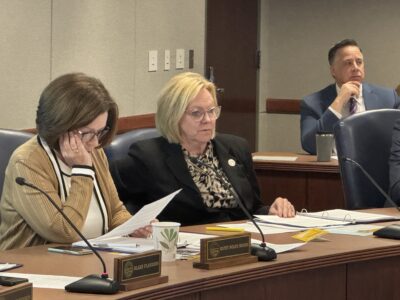
photo by: Chad Lawhorn/Journal-World
Regent Alysia Johnston, right, led many of the discussion on changing the state's tenure process for professors, Johnston, pictured on Jan. 14, 2026, is the chair of the Regents' Academic Affairs Committee.
The Kansas Board of Regents on Wednesday unanimously approved a new, tougher tenure process, which will go a long way in determining what university professors and other faculty members must do to keep their jobs.
Now, the question is whether it is tough enough to please Kansas legislators?
The Regents, who oversee the University of Kansas and the state’s other public universities, made significant changes to the tenure policy after the Republican-controlled Kansas Legislature had sent messages that it may revamp the policy itself over concerns that university professors were not meeting the expectations of Kansas taxpayers.
After Wednesday’s vote — which ended seven months of study by the Regents — KU Chancellor Douglas Girod said he was hopeful legislators would be appreciative of the changes.
“I would certainly hope so,” Girod said of the tenure changes being enough to hold off further action by the Legislature. “We can all say with a straight face and with confidence that this new system will be as robust as anywhere in the United States.”
The new system adds mandated annual reviews, requires department chairs or division leaders to create more specific annual work plans for professors, and shortens by two years the date upon which tenured faculty members must go before a committee of experts to argue that they are still qualified to hold the tenure rank.
But with all that said, the new process isn’t as tough as it was proposed to be a month ago.
A version of the tenure policy presented to Regents in December included language that would have required universities to dismiss any tenured professors who received two consecutive unsatisfactory annual reviews from their department chairs. The policy approved on Wednesday removed the language that a faculty member “will be dismissed” for two poor performance reviews. Now, the proposed policy states such faculty members are “subject to dismissal, reassignment, an additional one-year improvement plan, or other personnel actions.”
How Republican legislators will react to the new policy is unclear. In the past, lawmakers have expressed concern that the universities’ tenure policies are too undefined, and give the schools too much latitude in deciding when a professor is no longer meeting expectations.
Several university leaders and faculty members, however, said they were grateful that the Regents had made the change regarding the required dismissals. Girod applauded the Regents for making the change after receiving written comments from multiple faculty groups saying that such a strict system would have a negative impact on the ability of universities to attract and keep top professors.
“It is very important,” David Smith, a KU professor in sociology, said of the change that eliminated the automatic dismissal provision. “It allows common sense to enter the picture rather than just an automatic mechanism.
“We want decisions concerning education in general, but also the employment status of people who work at the university to be handled sensitively and intelligently with concern for the reality.”
Smith was among a group of KU faculty members who are active in the faculty union UAKU that attended Wednesday’s Regents meeting in Topeka. Several members were holding signs that urged KU administrators to complete negotiations with the union on an employment contract. KU and the union have been in negotiations since 2024, shortly after the union was formed and approved by the KU faculty.
Matters of job security and working conditions are both big issues with the union. Wednesday’s actions by the Regents impact both topics.
Tenure, which is an academic rank conferred upon faculty members who meet a certain level of scholarship, historically has been one of the most important components in attracting and retaining top professors. The tenure rank, through the job protections it has historically given to professors, has promoted the academic freedom that professors often desire.
In addition to the changes to the tenure policy, the Regents also approved changes to a workload policy for faculty members. The approved changes to the two policies amount to a tightening in several regards. They include:
• Professors who have received tenure would be required to undergo an extensive review by a committee every five years, instead of the current standard of every seven years. At least half of the review committee must be individuals who are not part of the professor’s department.
• Every faculty member — whether they have tenure or not — will have a written work plan that includes assigned teaching loads. The proposed policy stops short of mandating a minimum number of hours a professor much teach, but it does create an expectation. The policy states faculty members at research universities — such as KU, Kansas State and Wichita State — should typically teach six to nine credit hours per semester. In most instances, that equates to two to three classes per semester. At regional universities — which include Emporia State, Fort Hays State and Pittsburg State — faculty members should typically teach 12 hours, or the equivalent of four classes, per semester.
• Every faculty member would be required to go through an annual review with their department chair or division leader. While the current policy says such a review is a possibility, it is not technically a requirement. The proposed policy would mandate that each annual review specify how much time a faculty member will spend on teaching versus research versus other creative activities. Any faculty member who does not meet that workload expectation “will be placed on an improvement plan,” the proposed policy states.
Provisions like those are what led Girod to call the new policy as robust as any in the nation. While that title may please legislators who think the tenure system had become too open-ended, the changes might hamper recruiting of new professors. Girod said it was too early to tell whether the new tenure policy would hinder the ability of Kansas universities to attract new professors to the state.

photo by: Chad Lawhorn/Journal-World
University of Kansas Chancellor Douglas Girod visits with a member of the crowd following his State of the University address on Oct. 16, 2025.
Girod said requiring professors to defend their tenure status every five years instead of every seven years might be the biggest change that would give prospective professors pause. He said the process — known as “post tenure review” — is intensive and takes time away from research and other activities that professors highly value.
But Girod also said he generally doesn’t believe faculty members will have any problems in justifying their tenure status.
“We have really high quality faculty, and this will just prove it,” Girod said.
The policy also should be a good talking point with Kansas lawmakers who have expressed concerns about whether university professors are engaged in enough classroom teaching, some Regents said.
“The question I seem to get all the time, especially when I’m here in Topeka, is making sure I’m a good steward for the state’s funding for higher education,” Regent Matt Crocker said. “In particular, I think the workload policy we are putting in place helps answer that question, and I think it is going to be very valuable for us as we continue to have those dialogues with the Legislature.”
Regent Alysia Johnston, who as chair of the Regents’ Academic Affairs Committee led many of the preliminary discussions on the new policy, said the new system also will require several new reports showing the number of classes professors are teaching, the amount of research they are conducting and other important metrics.
“I think it will give us the data that we need to be able to communicate to people what’s really going on with tenure and post tenure because I think there are a lot of urban legends out there about what is really going on,” Johnston said.

photo by: Chad Lawhorn/Journal-World
The Hawker apartment complex at 1011 Missouri St. is pictured on March 18, 2024.
In other business, the Regents also unanimously approved a resolution authorizing KU to take on up to $100 million in new debt to help complete construction of a new cancer center on the KU Medical Center campus in Kansas City, Kan., and $35 million in new debt to buy the Hawker apartment complex that is at the north edge of the Lawrence campus. The Hawker Apartment complex, 1011 Missouri Street, currently is owned by a KU Endowment Association entity, which leases the apartment to KU’s student housing department for use by students. The approved debt resolution also authorizes KU to refinance approximately $300 million worth of bonds that were issued in 2016 to help construct the Central District project of classrooms, laboratories and student housing on KU’s Lawrence campus.
State Government
Regents approve tougher tenure policy that will require more frequent reviews for professors

Kansas governor revels in triumphs, warns against succumbing to ‘uncivilized’ politics

KU seeking to add $135M in debt to help with cancer center, student housing projects
Regents expected to take final vote on tightening tenure process for university professors

KU to give raises to employees next week, but faculty members not included due to union negotiations
Kansas Senate minority leader challenges GOP House speaker for insurance commissioner
TOPEKA — Kansas Senate Minority Leader Dinah Sykes will run for state insurance commissioner, vowing to decline ...