

K-State found to be in violation of state’s DEI law; student funding changed to come into compliance
Key lawmakers say Legislature may produce more DEI rules this session

photo by: AdobeStock
An entrance sign at Kansas State University is shown.
As the state has imposed new restrictions on diversity, equity and inclusion initiatives at universities, some supporters of DEI efforts perhaps have wondered whether the state is really in a position to enforce such bans.
On Tuesday, such wonderers got their strongest sign yet that state leaders are prepared to keep a pretty close eye on DEI. A key state council that oversees finances for universities and state agencies received an update on Tuesday that a previous complaint from the council has resulted in Kansas State University requiring its student government to stop funding some student organizations that have a DEI focus.
The State Finance Council of Kansas in July received an anonymous complaint from a Kansas State University student who alleged that a student-controlled committee called the Community Engagement Committee was actually a group that had a primary mission of creating and funding diversity, equity and inclusion programs throughout the K-State campus.
The anonymous whistleblower alleged the committee’s activity went against state law. On Tuesday, a K-State leader told the State Finance Council that the university agreed.
“There was language in student government where they were providing funds for DEI-related work that would be in conflict with Senate Bill 125,” Marshall Stewart, chief of staff for K-State’s president, told the council on Tuesday.
Senate Bill 125 is a budget bill approved in 2025 by the Kansas Legislature that included a provision that essentially prohibits state agencies and universities from expending funds on DEI programs and initiatives, among other matters.
Stewart told the State Finance Council that Kansas State took the matter “very seriously” and informed the student organization that it was out of compliance with the law.
“We laid all the facts out that this is the law, and this is what we need to do to be in compliance,” Stewart said.
Kansas State University’s student government then took up the matter through its formal process, Stewart said, and cancelled planned disbursements of money that were scheduled to go to groups that promoted DEI initiatives. The student organization also stopped making board appointments to any groups that have a DEI mission, he said.
“So, no longer are they dispersing money that is in conflict with that or making appointments that are in conflict with Senate Bill 125,” Stewart said.
It wasn’t immediately clear how much money or what specific type of activities lost funding at Kansas State. Members of the Finance Council were provided with a written report from Kansas State, but that report wasn’t made available to the audience of the meeting, which was conducted only online. The Journal-World has reached out to state officials to obtain a copy of the report.
The July whistleblower complaint alleged the Community Engagement Committee controlled a little more than $137,000 in the 2024-2025 school year, and that the group “overwhelmingly funds identity-based and progressive-aligned organizations.”
Whatever the amount, the process used to shut down that funding stream at Kansas State might be the biggest item of note for members of the University of Kansas campus community. Tuesday’s report showed that legislators do have a mechanism to get to the bottom of suspicions that universities are still engaged in DEI practices.
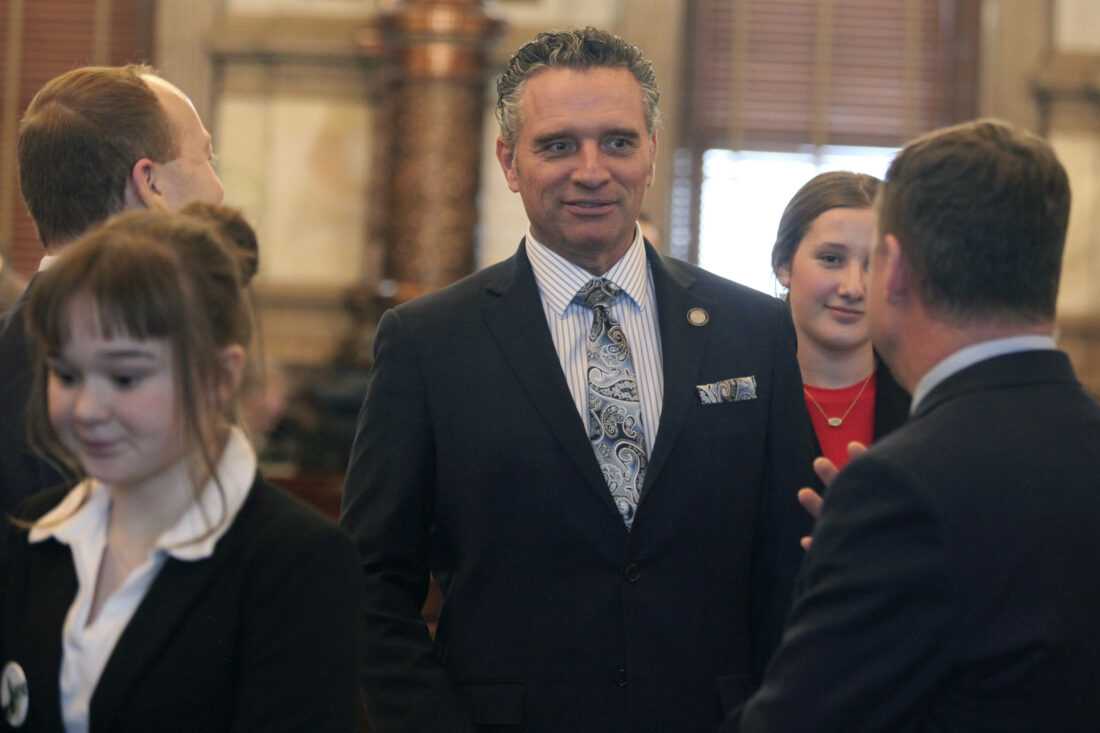
photo by: AP Photo/John Hanna
Kansas Senate President Ty Masterson, R-Andover, speaks to fellow senators before the Senate’s session, Wednesday, Feb. 7, 2024, at the Statehouse in Topeka.
The process got started when a student sent a copy of written allegations to Senate President Ty Masterson, R-Andover, who serves on the State Finance Council with other legislative leaders and Gov. Laura Kelly. During July’s meeting of the State Finance Council, Masterson shared the complaint with other members of the council. The council then directed the state’s Director of Administration to investigate the matter.
The director did investigate the matter, engaging the Kansas Board of Regents and KSU leaders, including the university’s general counsel. Those actions led to Tuesday’s findings that a violation had occurred.
There’s not a specific penalty in the state law for violating the DEI provisions, but universities found in violation would be taking a real chance for future state funding disruptions if they knowingly allowed a violation to persist. The Republican-controlled Kansas Legislature has great ability to craft budget language that could impact the Kansas Board of Regents or specific universities, if lawmakers believed a university was thumbing its nose at a DEI provision. Eliminating or curtailing DEI activities at universities and elsewhere has become a major plank in the platform of many Republicans following President Donald Trump’s denouncement of such policies.
On Tuesday, Masterson said he was pleased with Kansas State’s response to the student complaint, and said some lack of clarity in the state law may have played into the violation. But on that point, he said university leaders may see more specific instructions on DEI come out of the Kansas Legislature this session.
“I think there was probably, as we all can imagine, some lack of clarity in Senate Bill 125 that allowed for some maybe less than ideal instructions coming to the universities,” Masterson said.
Masterson went on to say that the work that now needs to be done “has to be done in the Legislature.” Whether that is a simple clean-up of Senate Bill 125 to make it more explicit or whether lawmakers will pursue more expansive legislation wasn’t addressed by Masterson during Tuesday’s meeting.
As the Journal-World has reported, members of the Kansas Board of Regents were recently told to expect significant legislative debate on a piece of model legislation from the Goldwater Institute. The Arizona-based advocacy group that touts the benefits of limited government, economic freedom and individual liberty is working to get state legislatures to adopt the Freedom from Indoctrination Act.
The act would dive deeper into the curriculum that faculty members teach in their classrooms. One provision, for example, would essentially prohibit the university from requiring any student to take a class that teaches DEI concepts.
KU leaders have said they believe the university currently is in compliance with the provisions of Senate Bill 125. KU administrators in late 2025 instructed employees to no longer use preferred pronouns — such as “they” and “them” — in the email signature lines of their university accounts. That move, which has drawn opposition from members of the faculty and staff, was identified as the last major initiative KU needed to complete in order to be in compliance with the Senate bill.
However, Kansas State officials also thought they were in compliance, until the July complaint surfaced. On Tuesday, Stewart said KSU would continue to be diligent on the matter.
“Universities are big, complex organizations,” Stewart said. “I’m not going to say if you go deep enough and look hard enough, you’re not going to find some things. But if you do find them, we ask that people share those with us, and we certainly want to be a good partner with state government, and we have done our very best to do that.”
State Government
Lawrence lawmaker rips proposed bill that would overturn local affordable housing ordinance; chides legislator for implying renters are ‘filthy’
As legislators target illicit e-cigarettes, a health official says they’re already a problem in Lawrence
House overrides veto; ‘bathroom bill’ limiting access to Kansas facilities will become law
Kansas bill would label kratom a Schedule 1 drug
TOPEKA — A bill heard Monday would list kratom as a Schedule 1 drug, moving the previously unclassified substance ...
Kansas Senate overturns veto of transgender bathroom bill, bringing controversial measure one step closer to becoming law
TOPEKA — The Kansas Senate overturned Gov Laura Kelly’s veto on Tuesday, putting the state one step closer to ...
Unauthorized vapes under fire by state lawmakers, Big Tobacco
TOPEKA — The Kansas Senate approved tougher regulations on vapes Wednesday in an effort to crack down on ...