

KU leaders reject pay proposal from faculty union; administration says it will seek an impasse in negotiations if deal not reached in 7 days
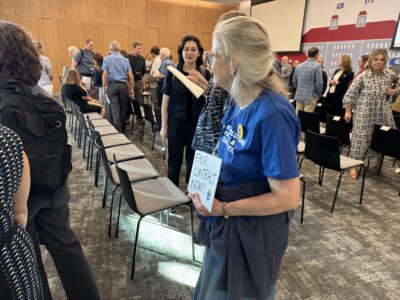
photo by: Chad Lawhorn/Journal-World
A member of the crowd at KU's State of the University speech is pictured on Oct. 16, 2025. The sign is urging KU to reach a contract deal with its faculty union.
University of Kansas leaders Thursday firmly rejected a set of employee raises proposed by KU’s faculty union, bringing the two sides ever closer to a formal impasse that could lead to a forced settlement in the labor dispute.
A lead attorney for KU’s negotiating team formally rejected all of the pay plans proposed by the faculty’s union, United Academics of KU. In a Thursday letter to the union, KU estimated the university would have to spend nearly $45 million over a three year period to fund all of the pay increases proposed by the union.
Ryan Denk, a KU-hired attorney with the Kansas City law firm of MVP Law, said in the letter that the plan was “unaffordable under the university’s constrained budget and current revenue projections.”
KU leaders have instead submitted a proposed pay plan that would provide one year of raises, but would allow the parties to reopen wage discussions in each of the two following years. However, under the plan proposed by KU administrators, some faculty members might only see a 1% pay increase this year.
In the letter, KU did not assign a dollar value to its proposed pay plan. The amount of increases for faculty members would vary greatly depending on their positions, years of service and other factors.
The plan would guarantee that members of the union would receive at least a 1% pay increase. However, KU leaders said there would be other members of the union that would receive double-digit pay increases, if data showed that their wages were below fair market minimums that KU has established by studying the regional labor market and wages at other top research universities.
In its letter, KU said the average pay raise for union members found to be below the fair market minimum would be 13%. However, KU did not disclose in the letter how many faculty members are below the fair market minimum. A KU spokeswoman said KU had no further information to share beyond what was included in the letter.
KU also has proposed to set aside $1.5 million to provide funds for employee retention programs and to provide some performance-based raises.
In the letter, KU said the offer was KU’s “last, best and final” offer on the matter of wages. The university has given UAKU seven days to accept the offer. If an agreement can’t be reached in the next seven days, KU intends to file a petition with the Kansas Public Employee Relations Board seeking that an impasse be declared in the labor negotiations, Denk said. If the employee relations board grants the petition the impasse would require both sides to participate in mediated negotiating sessions.
If those sessions don’t produce an agreement, state law could allow the Kansas Board of Regents — which is the governing authority for KU — to unilaterally approve a labor contract for KU faculty.
UAKU leaders have not yet posted a response to KU’s latest proposal. However, the union has made pay a central issue in the labor negotiations, and has accused KU leaders of “union busting” as recent negotiations have not produced an agreement.
“KU is refusing to pay faculty and academic staff a fair wage, forcing faculty to struggle for resources needed to deliver a strong public higher education,” UAKU has posted on its website that communicates updates to the public.
Faculty members in April 2024 overwhelmingly approved the formation of a union to represent approximately 1,550 full and part-time employees who are faculty members or academic staff members. Negotiations began shortly after the union was approved, but the parties have not yet come to an agreement on an overarching labor contract.
Kansas law generally prohibits public employees from going on strike, and employees who do strike could be fired by the university. While strikes are not common among public labor unions, public labor unions in other jurisdictions have instructed members to picket workplaces, stop any voluntary service that union members may be providing to a university and to operate under a “work-to-rule” philosophy, which generally means that employees will stop all work duties that are not clearly delineated.
As part of its pay proposal that KU leaders rejected, the union had sought several compensation changes. They included, according to KU’s summary of the proposals:
• Retroactive pay increases for 2025 to compensate faculty members after KU and the union did not fully agree on a pay plan for the last school year.
• A 3% across-the-board pay increase for all union employees in 2026, plus a signing bonus that would be equivalent to 1.25% of an employee’s annual pay.
• A 2% across-the-board pay increase for union employees in 2027, plus 2% pay increases for employees who meet certain merit pay requirements.
State Government
Property tax protest bill would let a few dozen voters block tax increases in some parts of Douglas County
Lawmakers pass bill to create sports authority to oversee new Chiefs stadium in Kansas
Kansas Legislature passes a bill that would give 10% of voters the power to stop some property tax increases
Kansas Senate, House pass budget bill that pegs raises at 1% for most state employees
U.S. Supreme Court Justice Sonia Sotomayor to visit KU next month; will speak to students, select guests
