KU’s Girod helped Trump administration craft letter calling on universities to adopt set of principles
KU leader joined three other university presidents to help Secretary of Education
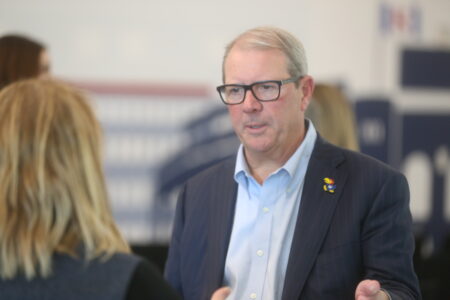
photo by: Chad Lawhorn/Journal-World
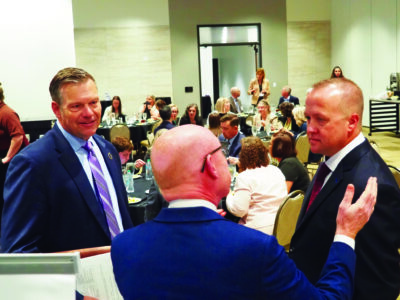
University of Kansas Chancellor Douglas Girod visits with a member of the crowd following his State of the University address on Oct. 16, 2025.
UPDATED 6:25 P.M. AUG. 3
KU Chancellor Doug Girod has helped the Trump administration craft a letter asking U.S. universities to broaden their ideological spectrum and put “Americans, and American interests” first.
Girod was among four university chancellors and presidents who helped U.S. Education Secretary Linda McMahon craft a letter sent Monday asking U.S. universities to publicly commit to seven “statements of principle” that range from artificial intelligence usage to ensuring that protests don’t disrupt learning on campuses.
Girod told the Journal-World via email that he chose to participate in the drafting of the letter in his role as chair of the board of directors of the Association of American Universities, which is generally regarded as the top collection of research universities in North America.
“This is a conversation higher education needs to have, and I believed it was important that universities themselves help shape it,” Girod said via email. “We used that opportunity to advocate for a voluntary, mission‑aligned process that recognizes the diversity of institutions and allows each university to answer in its own voice.”
While the letter asks universities to make a public statement of support by the end of the year, this letter — unlike a proposed “compact” last year — doesn’t state whether schools will be rewarded or punished based on how they respond to the request.
The letter also does not direct universities to adopt specific operating policies, but rather asks the universities to describe what commitments they will make to seven “statements of principle” outlined in the letter.
“Before the end of 2026, I call on every postsecondary institution to describe to the American public your commitments to rigorous teaching, pathbreaking research, and national service — commitments that make our universities a bedrock institution of the American public,” stated the letter, which was signed solely by McMahon.
Girod said the lack of mandates in the letter is important.
“I felt comfortable engaging because we were not signing onto a mandate,” Girod said via email. “We were helping move the conversation toward transparency and accountability in ways that respect academic freedom and institutional autonomy.”
Joining Girod in assisting the Trump administration with the letter was AAU vice-chair Ronald Daniels, president of Johns Hopkins University, according to reports by Bloomberg, which was the first organization to report the role of the university presidents. Andrew Martin at Washington University in St. Louis and Michael Crow at Arizona State University also were part of the group that helped craft the letter, according to Bloomberg.
Girod said KU will begin crafting a “collaborative process” to develop a KU-specific response to the questions posed in the letter, which will include areas where KU is committed to improving. However, Girod said that does not mean he’s supportive of every point the letter raises.
“I support the idea that universities should be able to answer these questions clearly and publicly,” Girod said via email. “Questions about how we admit students, protect free expression, ensure affordability and value, safeguard research and serve the country are legitimate.
“That said, I don’t agree with every nuance of the way each question is framed, and I’ve been candid with the administration about that. Some language still reflects tensions in the national debate that are more complicated on our campuses than a single sentence can capture.”
The seven principles outlined in the letter are:
• A transparent posting of the university’s admission criteria, including statements that show “admission decisions are based on merit, achievement, and your university’s educational purpose.”
• An “ethic of free speech” that allows for a “thriving marketplace of ideas, guided by open inquiry and honest debate.” The letter asks that each university describe how it will “guarantee that unruly and violent protestors do not harass students or disrupt classes, research, public lectures and campus operations.”
• An explanation of the university’s faculty and hiring practices with an eye toward ensuring that “all relevant perspectives are taken seriously.” The letter references a recent document authored by the presidents of Vanderbilt and Washington universities that argues political criteria have compromised the integrity of many academic fields.
“When disciplines skew toward one side of the ideological spectrum, the truth-seeking function of the university suffers and public trust declines,” McMahon said in the letter.
• A statement on how the university is working to “ensure that families can access affordable, high-return degrees.” The letter also asks universities to detail how they are making their pricing transparent, and what they are doing to equip students to repay their loans.
• A statement on how the university will “incentivize rigor” in the age of artificial intelligence. The statement specifically raises concerns about a trend of “grade inflation” on some university campuses.
• An explanation of how the university will protect its research projects and other key pieces of information from “foreign influence.” The statements said universities should be prepared to refuse gifts with “problematic conditions,” and also need to be ready to “ensure foreign actors do not unduly influence academic programming, research personnel, researcher assignments or student admissions.”
• A recognition that American taxpayers provide massive sums of funding to higher education, and that “American universities must put Americans, and American interests, first.” The letter specifically asks each university to describe how it will “advance American security interests” and also meet the country’s workforce needs.
Girod noted that the letter — which has been dubbed a call to action rather than a legal directive — has no formal enforcement mechanisms attached to it.
Whether universities that positively respond to the letter will receive different treatment from the administration than those that do not is an open question. On Monday, Girod said he thinks the future relationship between universities and the federal government is complex.
“Ultimately, how this and future administrations view universities will depend less on any one document and more on whether we are seen as responding seriously to legitimate public concerns about cost, value, free inquiry and service,” Girod said via email. “My focus — and KU’s focus — is not on trying to anticipate every possible federal reaction. It’s on doing the right thing for our students, for Kansas and for the public we serve.
“We intend to be transparent about how we address these areas because that aligns with our mission and our responsibilities as a public flagship. If we do that well, alongside other institutions, I believe it strengthens the case for continued public support of higher education, regardless of who is in office.”
State Government
State tax receipts top estimate by $147M for quarter
TOPEKA — The state of Kansas collected $147 million more in taxes than anticipated during the first quarter of ...
Rep. Tracey Mann to skip candidate forum in Lawrence; spokesman scarce on details

Kobach, Mann debate criminal justice priorities at Tuesday event as they campaign in attorney general race
Kansas must count mail ballots that arrive three days after November election, appeals court rules
Kansas AG nominees clash in debate