Legislature overrides governor’s veto of KIRK Act, creating new free speech regulations for KU, other universities
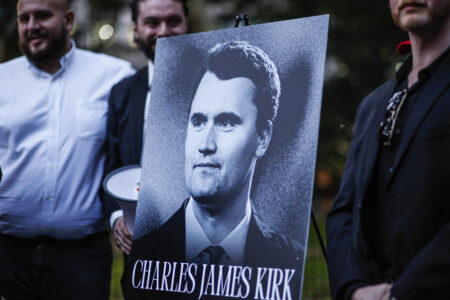
photo by: AP Photo/Kena Betancur
The New York Young Republicans Club holds a vigil for Turning Point USA CEO and co-founder Charlie Kirk at Madison Square Park on Friday, Sept. 12, 2025, in New York.
Public protests on the University of Kansas campus may soon have higher stakes attached to them — including monetary damages to KU if it prohibits certain groups from gathering.
Kansas Legislators on Thursday successfully voted to override the veto of Gov. Laura Kelly and enact the KIRK Act, which requires KU and other public universities to meet specific free speech requirements on campus — all in the name of the slain Turning Point USA leader Charlie Kirk.
The act also instructs the Kansas Attorney General to fine universities a minimum of $500 and $50 per day anytime a university has a policy that violates the act or improperly prevents an organization from gathering or protesting on a university campus.
“The legislature finds that public universities in this state are failing to provide adequate safeguards for the First Amendment rights of students, leading to a stifling of expression on campus,” the act reads.
Gov. Kelly vetoed the bill — HB 2333 — while arguing that the quality of public debate in the nation has been declining and calling for a “toning down of political rhetoric and a return to civility.” However, she said the KIRK Act will create more confusion and costs than anything else.
“Free speech and civil discussion are already protected by our state and federal constitutions,” Kelly said in a veto message. “This will cause confusion for courts and schools and create confusing caselaw.”
Lawmakers in the Kansas House and Senate both secured the two-thirds majorities to override Kelly’s veto of the bill.
While KU officials did not formally oppose the bill, they did tell legislators that complying with the new law will cost somewhere between $350,000 and $600,000 in each of the next two years. KU told lawmakers it believes it will need to set aside $250,000 for litigations costs, nearly $170,000 to hire two additional campus police officers, and $172,000 to provide an online training course for all employees.
KU has an existing policy on how, when and where various organizations can gather and protest on campus. That policy allows for a variety of gatherings and protests, but also gives KU administrators the authority to place particular restrictions on activities. Allowed restrictions listed in KU’s “Public Assembly Policy” include prohibitions on masks or facial coverings that conceal the identity of a protestor and are intended to obstruct the enforcement of any law or “intimidate, hinder or interrupt” university personnel or operations.
Other allowed restrictions include a prohibition on signs attached to sticks or poles, no wearing of body armor by protestors, and no camping as part of a protest or demonstration, among other restrictions.
It wasn’t immediately clear how the KIRK Act may require KU to change its existing policies. The act does allow universities to place reasonable “time, place and manner” restrictions on protests and demonstrations. However, the act also states that the universities must allow for the “campus community to spontaneously and contemporaneously assemble or distribute literature.” KU’s current policy generally requires groups to register at least three days in advance of any assembly.
Here’s a look at other provisions in the KIRK Act:
• Universities would not be allowed to create any designated free speech zones. Such zones generally allow for protests or demonstrations in a specified area but prohibit any such gatherings outside the zones. The KIRK Act generally allows for any outdoor area on campus to be eligible for protests and demonstrations, although universities can place some restrictions if an activity is deemed to “materially and substantially disrupt the functioning” of the university.
• Universities would be limited in when they could charge a group a security fee for providing police officers or other such services to a gathering. Universities could not take into account the content of the protests when determining whether a security fee would be charged. Rather, the university would have to limit its analysis to more general considerations such as the expected size of the gathering, its location, and whether alcohol would be served as part of the event.
• Each university will be required to submit an annual report to the governor and the Kansas Legislature detailing any incidents or disruptions related to a campus gathering. If a university gets sued over a matter involving a protest or gathering, the university would be required to submit a separate report to the governor and the legislature within 30 days of the filing of the lawsuit.
• The bill extends the same types of protections that religious student organizations currently have to “political or ideological” student organizations. That provision of the bill also would give political or ideological student organizations the ability to deny membership to individuals if the leaders of the organization don’t believe an individual “sincerely” holds the same core beliefs of the organization.
Representatives of the ACLU of Kansas, Kansas Interfaith Action and the Mainstream Coalition all testified against the bill when the Senate Committee on Education worked the bill earlier this session. Among the arguments opponents made was that the bill could enable discrimination by allowing student associations to exclude individuals based on their political or ideological beliefs.
Several organizations came out in support of the bill, including the Alliance Defending Freedom, Kansas Family Voice, and the leaders of the Turning Point USA chapters of KU and Kansas State.
The bill devoted several paragraphs of praise to Kirk, the Turning Point USA founder who was assassinated on Sept. 10 during a speech at Utah Valley University.
“Charlie Kirk embodied the principles of the First Amendment of the Constitution of the United States by exercising his God-given right to speak freely and challenge prevailing narratives, and he did so with honor, courage and respect for his fellow Americans, serving as a role model for young Americans across the political spectrum,” the bill reads.
State Government
Legislature overrides governor’s veto of KIRK Act, creating new free speech regulations for KU, other universities

Gov. Kelly vetos dozens of bills and budget provisions; legislators have already overridden abortion bill decisions

Gov. Kelly proposes last-minute plan for property tax relief, after vetoing controversial protest petition bill

Where key Kansas education bills stand ahead of legislature’s veto session
U.S. Supreme Court Justice Sonia Sotomayor reminds Lawrence crowd that people have the power to change bad laws