U.S. Supreme Court Justice Sonia Sotomayor reminds Lawrence crowd that people have the power to change bad laws
Justice speaks to about 1,700 at invitation-only event at Lied Center
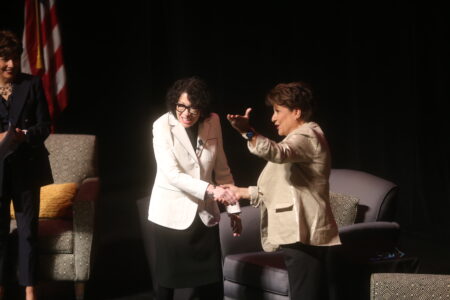
photo by: Chad Lawhorn/Journal-World
U.S. Supreme Court Justice Sonia Sotomayor, center, is welcomed to the Lied Center stage on Tuesday, April 7, 2026 by Janet Murguía, right and by Mary H. Murguía, chief judge of the Ninth Circuit U.S. Court of Appeals, left.
Good people can change bad laws — if they aren’t too scared to try, U.S. Supreme Court Justice Sonia Sotomayor told a Lawrence crowd on Tuesday evening.
The power of people and the need for courage were a pair of themes that Sotomayor came back to multiple times during an approximately hourlong, invitation-only event hosted by the University of Kansas law school on KU’s West Campus.
“Those protests have made a difference,” Sotomayor told a crowd of approximately 1,700 that nearly filled the Lied Center’s main hall. “You’re not reading about it in the news anymore, all right. A war has taken some of the attention, OK.
But laws are made made by people. Policies are made by people. Bad policies can be changed by people, and I think that is what we all have to understand.”
Sotomayor, though, also spent time urging the crowd to not let their fears get in the way of taking actions. An author of one children’s book, with another on the way, Sotomayor said she often asks children to think about what they would be missing out on if they had been too scared to try ice cream for the first time. She said fears, of course, aren’t limited to childhood.
“Every step of the way, I worried,” Sotomayor said of her journey from a Catholic high school in the Bronx borough of New York City to undergraduate studies at Princeton University. “Am I going to make it?”
Those worries extended to Harvard law school and also popped up again as she became the nation’s first Hispanic justice on the Supreme Court, and the third woman to serve on the court, after being appointed by President Barack Obama in 2009.
“I wouldn’t spend as much time worrying as I did,” Sotomayor said when asked what advice she would give her younger self.
Sotomayor answered questions from a pair of distinguished KU Law alumnae, Mary H. Murguía, the chief judge of Ninth Circuit U.S. Court of Appeals and Janet Murguía, president and CEO of the Latino civil rights organization UnidosUS. The invitation-only event drew a crowd of state lawmakers, university officials, judges, attorneys and law school students, among others.
Sotomayor was neither asked about nor commented on any pending cases before the Supreme Court, and also did not mention President Trump nor any lawmakers. But she did receive a question about a past immigration case — Noem v Vasquez Perdomo — where she wrote in a dissent that “we should not have to live in a country where the government can seize anyone who looks Latino, speaks Spanish and appears to work in a low wage job.”
At issue in the case was whether federal agents could make stops based on race, language or occupation. Sotomayor told the Lawrence crowd on Tuesday that she believed she had to speak firmly in dissent of the court’s 6-3 ruling.
“There are some people who can’t understand our experiences, even when you tell them,” Sotomayor said. “I have a colleague in that case who wrote, you know, these are only temporary stops.”
Sotomayor said her colleague — she didn’t name him — likely doesn’t have much familiarity with blue collar workers who punch a clock and get paid by the hour. But Sotomayor — the daughter of nurse who went to college when she was 40 — said she understands the havoc such a stop can cause.
She said the hours they may be held while police demand that they produce a birth certificate or some other documents simply because of the language they speak or the jobs they hold likely means they won’t be getting paid for the work they missed.
“Life experiences teach you to think more broadly, and to see things other may not,” Sotomayor said.

photo by: Chad Lawhorn/Journal-World
A crowd of approximately 1,700 people prepare to listen to U.S. Supreme Court Justice Sonia Sotomayor speak at the Lied Center on the University of Kansas campus on April 7, 2026.
KU law school officials previously announced that Sotomayor would be in Lawrence on Monday and Tuesday, and would participate in a variety of events. Those included sessions with students, faculty members and even with elementary school students.
Sotomayor is the first sitting Supreme Court justice to visit KU since Justice Clarence Thomas in 2018, a law school spokeswoman told the Journal-World.
Sotomayor touched on several other topics during the moderated discussion. That included a question from Judge Murguía about the Supreme Court’s more frequent use of its emergency docket, which is a process where the Supreme Court intervenes in a case before it has had a chance to go through the normal appellate process. The emergency docket has been called the Shadow Docket, in part because the rulings from the court often have come with little explanation.
Sotomayor said there is a reason why the court sometimes does not give reasoning to decisions made on the emergency docket: “Because we are not agreeing as to why,” Sotomayor said of her fellow justices.
“That’s not a whole lot of help today, is it?” Sotomayor said to some laughter. “But we’re doing that.”
Sotomayor also told the crowd of her desire to become first a lawyer and then a judge. After being diagnosed with diabetes at a young age, she was led to believe many career paths had been made impossible, including her preferred profession of becoming a detective — like Nancy Drew, in the books that she often read.
But television programs like Perry Mason showed her lawyers who appeared to be doing the work of detectives for at least half of an episode, so she thought that might be a good alternative, she said.
It was later, though, during the period where courts were deciding on the issue of school segregation that she found even more powerful reasons to choose the law as a career path. She remembers reading coverage of cases where judges in the South were ordering schools follow the law and desegregate.
“Men who have been educated to believe that segregation was the right thing for society, who I am sure themselves, their families, believed in racism and segregation,” Sotomayor said of many southern judges of the day. “And yet these men because they believe in the law, followed and ordered schools in the South, in their neighborhoods, to be desegregated.”
She said those actions have stuck with her ever since.
“They so believed in the power of the law that they followed it,” Sotomayor said. “They’re the ones that ultimately inspired me to become a judge. It is their model that I’m trying to follow as a judge — to do what I think the Constitution requires.”
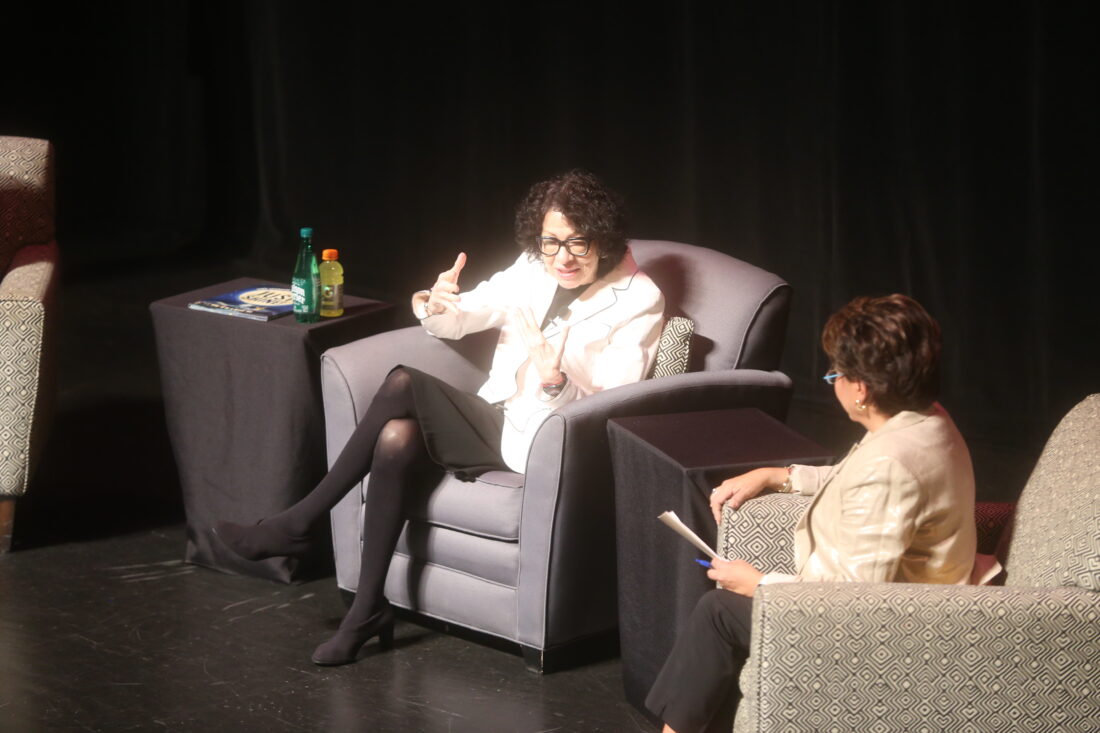
photo by: Chad Lawhorn/Journal-World
U.S. Supreme Court Justice Sonia Sotomayor speaks to a crowd of about 1,700 people at the Lied Center on the University of Kansas campus on April 7, 2026.
State Government
U.S. Supreme Court Justice Sonia Sotomayor reminds Lawrence crowd that people have the power to change bad laws
Property tax protest bill would let a few dozen voters block tax increases in some parts of Douglas County

Lawmakers pass bill to create sports authority to oversee new Chiefs stadium in Kansas
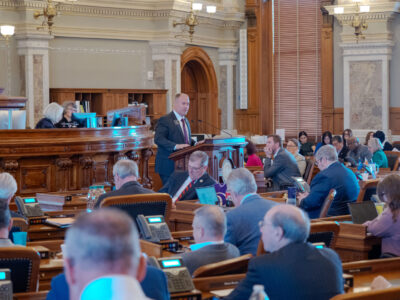
Kansas Legislature passes a bill that would give 10% of voters the power to stop some property tax increases
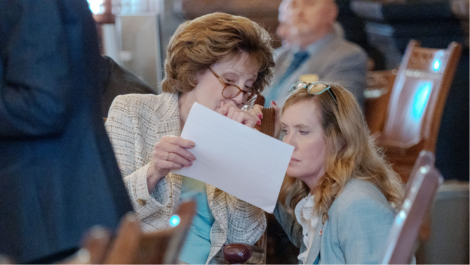
Kansas Senate, House pass budget bill that pegs raises at 1% for most state employees