Regents begin to hear faculty concerns about proposed changes to tenure policy; vote now set for January
Board also hears from lawmaker who questions whether changes go far enough
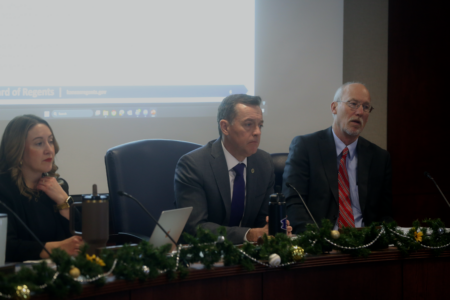
photo by: Chad Lawhorn/Journal-World
Leaders of the Kansas Board of Regents listen to proposed changes to the board's tenure policy for university faculty on Dec. 17, 2025. From left to right are: Vice Chair Diana Mendoza, Chair Blake Benson, and President and CEO Blake Flanders.
A plan to tighten the state’s tenure system for university professors began to receive pushback from academic groups Wednesday, but the Kansas Board of Regents largely stayed silent about what direction it intends to move the policy.
Instead, it pushed any votes on the matter to the board’s January meeting, while board members said they wanted to show state legislators and the general public that the tenure system has a strong level of accountability and transparency regarding the benefits university faculty members receive through the rank of tenure.
“In the end we want to show that this is a very accountable and excellent process that has been vetted,” Regent Alysia Johnston said at Wednesday’s meeting.
But some professors from across the state began to publicly question whether particular provisions in the proposed tenure policy were fair or beneficial. In particular questions arose about the appropriateness of proposed language that would require the dismissal of faculty members who receive two consecutive unsatisfactory annual reviews from a department chair or dean.
Regents were told the board office recently had received written comments from a variety of groups, including faculty senates and distinguished professors at both the University of Kansas and Kansas State University. Some of those comments question whether the requirement of dismissal after two consecutive poor reviews was fair.
Written comment from Emporia State University’s Faculty Senate Chair, who is also the current chair of the Council System of Faculty Senate Presidents for the entire statewide system, said the group believed the proposed dismissal requirement was “overly rigid and lacking consideration for extenuating circumstances.”
A letter signed by more than 75 distinguished professors at the University of Kansas and Kansas State also took exception to the dismissal policy. The professors noted that faculty members who are reviewed on research activity often would be penalized by a one-year review because research grant cycles often wouldn’t line up with a one-year review cycle.
“One-year-improvement plans are likely to discourage innovative, high-risk research,” the group said via its written comment.
The group also expressed concern about policy language that sets an expectation that professors at research universities teach six to nine credit hours per semester, which in most instances equates to two to three classes. The group of professors said the proposed policy creates too narrow of an expectation, and doesn’t recognize the variables that come with different type of faculty positions — ranging from researchers who must spend significant time on grant-writing and reporting activities to humanities and performing arts positions that often require significant one-on-one mentoring time.
The professors said the proposed policy likely would reduce the amount of time professors have to provide service to their academic discipline, and would result in a loss of expertise and competitive edge for universities.
“If our top faculty cannot do research and outreach here, they will go to places where they can get it done,” the professors said in the letter.
KU Chancellor Douglas Girod has long said one of his top concerns with new tenure and workload policies is that they don’t become a hurdle in recruiting new professors and keeping existing professors.
On Wednesday, Girod told the Journal-World that he hadn’t yet come to any conclusions about whether the proposed changes would create those recruitment and retention problems. He said he was awaiting more comments from the university community to inform his opinion.
He told the Regents staff that he expected more comments to come from university stakeholders and others.
“I think you are going to get it from every direction,” Girod said of feedback about the proposed changes.
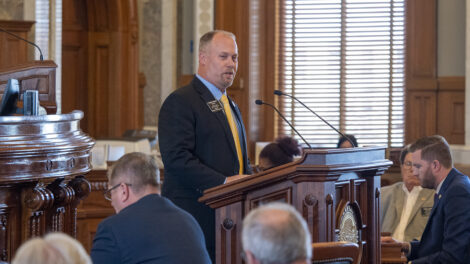
Indeed, among the written comments the Board of Regents office has recently received is one from Rep. Steven Howe, a Salina Republican, who until recently was the chair of the House Committee on Education.
State legislators have had several questions about the tenure and workload policies for state universities. Regents earlier this year created the goal of comprehensively studying both policies, in part, because they believed the Kansas Legislature was likely to make changes to the policy if the Regents do not.
Howe made a similar statement in his Dec. 16 letter to the Regents.
“I believe some additional changes are needed before this policy is ‘ready for prime-time,'” Howe said in his letter. “The last thing KBOR will want is the Legislature to get involved after the fact.”
Howe’s letter raised the question of whether the Board of Regents itself should be involved in the granting of tenure, rather than leaving that responsibility to university presidents and the chancellor. It also raised the issue of whether more outside voices should be included on post-tenure review committees that would examine the work of tenured professors every five years.
Howe also questioned whether the Regents should include language in the policy that makes it clear political or idealogical activity by a professor won’t play into the tenure decision. Multiple Republican lawmakers across the country have expressed beliefs that some university professors have been punished by their universities for being overly conservative.
“This very well may be a blind spot,” Howe said of the absence of any such language in the proposed tenure policy. “KBOR and the Legislature have worked hard to strengthen First Amendment rights over the last several years, and me personally, I would like KBOR to take a closer look at this area.”
While the issue of political affiliation didn’t come up during Wednesday’s meeting, the Regents did hear about the importance of the tenure process protecting the academic freedom of faculty members to conduct research that could be considered controversial.
“If those protections aren’t in place for faculty, we lose the ability for faculty to take on those difficult challenges and pursue paths that are a little unconventional but often benefit society and really benefit all of us,” Rusty Monhollon, vice president of academic affairs for the Regents, told the board.
But some board members also noted that the amount of protections that tenure offers professors is sometimes what lawmaker and the public find objectionable.
“If an individual is not working in alignment with the mission of the university, I’m not sure that is really something we want to protect,” new Regent Matt Crocker said.
Regents ultimately took no vote on the tenure or workload policies at Wednesday’s meeting, but rather said they expected the issue to be back on the board’s agenda at the January meeting.
State Government

KU’s faculty and university senates call for a vote to determine if university community has confidence in chancellor
2 Lawrence residents file suit over Kansas law that restricts bathroom use and invalidates driver’s licenses
Trans Kansans struggle with ‘cruelty’ as driver’s licenses, birth certificates are invalidated
KU leaders reject pay proposal from faculty union; administration says it will seek an impasse in negotiations if deal not reached in 7 days

KU research dollars set a new record in 2025; university conducted more than $600M in research activities