Thinking big picture: KU opens $30M Jayhawk Welcome Center to battle new challenges with student recruitment
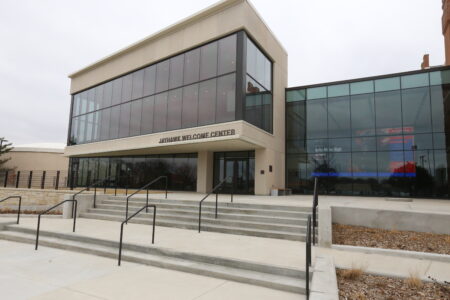
photo by: Chad Lawhorn/Journal-World
The Jayhawk Welcome Center, located on the north end of Jayhawk Boulevard, is pictured on Feb. 15, 2023.
The view from a cliff often produces a big picture.
The University of Kansas indeed stands at the edge of a demographic cliff that is expected to produce a big drop in the number of high school graduates for the university to recruit for years to come. With that in mind, it’s not surprising that KU’s new $30 million Jayhawk Welcome Center was built with a big picture in mind.
But, maybe you weren’t expecting such a literal big picture. As in a 34-foot-tall video screen that not only dominates the lobby of the new building at the northern end of Jayhawk Boulevard, but — due to the building’s modern design with large expanses of glass — begins attracting your attention while you are still on the street.
No, the huge screen isn’t just for watching KU basketball, although that may happen. It is really about creating a big first impression for potential Jayhawks.
“We know how important it is to win the campus visit,” said Heath Peterson, president of the KU Alumni Association, which took a leading role in developing the new Welcome Center that sits on what used to be a parking lot for the association. The new 30,000-square-foot building ties into the Alumni Association’s existing building.
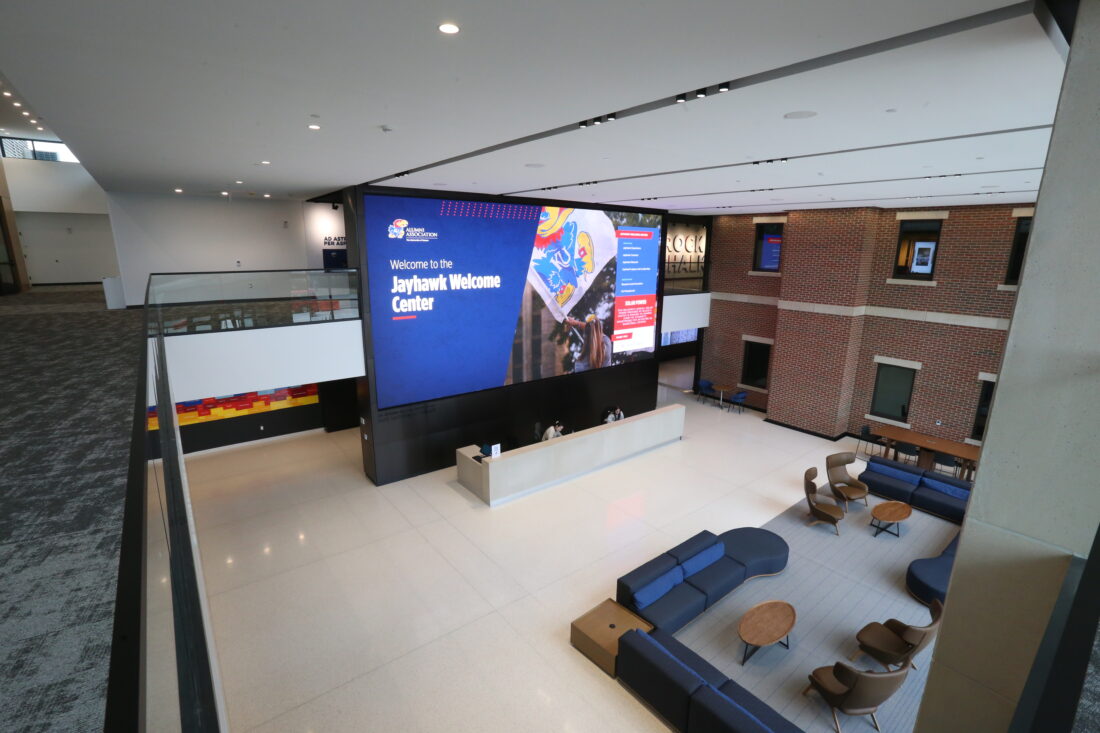
photo by: Chad Lawhorn/Journal-World
A 34-foot tall video screen is a dominant feature in the lobby of the new Jayhawk Welcome Center, pictured on Feb. 15, 2023.
Apparently, a winning strategy involves making prospective students feel big time in their own right. On a day last week when the Journal-World received a tour of the facility, the big screen was emblazoned with a “Welcome Belle Plaine High School,” which had a group of students on campus for tours. The big board scrolled their names across the bottom of the screen, and a countdown clock for when their tour began also was displayed.
Individual students who sign up for a campus tour get a similar treatment on the big screen — a site normally reserved for those few who make plays on a field or court equipped with a Jumbotron.
Take that, Patrick Mahomes (who was not a Jayhawk, by the way).
“The board is unbelievable,” Lisa Pinamonti Kress, director of admissions for KU, said while describing recent student tours at the center. “People were standing up here on this ledge waiting for their names to come across so they could take a picture. It was so much fun to see. They love it.”
That’s the reaction designers of the center wanted. Now, they hope it leaves prospective students with the message they intended as well.
“We think it shows how much we really want them to join the Jayhawk family,” Peterson said.
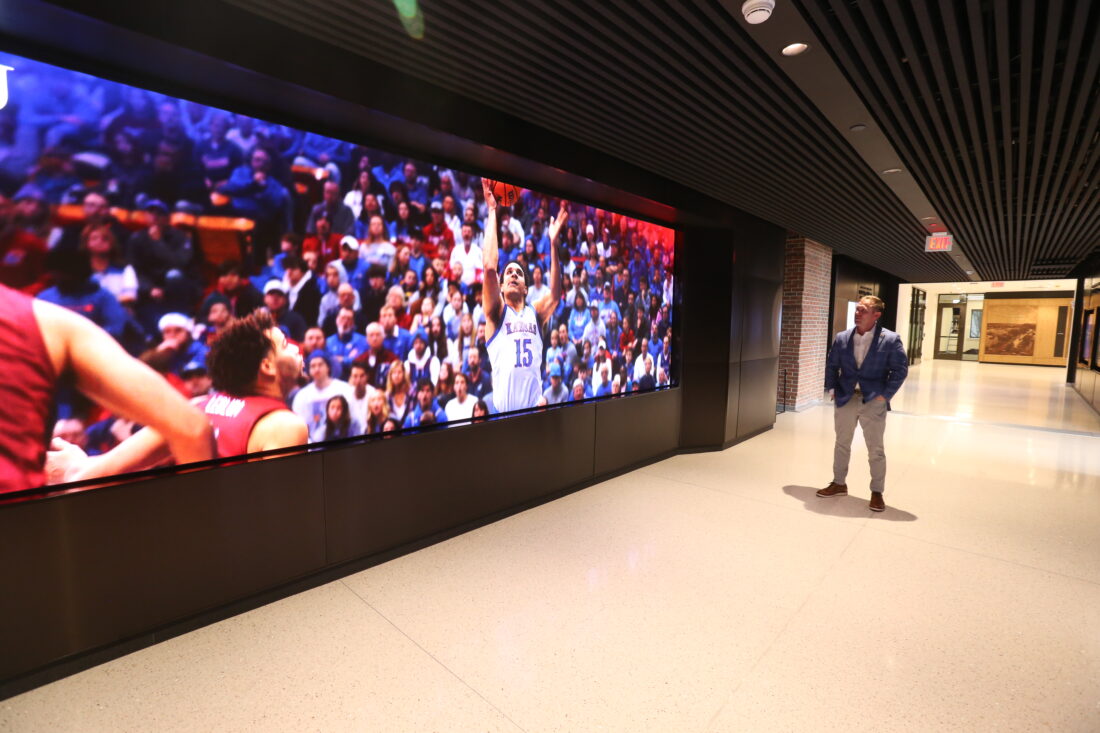
photo by: Chad Lawhorn/Journal-World
Heath Peterson, president of the KU Alumni Association, stands in the Jayhawk Experience section of the Jayhawk Welcome Center on Feb. 15, 2023.
A smaller piece of technology, though, may play a big role in making an impact with prospective students. Every student who signs up for a campus visit provides some information about their interests and then is given a QR code. When the prospective students are touring the welcome center, there are various opportunities for them to scan the QR code and get information geared toward them.
For example, if the prospective student is interested in engineering, the digital display that highlights notable KU alumni is going to put a heavier emphasis on showing KU graduates who have had great careers in the engineering world.
KU leaders said it is a smart use of technology. Universities across the country probably are going to have to get smarter in how they attract new students because competition for a declining number of high school graduates both in Kansas and nationally is expected to become intense.
Higher education officials have long known that declining birth rates eventually would create smaller graduating classes. That eventuality is very nearly here. Depending on which set of statistics you look at, high school graduation rates will start a long decline in 2025 or 2026.
By 2030, the federal agencies and higher education commissions believe the number of public high school graduates will be about 3.2 million, down from about 3.5 million in 2025. In Kansas, the Western Interstate Commission for Higher Education projects total high school graduates in 2030 will drop to about 35,000, down from a projected 37,000 this school year. By 2036-37, the commission projects high school graduates in the state will be just less than 32,000.
KU already gets about 40% of its student body from outside the state of Kansas, which will be an important strategy to maintain enrollments in the future. But, the numbers suggest it will be plenty challenging on that front too. For example, Chicago is a hotspot for KU recruitment, but Illinois is expected to see a steeper decline in high school graduates than Kansas. The commission projects a 22% drop by 2036-37 in Illinois, compared to a 13% drop in Kansas.
KU Chancellor Douglas Girod said the demographic changes make it more critical than ever for KU to “not only put our best foot forward but in a unique and powerful way, and to tell the Jayhawk story.”
The new center does most of its storytelling through digital displays. With screens throughout the building, content can be changed frequently. Peterson said the Alumni Association and KU already have created a “content governance committee” that will decide when stories, images and themes of the center need to change.
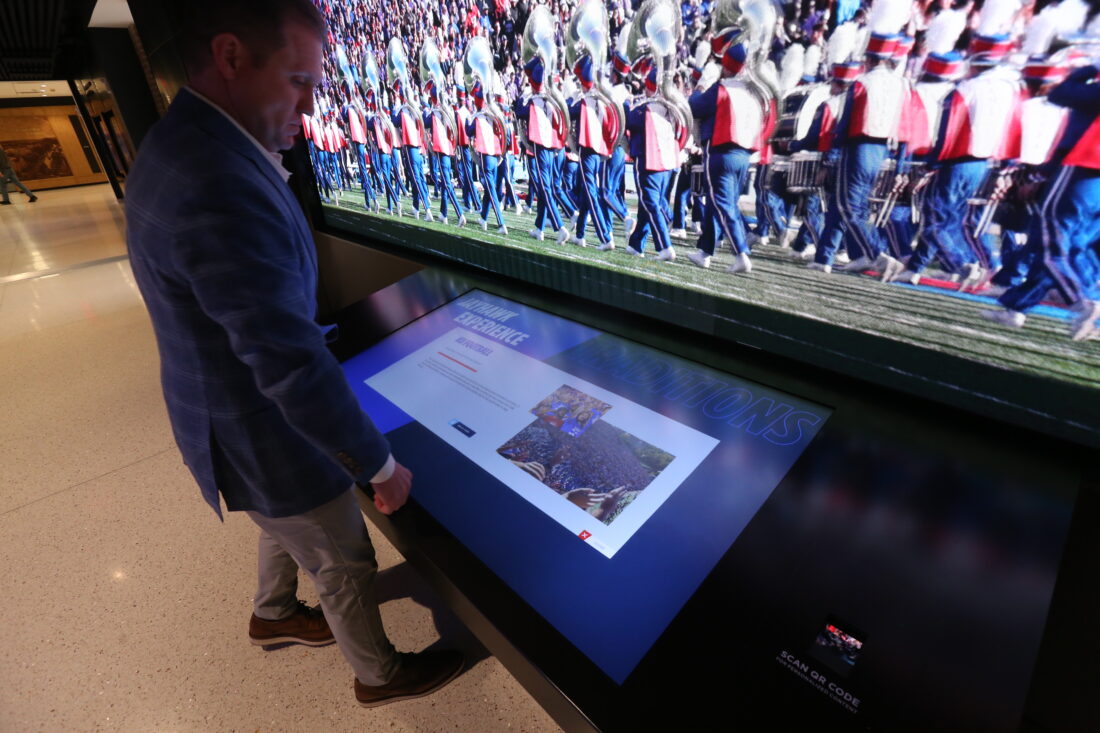
photo by: Chad Lawhorn/Journal-World
Heath Peterson, president of the Kansas Alumni Association, demonstrates how the Jayhawk Experience digital display function at KU’s new Welcome Center on Feb. 15, 2023.
That committee also will analyze whether the content is reaching the audiences KU most needs to reach in order to grow or maintain its enrollment. For instance, currently the university wants to particularly appeal to minority and first generation college students for a variety of reasons, including that state statistics show those groups could be a new source of students to help dampen the impacts of the demographic cliff.
Just in the past week, the chancellor and presidents of the state’s largest public universities were told a blunt message by the president and CEO of the Kansas Board of Regents, which oversees the schools.
“Candidly, here’s our issue,” Blake Flanders, president and CEO of the Regents, told university leaders and Regents. “We have never done very well with under-represented minorities and first generation college students, period. We have always had lower college-going rates and have not had the same completion rates. That’s where we need to transform our systems and approach.”
In addition, the numbers also show the entire university system in the state is doing a poor job of convincing rural students to attend universities. Combine those factors with the already declining number of high school graduates in general, and the challenges start to add up for universities, like KU, that rely heavily on tuition dollars to fund their operations.
Girod said that’s why he was extremely supportive of the idea of the Alumni Association “thinking beyond” its normal mission of serving alumni by becoming a leading partner in the Welcome Center. Peterson said Alumni Association leaders were on board with the project because Girod and other leaders had made clear that student recruitment had to change or stagnate. The third key partner in the project ended up being the KU Endowment Association, the private fundraising arm of the university. The $29.4 million project budget for the center ended up being funded with private donations to the university and the Alumni Association.
Both the approach to the project and the actual building itself have been met with Girod’s approval.
“I think,” Girod said “it is just a game-changer for us from a telling-our-story perspective … And we know that it is coming online at the right time to help us be as competitive as possible.”
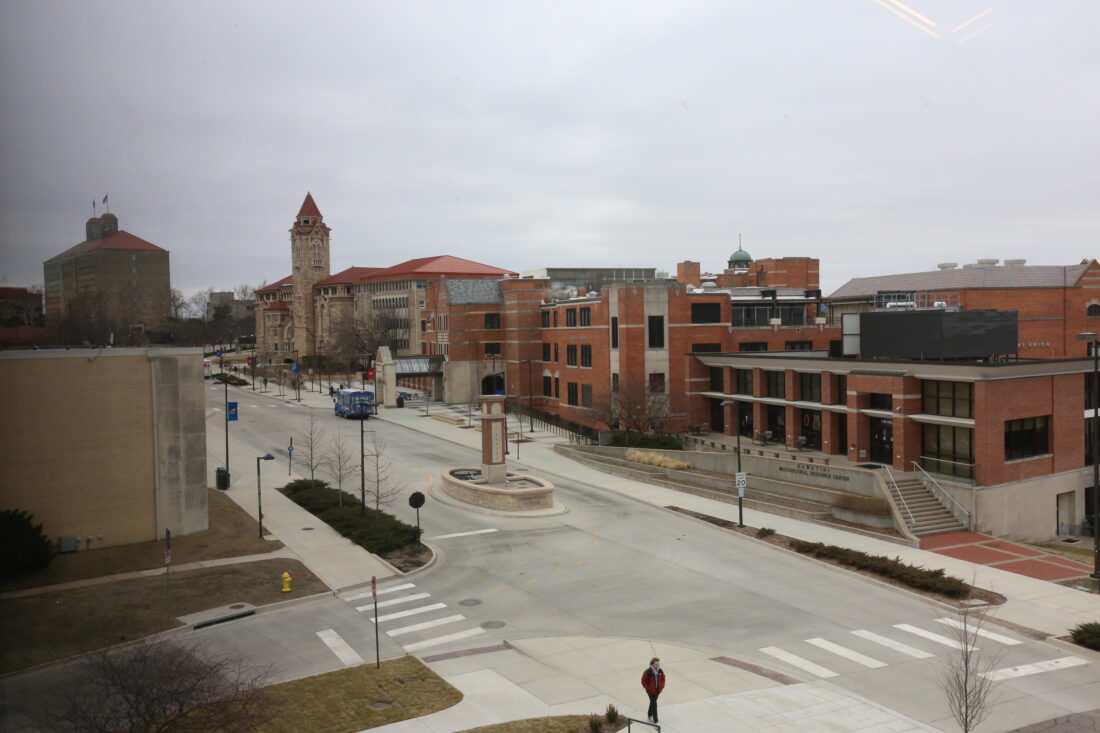
photo by: Chad Lawhorn/Journal-World
The University of Kansas campus is pictured in February 2023.
•••
Here’s a look at other features and facts about the Jayhawk Welcome Center, which is located at 1266 Oread Avenue and currently is in a soft-opening phase. The center expects to be fully open by the last week of February.
• The center has a “Jayhawk Experience” zone, which is basically a sound and video corridor where visitors can get a feel for some of the more prominent spots on campus. Using touchscreen technology, visitors can select venues or experiences such as the football stadium, Allen Fieldhouse, the Chi Omega fountain, Hawk Week, commencement ceremonies and several others. Each experience produces its own set of video and sound. For instance, the David Booth Kansas Memorial Stadium option uses drone footage of the stadium on game day, while the Allen Fieldhouse experience has all types of images from the basketball arena, but also shows scenes from Massachusetts Street following last season’s national championship victory.
• A high-tech photo booth feature is located on the second floor of the center. The area features a digital green screen. Visitors can digitally insert a number of backgrounds on the screen, including the Campanile, Potter Lake, Fraser Hall, Dyche Hall, numerous Jayhawks, and of course the football stadium and Allen Fieldhouse. Visitors stand on a designated spot, and a ceiling mounted camera takes a photo. The system will text the photo to your phone, if you provide the center your number. KU officials said visitors often are posting the photos on social media, which turns the photo into another form of recruitment.
“On tours, this is the space that holds us up,” Peterson said. “Everybody wants an individual photo. They want a group photo. They are taking lots of photos, which is great.”
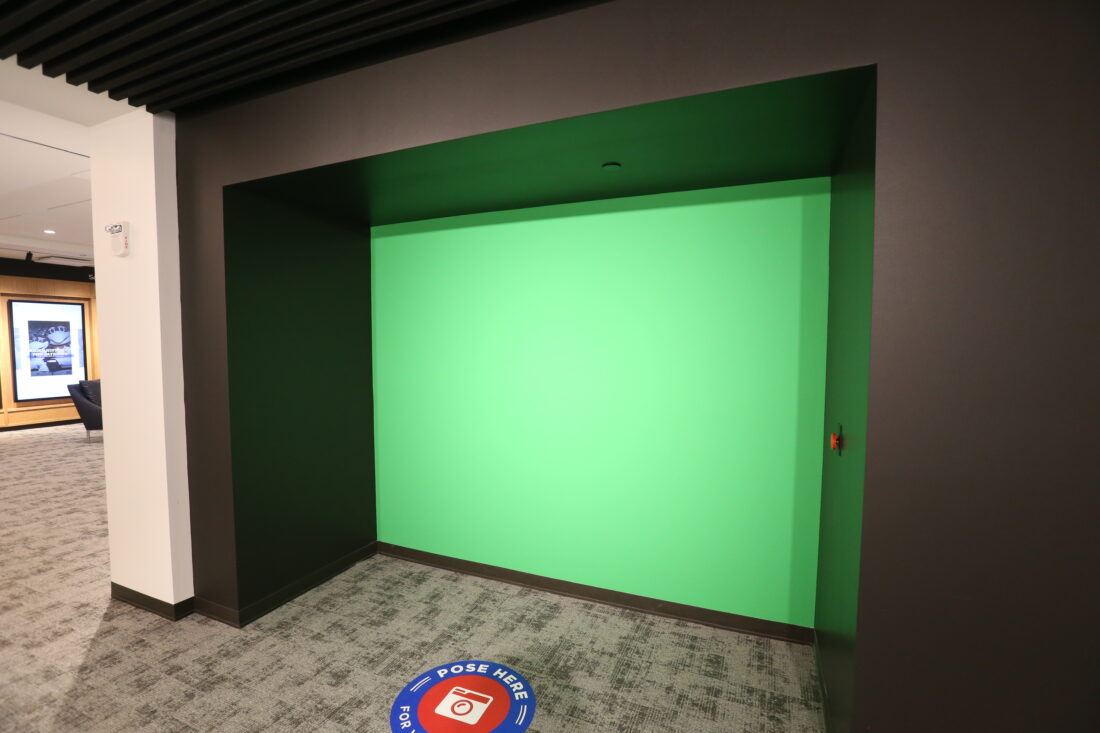
photo by: Chad Lawhorn/Journal-World
A digital greenscreen allows visitors at the Jayhawk Welcome Center to take a photo with a variety of KU backgrounds.
• The center, which has two stories, grew the Alumni Association complex to about 60,000 square feet. The Alumni Association since the 1990s had operated out of the Adams Alumni Center, which is about a 30,000-square-foot brick building that has a fairly traditional architectural style. The new Welcome Center has a much more modern architectural style. Peterson said more than 100 architecture and design students were asked to provide input into the design very early in the process. He said all the students recommended a contemporary design for the center, in order to appeal to prospective students.
• The two buildings are physically tied together, and the welcome center includes a strong alumni component. A “Leadership and Legacy” digital display highlights prominent KU alumni, and there also is a section where visitors can click on a map of the United States and hear stories from more recent graduates about how they are putting their KU degrees to use.
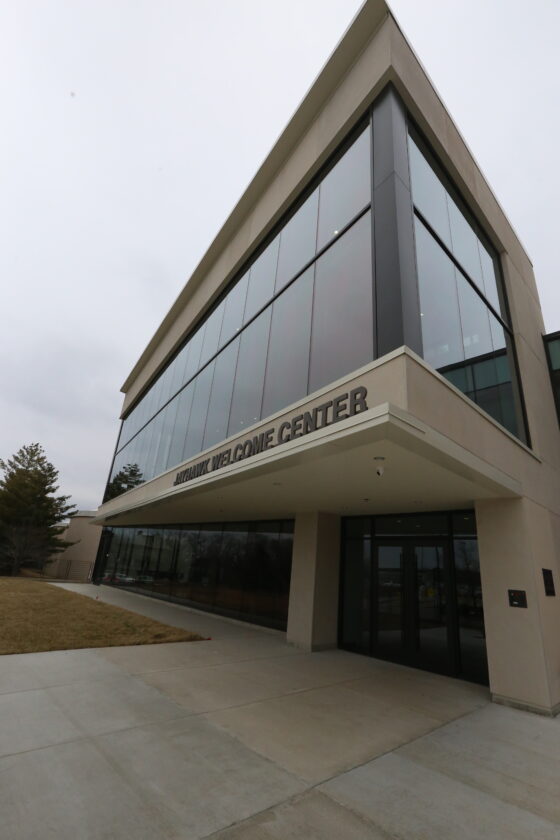
photo by: Chad Lawhorn/Journal-World
The Jayhawk Welcome Center is pictured on Feb. 15, 2023.
• The Welcome Center is across the street from the large parking garage adjacent to the Kansas Union. KU officials believe many visitors will come to the center via Mississippi Street and enter the garage from that location. The top floor of that garage actually is at ground level to the Welcome Center. That helps the center have some dramatic views overlooking Jayhawk Boulevard, the football stadium and parts of western Lawrence.
• About 25 members of the KU Admissions staff, plus student ambassadors — the folks who walk backward around campus providing tours — are based out of the Welcome Center. The center has two large presentation rooms where groups of visitors can gather for information sessions about the university, plus several smaller group rooms.
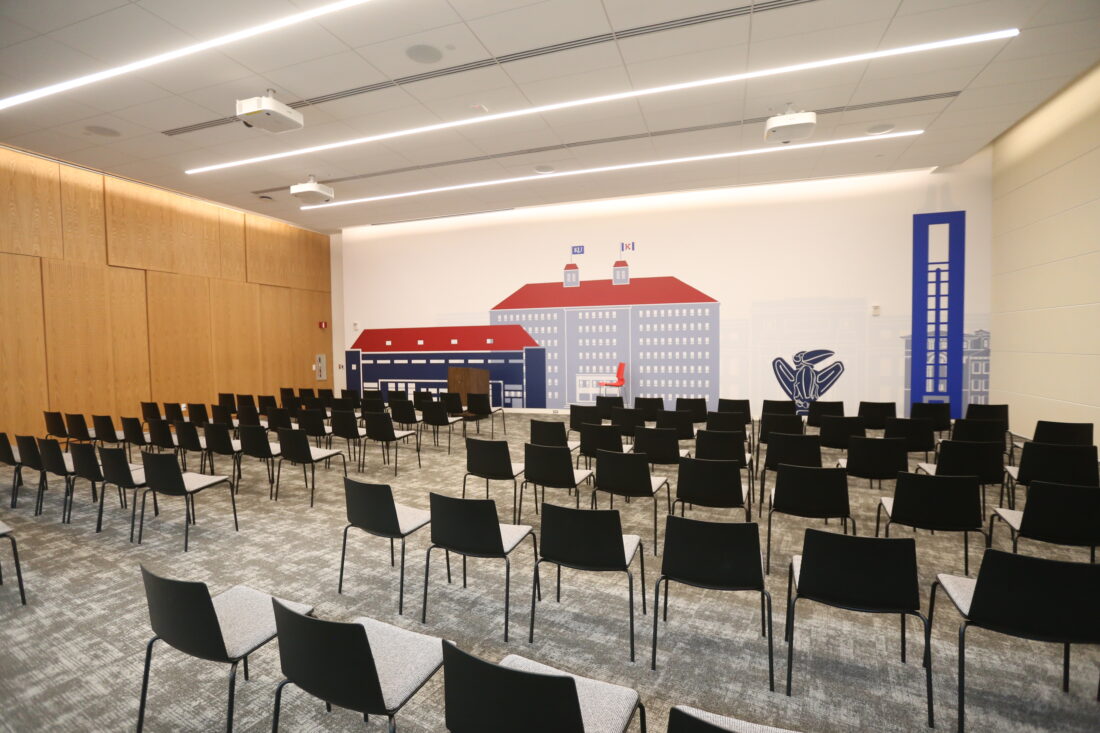
photo by: Chad Lawhorn/Journal-World
A meeting room to host prospective students is pictured in the Jayhawk Welcome Center on Feb. 15, 2023.
• In addition to the meeting rooms for prospective students and their families, the Welcome Center and the attached Alumni Center have a pair of banquet rooms and even a pub area that can be used for various university-related dinners and events. Peterson said he’s hopeful that the center will be used by business groups and other organizations that are trying to attract new companies and residents to the area.
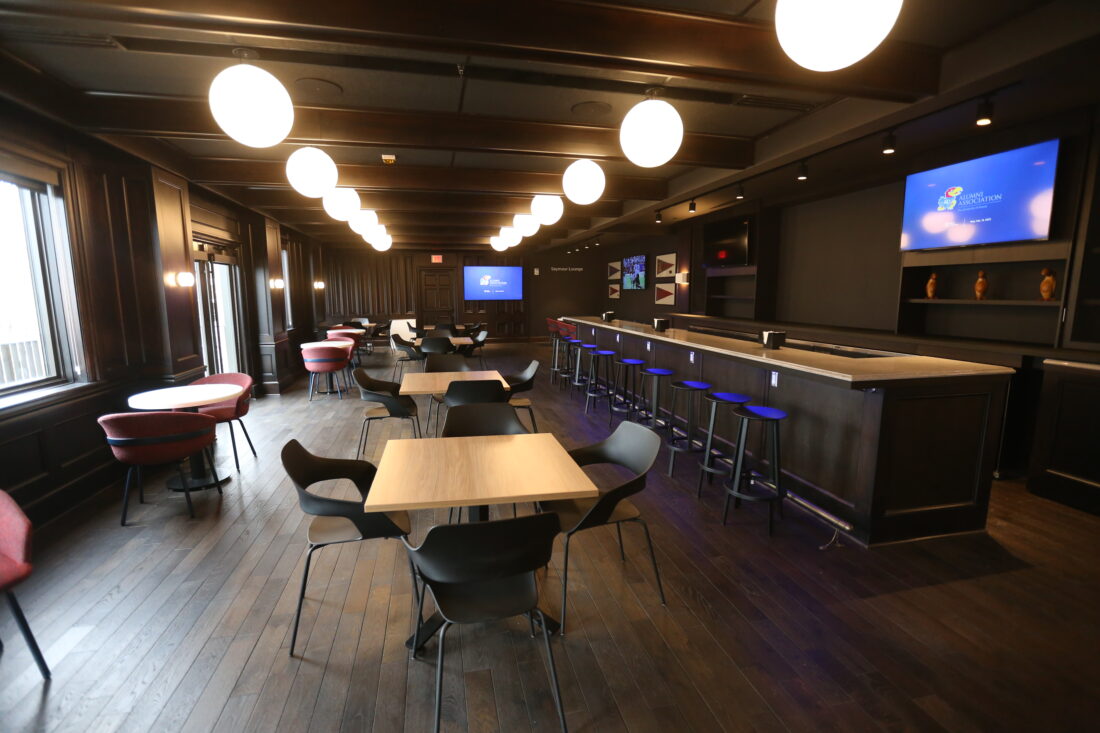
photo by: Chad Lawhorn/Journal-World
The Jayhawk Welcome Center project also included improvements to the existing Adams Alumni Center, including upgrades to the Alumni Center’s pub area, which features wood paneling from the original Fraser Hall.
• Look for a new Jayhawk statue to become part of the center in the near future. Peterson said plans call for a bronze statue of Baby Jay, complete with a blue jersey, to be added to the plaza area in front of the building.
• Admissions officials believe they will host more than 10,000 student tours per year out of the center. But Peterson believes when visitors for other types of events are added to the mix, about 200,000 people per year will go through the Welcome Center. Girod thinks the number ultimately will be even larger as KU develops the area near the football stadium — which is just down the hill from the Welcome Center — into a “campus gateway” area. He thinks visitor numbers could grow to 400,000 per year at the center.
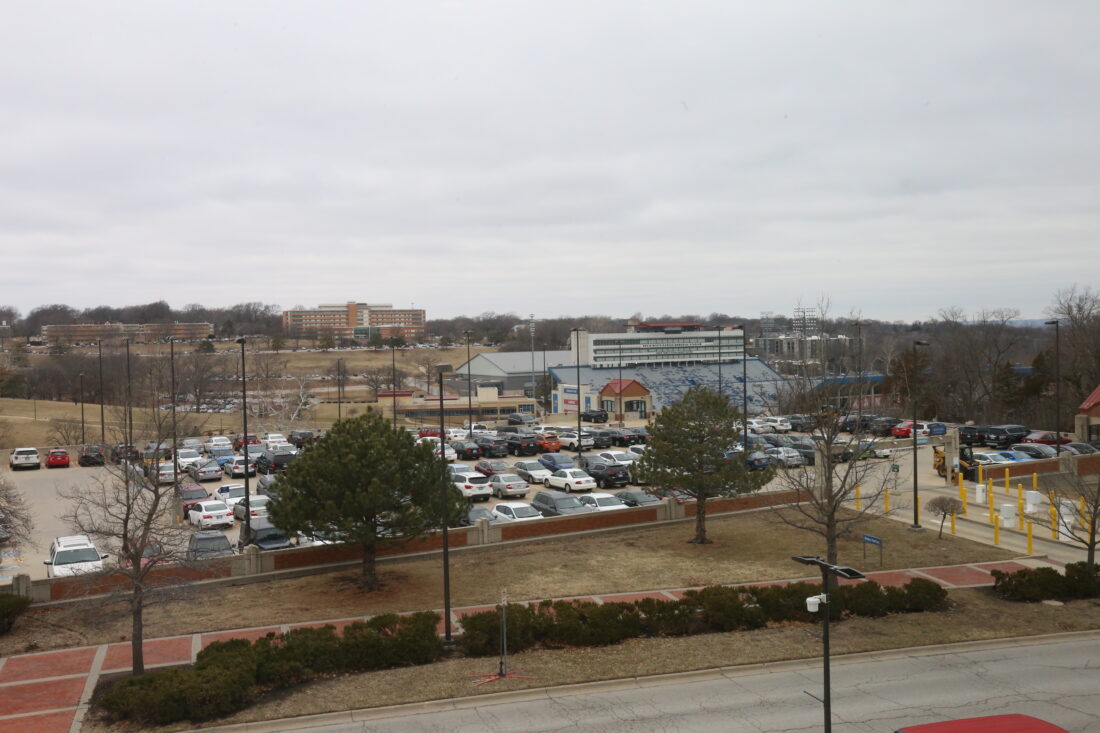
photo by: Chad Lawhorn/Journal-World
The new Jayhawk Welcome Center and remodeled Adams Alumni Center offer several vistas of the KU campus, pictured on Feb. 15, 2023.
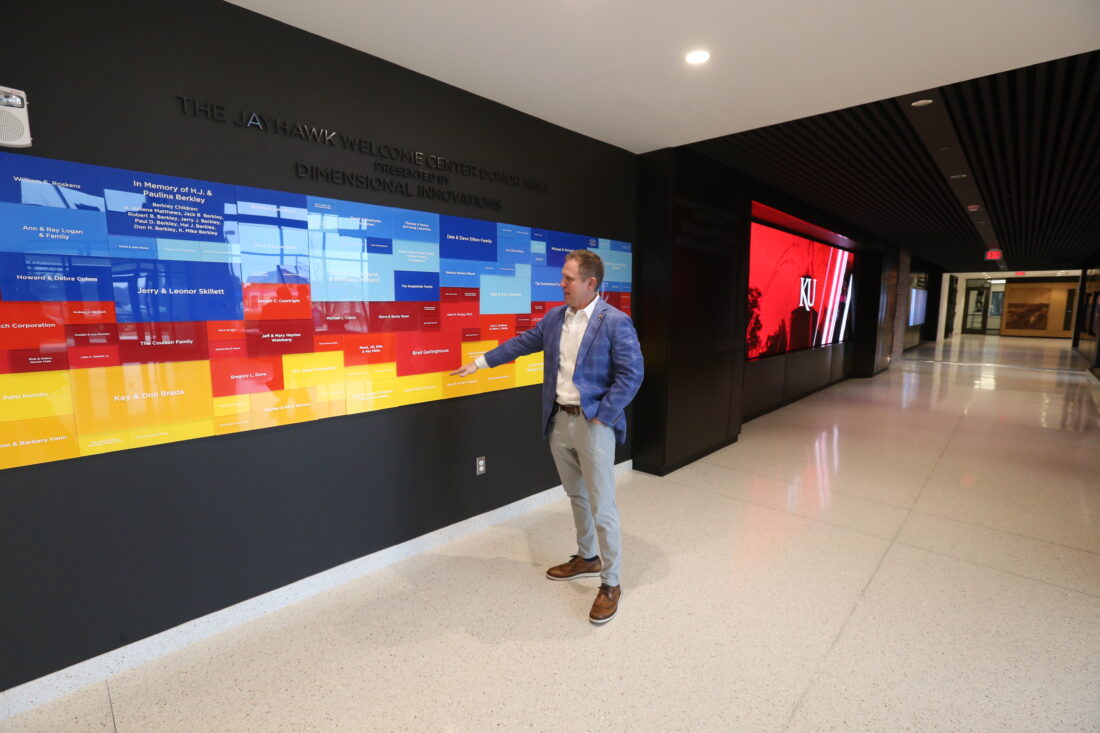
photo by: Chad Lawhorn/Journal-World
Heath Peterson, president of the KU Alumni Association, points out features of the new Jayhawk Welcome Center on Feb. 15, 2023.
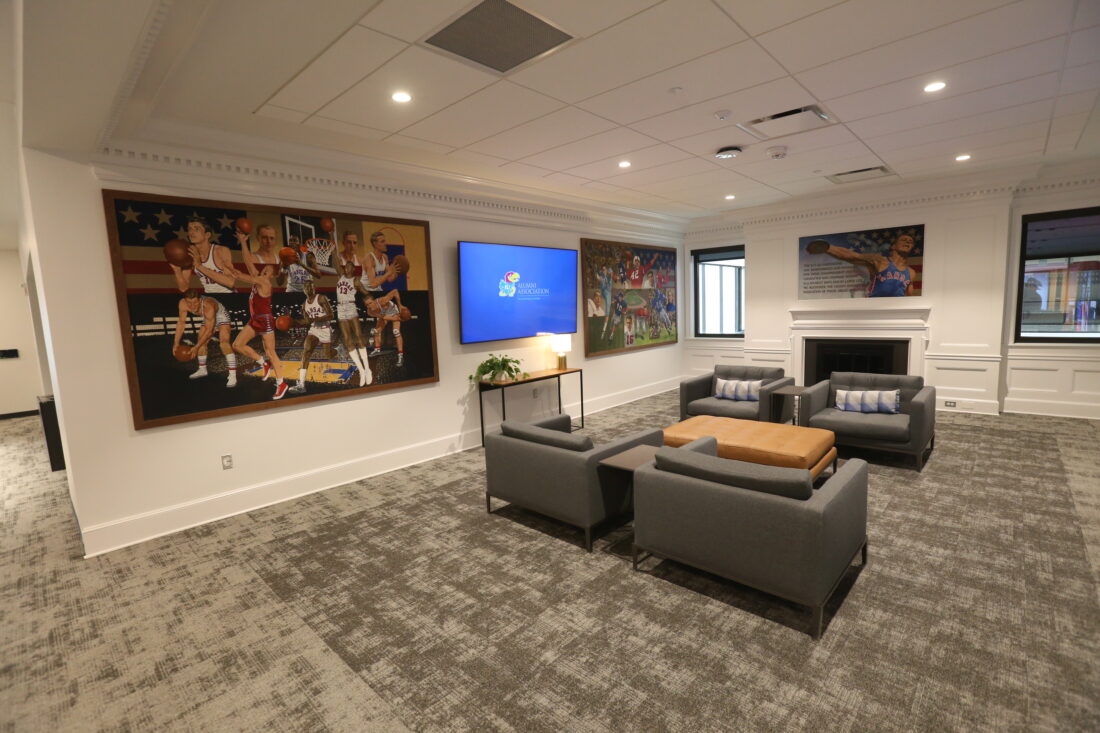
photo by: Chad Lawhorn/Journal-World
The All-American Room inside the Adams Alumni Center was remodeled as part fo the project to build a new Jayhawk Welcome Center adjacent to the Alumni Center. The digital display will list the roster of KU All-Americans through time.
KU
Jayhawk success in NCAA Tournament can go beyond just local pride; Lawrence leaders believe shared passion boosts community, KU

With $5.2M in federal funds, Dole Institute can digitize thousands of films and tapes from Sen. Bob Dole’s career
Kansas House committee makes key changes to bill that will keep KU, other universities under the oversight of Board of Regents
KU Athletics to receive payout of $2.7 million for participating in London game

Monarch Watch reflects on study tracking butterflies with solar-powered radio tags