

These designers want to capture Lawrence’s World Cup moment in wearable public art
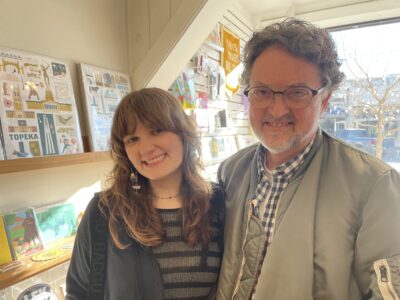
Tim Hossler and Lizzy Arnold are pictured at Wonder Fair on Wednesday, March 18, 2026.
You yourself could be the canvas for the artwork that Tim Hossler and Lizzy Arnold are creating for the 2026 FIFA World Cup.
Hossler, a University of Kansas design professor, and Arnold, the graphic designer for the KU School of Architecture and Design, are among the artists being featured in the City of Lawrence’s soccer-themed Unmistakable Public Art Exhibition this summer. But rather than sculpting or painting, they’re making art that people can wear – soccer scarves and jerseys inspired by Lawrence history.
“If I’m thinking about what I’d love to see happen, I’d love to be able to sit at a cafe and look out and see multiple people walking down the sidewalk and wearing our scarf,” Hossler told the Journal-World while sitting in a cafe on Mass. this past week. “That’s where I see it living, is people wearing it, seeing people with it on and engaged in it.”
The designs aren’t final yet, but Hossler and Arnold said they’ll eventually be for sale here in Lawrence, including at Wonder Fair on Mass.
The World Cup’s games in Kansas City in June and July are expected to draw more than 600,000 visitors to the greater KC area, and here in Lawrence the Algerian men’s national team will have its base camp at Rock Chalk Park. With a surge of international guests expected, the designers said their art could serve as a memento of the special year for both locals and tourists.
“Just thinking about the World Cup and about people coming in, I think doing something different makes a lot of sense,” Hossler said of this approach to a public art project. “I think sculptures are beautiful, and it’s going to be great, but I think this might be something that connects a little bit more – that connects, at least, with people visiting and the community being excited about the games.”
• • •
Hossler remembers a time when there wasn’t any real excitement about soccer in America. “As a kid growing up, we didn’t have soccer in school; we had no soccer team,” he said. Even after the U.S. hosted the World Cup in 1994, he said, the sport was still struggling to gain a foothold here.
But he loves soccer culture and the functional objects that are part of it.
“I’m a huge fan of soccer kits, jerseys,” Hossler said. “And I love it when it’s sort of like a dual read. They’re designed so there’s one thing you see from a distance, what really pops out. But then there’s these great details that you don’t really see until you’re pretty close or you actually own it or you’re wearing it.” He said the Lawrence jerseys will have these “macro/micro” touches, too.
As for the scarves, their versatility is part of the appeal.
“One thing I love about soccer scarves too is the way that they’re used,” Hossler said. They’re wearable, of course, but fans also hold them up in the stands to show their support for the team. “We’re designing and thinking, ‘How is it going to be if they hold it up to cheer on their team or cheer on the city? And how’s it also look when you wrap it around your neck?”
Arnold said the scarves will be interesting as purely decorative objects, too.
“You can hang it on your wall,” she said. “You can adorn your house with it in some way. It can really just act as a lot of things.”
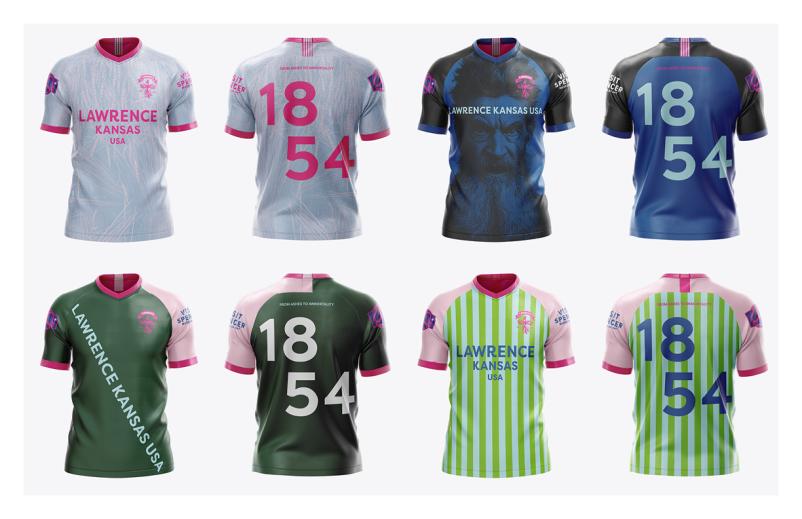
photo by: Contributed
These renderings of jerseys were submitted by Tim Hossler and Lizzy Arnold when they applied for the Unmistakable Public Art Exhibition. They say the final designs will be different from these.
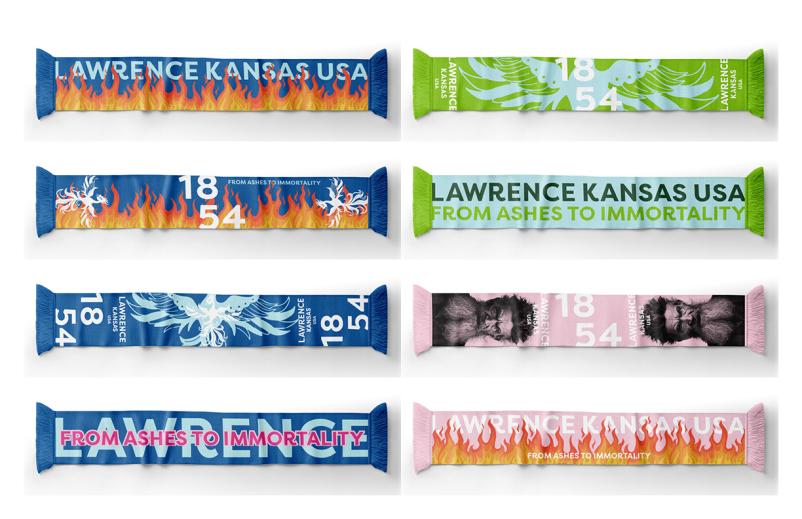
photo by: Contributed
These renderings of scarves were submitted by Tim Hossler and Lizzy Arnold when they applied for the Unmistakable Public Art Exhibition. They say the final designs will be different from these.
When Arnold and Hossler applied, they submitted designs with flames – a representation of the fiery attacks on Lawrence by proslavery forces during the Bleeding Kansas era – and images of abolitionist John Brown. But they’ve since broadened the design to what Hossler describes as a “collage of history, people and words” about the city.
“It’s interesting thinking about, ‘What really is Lawrence?'” he said. “… Flames and John Brown are the quick things you think of first, but I think there’s so much more complexity to the history of Lawrence.”
To capture that, he and Arnold collaborated with institutions such as the Watkins Museum, the Lawrence Public Library and KU’s Hall Center for the Humanities for advice on what to include.
“I think that duality is really important with anything – recognizing the past as a foundation for where we are now and celebrating the things that got us here, but also being mindful of the context of everything,” Arnold said. “I think that’s where we’re sitting right now as far as using or not using certain imagery. All those choices feel very intentional, so we’re treating them with such intention.”
History is “really woven – pun intended, I guess – into the design,” she said. But it isn’t their only influence. Hossler said some inspiration came from an Italian artist named Maurizio Cattelan who created soccer scarves that represented art museums: “The Museum League.”
The designs are also shaped by the constraints of the material itself. “Those lines have to fall into the grid of the way things are knit,” Arnold said.
But “as designers,” Hossler added, “we like those kinds of restraints.”
• • •
Another thing they both like is the effect their work has on people.
Designers aren’t like other types of artists, Hossler and Arnold both noted, because they make functional objects that are intended to be used for something, not just appreciated for their aesthetics.
“As a designer, it’s amazing to design something and see someone carrying it or using it; I think it’s the best part about being a designer,” Hossler said.
“It really is,” Arnold added. “I love that about work, too. Students will come for tours (of the art and design school) and leave with tote bags I made, and walk around Mass., shopping for the day, in this prospective college town they might decide to move to, with a tote bag I made on their arm.
“That’s so cool! And that just becomes part of their day and part of their experience.”
So, what experience do they want the people who wear their scarves and jerseys to have?
For those who live here, they said, it’s one more way to show their local pride.
“Town merch is definitely a thing,” Arnold said. “You see people walking around with their ‘LFK’ stickers and their shirts, and just the amount of local artists and designers in the area making things to showcase that they are a fan of where they live. I think we’ll just be adding to the already great collection of Lawrence-centered apparel.”
For fans from elsewhere in the world, they hope it will be a reminder of the hospitality that Lawrence showed them during their visit.
Hossler thinks that Lawrence’s “nice Midwestern friendliness” will make an impression on visitors, including those from Algeria who want to stay in their national team’s home away from home. He thinks the scarves will be more popular for international visitors than the jerseys will: “You can wear your team’s jersey and your Lawrence scarf.”
Arnold thinks they’ll remember a place that loves sports and the special bonds that sports can create.
“A big part of sports and what makes sports so awesome is those memories that you get to form with your community, people that you watch the game with and the life you were living at the time of the game,” she said. “So I’m hoping that this scarf kind of becomes a memory of summer 2026 … all that it means in the context of sports, but also who you were at that time, who you spent your time with.”
“It kind of becomes a reflection of the life that you live,” she said, “when you get to bring this wearable art and this memory with you wherever you go.”
Even if where you go is back to your home in Algeria, after a trip you’ll remember for a lifetime.
“I would love to see, after the World Cup,” Hossler said, “a picture of someone in Algeria wearing our Lawrence scarf.”
City Government
These designers want to capture Lawrence’s World Cup moment in wearable public art

About 5K Lawrence residents receive the wrong water and sewer bill from the city due to tech issue
Lawrence’s Historic Resources Commission recommends further review of proposed super-dense apartment complex in Oread neighborhood

City of Lawrence names longtime prosecutor as next Municipal Court judge
City leaders hope to be chosen for pilot project that rehabilitates abandoned and dilapidated homes